



 Chat with AI
Exam 9: Geometry

Exam 1: The Art of Problem Solving190 Questions
Exam 2: The Basic Concepts of Set Theory316 Questions
Exam 3: Introduction to Logic315 Questions
Exam 4: Numeration Systems245 Questions
Exam 5: Number Theory171 Questions
Exam 6: The Real Numbers and Their Representations401 Questions
Exam 7: The Basic Concepts of Algebra273 Questions
Exam 8: Graphs, Functions, and Systems of Equations and Inequalities136 Questions
Exam 9: Geometry182 Questions
Exam 10: Counting Methods213 Questions
Exam 11: Probability140 Questions
Exam 12: Statistics152 Questions
Exam 13: Personal Financial Management260 Questions
Exam 14: Trigonometry Formerly234 Questions
Exam 15: Graph Theory110 Questions
Exam 16: Voting and Apportionment99 Questions
Select questions type


Use the properties of parallel lines to solve the problem.
-In the figure, . Find the measures of angles , and .
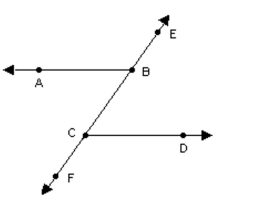
(Multiple Choice)
4.8/5  (80)
(80) 
Classify the triangle as acute, right, or obtuse and as equilateral, isosceles, or scalene.
-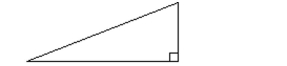
(Multiple Choice)
4.9/5 (65)
(65) Refer to the given figure, an isosceles triangle with AB = AC. 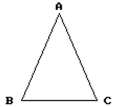 -If measures find the measure of .
 (Multiple Choice)
4.9/5 (84)
(84) 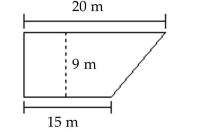 (a trapezoid)
Give the measure of the missing angle using the similar triangles below.
-
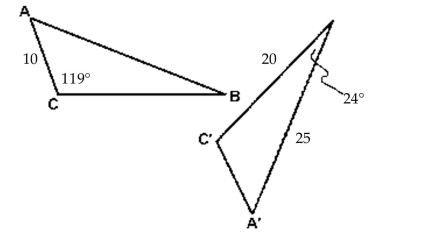
(Multiple Choice)
4.9/5 (78)
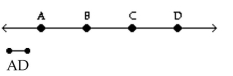
(78) Match the symbol with the answer choice that names the same set of points based on the given figure.
-
(Multiple Choice)
4.9/5 (87)
(87) Give the symbol that represents the portion of the line named and draw a figure showing just the portion named.
-
(Multiple Choice)
4.9/5 (81)
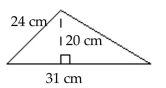
(81) Solve the problem.
-The length of a rectangle is 16 meters, and the width is 12 meters. Find the measure of the diagonal of the rectangle. 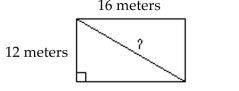
(Multiple Choice)
4.8/5 (70)
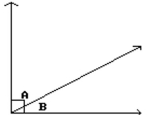
(70) 
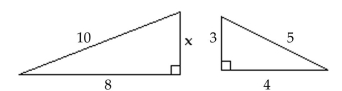
The two triangles below are similar. Find the unknown side lengths.
-
(Multiple Choice)
4.9/5 (77)
(77) Solve the problem.
-A church steeple casts a shadow 109 ft long, and at the same time a 9.0-ft post casts a shadow 5.0 ft long. How high is the steeple? Round to the nearest unit.
(Multiple Choice)
5.0/5 (68)
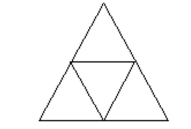
(68) 
Decide whether the statement is true or false.
-If a triangle is equilateral (all sides the same), then it cannot be obtuse.
(True/False)
4.8/5 (84)
(84) a and b represent the two legs of a right triangle, while c represents the hypotenuse. Find the length of the unknown side.
-
(Multiple Choice)
4.8/5 (87)
(87) 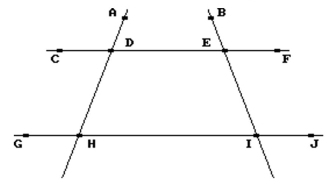 -Are
Two parallel lines never meet because they lie in different planes.
(True/False)
4.8/5 (67)
(67) If two lines do not meet and they are not parallel, they must be skew.
(True/False)
4.9/5 (78)
(78) Provide a STATEMENT/REASON proof for the congruence.
-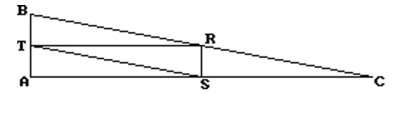 Given:
Prove:
Given:
Prove: (Essay)
4.8/5 (89)
(89) Give the measure of the missing angle using the similar triangles below.
-
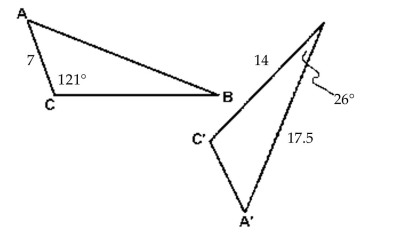
(Multiple Choice)
4.7/5 (84)
(84) 
Filters
- Essay(0)
- Multiple Choice(0)
- Short Answer(0)
- True False(0)
- Matching(0)