Exam 9: Geometry

arrow
  • Select Tags
search iconSearch Question
flashcardsStudy Flashcards
  • Select Tags

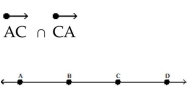
Based on the figure, specify the given set in a simpler way. -Based on the figure, specify the given set in a simpler way. -
(Multiple Choice)
4.7/5
(78)

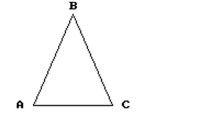
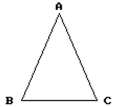
Refer to the given figure, an isosceles triangle with AB = AC.  Refer to the given figure, an isosceles triangle with AB = AC.   -If the perimeter of  \triangle \mathrm { ABC } = 58 \mathrm {~m} , and  \mathrm { AB } = 25 \mathrm {~m} , what is the length  \mathrm { BC }  ? -If the perimeter of △ABC=58 m\triangle \mathrm { ABC } = 58 \mathrm {~m} , and AB=25 m\mathrm { AB } = 25 \mathrm {~m} , what is the length BC\mathrm { BC } ?
(Multiple Choice)
4.8/5
(84)

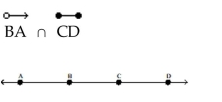
Based on the figure, specify the given set in a simpler way. -Based on the figure, specify the given set in a simpler way. -
(Multiple Choice)
4.9/5
(92)

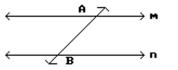
Use the properties of parallel lines to solve the problem. -Assume that m and n are parallel. Find the measures of angles A and B.  Use the properties of parallel lines to solve the problem. -Assume that m and n are parallel. Find the measures of angles A and B.    \angle A=(4 x-5)^{\circ}, \angle B=(3 x+26)^{\circ}   ∠A=(4x−5)∘,∠B=(3x+26)∘\angle A=(4 x-5)^{\circ}, \angle B=(3 x+26)^{\circ}
(Multiple Choice)
4.8/5
(78)

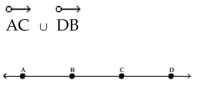
Based on the figure, specify the given set in a simpler way. -Based on the figure, specify the given set in a simpler way. -
(Multiple Choice)
4.7/5
(70)

a and b represent the two legs of a right triangle, while c represents the hypotenuse. Find the length of the unknown side. - a=10 in., b=24 in. a = 10 \text { in., } b = 24 \text { in. }

(Multiple Choice)
4.8/5
(90)

Refer to the given figure, an isosceles triangle with AB = AC.  Refer to the given figure, an isosceles triangle with AB = AC.   -If  \angle A  measures  117 ^ { \circ }  find the measure of  \angle B . -If ∠A\angle A measures 117∘117 ^ { \circ } find the measure of ∠B\angle B .

(Multiple Choice)
4.8/5
(81)

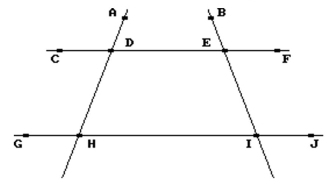
 Refer to this figure to answer the question. Assume CF↔ and GJ↔ are parallel. \text { Refer to this figure to answer the question. Assume } \overleftrightarrow { \mathrm { CF } } \text { and } \overleftrightarrow { \mathrm { GJ } } \text { are parallel. } \text { Refer to this figure to answer the question. Assume } \overleftrightarrow { \mathrm { CF } } \text { and } \overleftrightarrow { \mathrm { GJ } } \text { are parallel. }     -Are  \angle D E B  and  \angle B E F  adjacent angles? -Are ∠DEB\angle D E B and ∠BEF\angle B E F adjacent angles?

(Multiple Choice)
4.7/5
(79)

Solve the problem. -The difference between two complementary angles is 85°. What is the measure of the larger angle?

(Multiple Choice)
4.8/5
(81)

Classify the triangle as acute, right, or obtuse and as equilateral, isosceles, or scalene. -Classify the triangle as acute, right, or obtuse and as equilateral, isosceles, or scalene. -
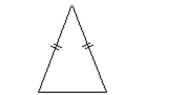
(Multiple Choice)
4.9/5
(89)

There are various formulas that will generate Pythagorean triples. Use the specified formula and specified values to generate a Pythagorean triple. -If m is an odd positive integer greater than 1, then (m,m2−12,m2+12)\left( \mathrm { m } , \frac { \mathrm { m } ^ { 2 } - 1 } { 2 } , \frac { \mathrm { m } ^ { 2 } + 1 } { 2 } \right) is a Pythagorean triple. Use this method with the value m=5\mathrm { m } = 5 to generate a Pythagorean triple.

(Multiple Choice)
4.9/5
(82)

The alternate exterior angles of two parallel lines cut by a transversal always have the same angle measure.

(True/False)
4.9/5
(76)

Give the symbol that represents the portion of the line named and draw a figure showing just the portion named. - Give the symbol that represents the portion of the line named and draw a figure showing just the portion named. -   \text { Ray QS }  Ray QS \text { Ray QS }

(Multiple Choice)
4.9/5
(77)

Give the measure of the missing angle using the similar triangles below. - ∠B\angle B  Give the measure of the missing angle using the similar triangles below. - \angle B      \triangle \mathrm { ABC } \sim \triangle \mathrm { DEC } , \overline { \mathrm { AC } } = 8 \mathrm {~cm} , \angle \mathrm { E } = 58 ^ { \circ } △ABC∼△DEC,AC‾=8 cm,∠E=58∘\triangle \mathrm { ABC } \sim \triangle \mathrm { DEC } , \overline { \mathrm { AC } } = 8 \mathrm {~cm} , \angle \mathrm { E } = 58 ^ { \circ }
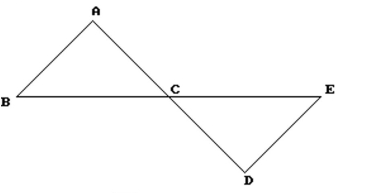
(Multiple Choice)
4.8/5
(73)

 Refer to this figure to answer the question. Assume CF↔ and GJ↔ are parallel. \text { Refer to this figure to answer the question. Assume } \overleftrightarrow { \mathrm { CF } } \text { and } \overleftrightarrow { \mathrm { GJ } } \text { are parallel. } \text { Refer to this figure to answer the question. Assume } \overleftrightarrow { \mathrm { CF } } \text { and } \overleftrightarrow { \mathrm { GJ } } \text { are parallel. }     - \text { What is the measure of } \angle \mathrm{DEF} \text { ? }   -  What is the measure of ∠DEF ? \text { What is the measure of } \angle \mathrm{DEF} \text { ? }

(Multiple Choice)
4.8/5
(78)

Find the measure of each unknown angle in triangle ABC. - Find the measure of each unknown angle in triangle ABC. -   \angle A = x ^ { \circ } , \angle B = 48 ^ { \circ } , \angle C = x ^ { \circ } ∠A=x∘,∠B=48∘,∠C=x∘\angle A = x ^ { \circ } , \angle B = 48 ^ { \circ } , \angle C = x ^ { \circ }

(Multiple Choice)
4.9/5
(73)

Solve the problem. -A ladder is resting against a wall. The top of the ladder touches the wall at a height of 6 ft. Find the length of the ladder if the length is 2 ft more than its distance from the wall.

(Multiple Choice)
4.8/5
(87)

Give the symbol that represents the portion of the line named and draw a figure showing just the portion named. - Give the symbol that represents the portion of the line named and draw a figure showing just the portion named. -   \text { Ray QP }    Ray QP \text { Ray QP }

(Multiple Choice)
5.0/5
(85)

 Refer to this figure to answer the question. Assume CF↔ and GJ↔ are parallel. \text { Refer to this figure to answer the question. Assume } \overleftrightarrow { \mathrm { CF } } \text { and } \overleftrightarrow { \mathrm { GJ } } \text { are parallel. } \text { Refer to this figure to answer the question. Assume } \overleftrightarrow { \mathrm { CF } } \text { and } \overleftrightarrow { \mathrm { GJ } } \text { are parallel. }     -What is the vertex of  \angle \mathrm { DEI }  ? -What is the vertex of ∠DEI\angle \mathrm { DEI } ?

(Multiple Choice)
4.9/5
(93)

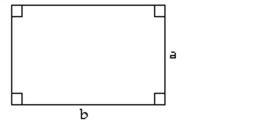
Find the area. - Find the area. -   a = 2.2 \mathrm {~m} , \mathrm {~b} = 7.4 \mathrm {~m} a=2.2 m, b=7.4 ma = 2.2 \mathrm {~m} , \mathrm {~b} = 7.4 \mathrm {~m}

(Multiple Choice)
4.9/5
(87)
Showing 121 - 140 of 182
close modal

Filters

  • Essay(0)
  • Multiple Choice(0)
  • Short Answer(0)
  • True False(0)
  • Matching(0)