



 Chat with AI
Exam 9: Analytic Geometry

Exam 1: Functions and Their Graphs297 Questions
Exam 2: Linear and Quadratic Functions302 Questions
Exam 3: Polynomial and Rational Functions354 Questions
Exam 4: Exponential and Logarithmic Functions517 Questions
Exam 5: Trigonometric Functions354 Questions
Exam 6: Analytic Trigonometry342 Questions
Exam 7: Applications of Trigonometric Functions105 Questions
Exam 8: Polar Coordinates; Vectors253 Questions
Exam 9: Analytic Geometry200 Questions
Exam 10: Systems of Equations and Inequalities235 Questions
Exam 11: Sequences; Induction; the Binomial Theorem238 Questions
Exam 12: Counting and Probability115 Questions
Exam 13: A Preview of Calculus: the Limit, Derivative, and Integral of a Function145 Questions
Exam 14: Foundations: a Prelude to Functions234 Questions
Exam 15: Graphing Utilities29 Questions
Select questions type


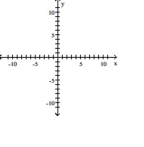
Find an equation for the ellipse described. Graph the equation.
-Vertices at and ; length of minor axis is 6
(Multiple Choice)
4.9/5  (82)
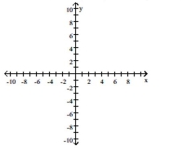
(82) Rotate the axes so that the new equation contains no xy-term. Graph the new equation.
-
(Multiple Choice)
4.7/5 (95)
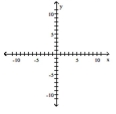
(95) Find the vertex, focus, and directrix of the parabola. Graph the equation.
-
(Multiple Choice)
4.9/5 (65)
(65) Solve the problem.
-A reflecting telescope contains a mirror shaped like a paraboloid of revolution. If the mirror is 24 inches across at its opening and is 4 feet deep, where will the light be concentrated?
(Multiple Choice)
4.8/5 (77)
(77) 
Determine the appropriate rotation formulas to use so that the new equation contains no xy-term.
-
(Multiple Choice)
4.9/5 (83)
(83) 
Find a polar equation for the conic. A focus is at the pole.
- ; directrix is parallel to the polar axis 1 above the pole
(Multiple Choice)
4.9/5 (81)
(81) Find an equation for the ellipse described. Graph the equation.
-Foci at and ; length of major axis is 10
(Multiple Choice)
4.7/5 (81)
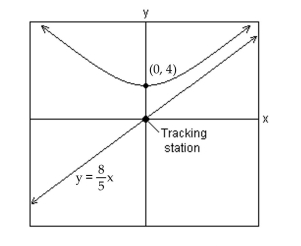
(81) Solve the problem.
-A satellite following the hyperbolic path shown in the picture turns rapidly at and then moves closer and closer to the line as it gets farther from the tracking station at the origin. Find the equation that describes the path of the rocket if the center of the hyperbola is at .
(Multiple Choice)
4.9/5 (81)
(81) Find a rectangular equation for the plane curve defined by the parametric equations.
-
(Multiple Choice)
4.9/5 (68)
(68) 
Rotate the axes so that the new equation contains no xy-term. Graph the new equation.
-
(Multiple Choice)
4.9/5 (86)
(86) Choose the one alternative that best completes the statement or answers the question.
Match the equation to the graph.
-
(Multiple Choice)
4.8/5 (88)
(88) 
Filters
- Essay(0)
- Multiple Choice(0)
- Short Answer(0)
- True False(0)
- Matching(0)