



 Chat with AI
Exam 11: Trees

Exam 1: The Foundations: Logic and Proofs200 Questions
Exam 2: Basic Structures: Sets, Functions, Sequences, Sums, Matrices214 Questions
Exam 3: Algorithms52 Questions
Exam 4: Number Theory and Cryptography154 Questions
Exam 5: Induction and Recursion53 Questions
Exam 6: Counting156 Questions
Exam 7: Discrete Probability53 Questions
Exam 8: Advanced Counting Techniques128 Questions
Exam 9: Relations74 Questions
Exam 10: Graphs127 Questions
Exam 11: Trees97 Questions
Exam 12: Boolean Algebra77 Questions
Exam 13: Modeling Computation71 Questions
Select questions type


If T is a full binary tree with 50 leaves, its minimum height is .
(Short Answer)
4.7/5  (87)
(87) Use the merge sort to sort the list 3, 8, 12, 4, 1, 5, 9, 6 in increasing order.
(Short Answer)
4.9/5 (80)
(80) Find a spanning tree for the graph K3,4 using a depth-first search. (Assume that the vertices are labeled in one set and in the other set, and that alphabetical ordering is used in the search,
with numerical ordering on the subscripts used to break ties.)
(Short Answer)
4.8/5 (73)
(73) Prove that if T is a full m-ary tree with l leaves, then T has (ml − 1)/(m − 1) vertices.
(Short Answer)
4.7/5 (66)
(66) Every full binary tree with 45 vertices has internal vertices.
(Short Answer)
4.8/5 (75)
(75) refer to this graph. 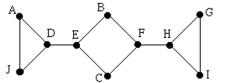 -Using the ordering C, D, E, F, G, H, I, J, A, B, C, find a spanning tree for this graph by using a depth-first
search.
-Using the ordering C, D, E, F, G, H, I, J, A, B, C, find a spanning tree for this graph by using a depth-first
search. (Short Answer)
4.8/5 (75)
(75) refer to this graph. 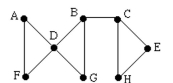 -Using the ordering C, D, E, F, G, H, I, J, A, B, C, find a spanning tree for this graph by using a breadth-first
search.
-Using the ordering C, D, E, F, G, H, I, J, A, B, C, find a spanning tree for this graph by using a breadth-first
search. (Short Answer)
4.9/5 (77)
(77) Use the merge sort to sort the list 4,8,6,1,5,7,3,2 in increasing order.
(Short Answer)
4.8/5 (70)
(70) refer to this graph.
-Using reverse alphabetical ordering, find a spanning tree for the graph by using a breadth-first search.
-Using reverse alphabetical ordering, find a spanning tree for the graph by using a breadth-first search. (Short Answer)
4.9/5 (94)
(94) 
Filters
- Essay(0)
- Multiple Choice(0)
- Short Answer(0)
- True False(0)
- Matching(0)