



 Chat with AI
Exam 11: Trees

Exam 1: The Foundations: Logic and Proofs200 Questions
Exam 2: Basic Structures: Sets, Functions, Sequences, Sums, Matrices214 Questions
Exam 3: Algorithms52 Questions
Exam 4: Number Theory and Cryptography154 Questions
Exam 5: Induction and Recursion53 Questions
Exam 6: Counting156 Questions
Exam 7: Discrete Probability53 Questions
Exam 8: Advanced Counting Techniques128 Questions
Exam 9: Relations74 Questions
Exam 10: Graphs127 Questions
Exam 11: Trees97 Questions
Exam 12: Boolean Algebra77 Questions
Exam 13: Modeling Computation71 Questions
Select questions type


refer to this graph.  -Using alphabetical ordering, find a spanning tree for this graph by using a breadth-first search.
 (Short Answer)
4.9/5  (81)
(81) Every full 3-ary tree of height 2 has at least vertices and at most vertices.
(Short Answer)
4.9/5 (84)
(84) Use Prim's algorithm to find a minimal spanning tree for this weighted graph. Use alphabetical order to break
ties. 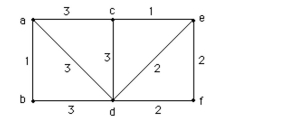
(Short Answer)
4.9/5 (78)
(78) refer to the tree at the right.
-Find the postorder traversal.
(Short Answer)
4.9/5 (84)
(84) (a) Set up a binary tree for the following list, in the given order, using alphabetical ordering: STOP, LET, THERE, TAPE, NONE, YOU, ANT, NINE, OAT, NUT.
(b) Explain step by step how you would search for the word TEST in your tree.
(c) What is the height of the shortest binary search tree that can hold all 10 words?
(d) Write the preorder traversal of the tree.
(e) Write the postorder traversal of the tree.
(f) Write the inorder traversal of the tree.
(Essay)
4.8/5 (72)
(72) Find a spanning tree for the graph K3,4 using a breadth-first search. (Assume that the vertices are labeled
u1, u2, u3 in one set and v1, v2, v3, v4 in the other set, and that alphabetical ordering is used in the search,
with numerical ordering on the subscripts used to break ties.)
(Short Answer)
4.8/5 (80)
(80) mark the statement TRUE or FALSE.
-In a binary tree with 16 vertices, there must be a path of length 4.
(True/False)
5.0/5 (72)
(72) refer to this graph.  -Using alphabetical ordering, find a spanning tree for this graph by using a depth-first search.
 (Short Answer)
5.0/5 (77)
(77) mark the statement TRUE or FALSE.
-If T is a tree with 17 vertices, then there is a simple path in T of length 17.
(True/False)
4.8/5 (93)
(93) refer to this graph.
-Using reverse alphabetical ordering, find a spanning tree for the graph by using a breadth-first search.
-Using reverse alphabetical ordering, find a spanning tree for the graph by using a breadth-first search. (Short Answer)
4.7/5 (68)
(68) If T is a full binary tree with 101 vertices, its maximum height is .
(Short Answer)
4.9/5 (76)
(76) Use Huffman coding to encode these symbols with given frequencies: the average number of bits required to encode a character?
(Short Answer)
4.7/5 (84)
(84) refer to this graph.
-Using the ordering C, D, E, F, G, H, I, J, A, B, C, find a spanning tree for this graph by using a breadth-first
search.
-Using the ordering C, D, E, F, G, H, I, J, A, B, C, find a spanning tree for this graph by using a breadth-first
search. (Short Answer)
4.8/5 (77)
(77) The best comparison-based sorting algorithms for a list of n items have complexity ( )
(Short Answer)
4.8/5 (93)
(93) Describe the difference between Prim's algorithm and Kruskal's algorithm for finding a spanning tree of
minimum cost.
(Short Answer)
4.8/5 (70)
(70) Suppose you have 5 coins, one of which is counterfeit (either heavier or lighter than the other four). You use
a pan balance scale to find the bad coin and determine whether it is heavier or lighter.
(a) Prove that 2 weighings are not enough to guarantee that you find the bad coin and determine whether it
is heavier or lighter.
(b) Draw a decision tree for weighing the coins to determine the bad coin (and whether it is heavier or lighter)
in the minimum number of weighings.
(Short Answer)
4.7/5 (67)
(67) The algebraic expression  is written in prefix notation. Write the expression in postfix
notation.
is written in prefix notation. Write the expression in postfix
notation. (Short Answer)
4.9/5 (76)
(76) 

Filters
- Essay(0)
- Multiple Choice(0)
- Short Answer(0)
- True False(0)
- Matching(0)