



 Chat with AI
Exam 3: Professional Ethics

Exam 1: Auditing and the Public Accounting69 Questions
Exam 2: Financial Statement Audits and84 Questions
Exam 3: Professional Ethics86 Questions
Exam 4: Auditors Legal Liability67 Questions
Exam 5: Overview of the Audit Process49 Questions
Exam 6: Audit Evidence, Audit Objectives,71 Questions
Exam 7: Accepting the Engagement and56 Questions
Exam 8: Materiality Decisions and Performing Analytical Procedures47 Questions
Exam 9: Audit Risk, Including the Risk of Fraud44 Questions
Exam 10: Understanding Internal Controls91 Questions
Exam 11: Audit Procedures in Response to Assessed Risks: Tests of Controls18 Questions
Exam 12: Audit Procedures in Response to Assessed Risks: Substantive Tests82 Questions
Exam 13: Audit Sampling in Substantive Tests72 Questions
Exam 14: Auditing the Revenue Cycle72 Questions
Exam 15: Auditing the Expenditure Cycle80 Questions
Exam 16: Auditing the Production and81 Questions
Exam 17: Auditing the Investing and77 Questions
Exam 18: Auditing Investments and92 Questions
Exam 19: Completing the Audit and Postaudit102 Questions
Exam 20: Attest and Assurance Services, and Related Reports61 Questions
Exam 21: Internal, Operational, and103 Questions
Select questions type


1.Distinguish between the Principles and Rules of the AICPA Code of Professional Conduct and indicate the enforceability of each.
2.Identify the applicability of the Rules to members in public practice and other members.
(Essay)
4.9/5  (80)
(80) The Principle of Integrity in the AICPA's Code of Professional Conduct would be violated in cases of:
(Multiple Choice)
4.9/5 (94)
(94) Enforcement of the Rules in the Code of Professional Conduct rests with the:
(Multiple Choice)
4.8/5 (83)
(83) Which of the following would not be considered an indirect financial interest for a given CPA?
(Multiple Choice)
4.9/5 (80)
(80) For covered members, the prohibition against a direct financial interest under Rule 101 is absolute.
(True/False)
5.0/5 (89)
(89) Under Rule 505 in the AICPA's Code of Professional Conduct, the name of the firm cannot be:
(Multiple Choice)
4.9/5 (71)
(71) Which section of the AICPA's Rules of Conduct currently has no rules within it?
(Multiple Choice)
4.8/5 (71)
(71) Unpaid fees for professional services will impair independence if:
(Multiple Choice)
4.9/5 (82)
(82) For each of the following actions by a member CPA, indicate (1) the rule of conduct that is applicable and (2) whether the actions does (yes) or does not (no) violate the rule. You may identify the rule by number on your answer sheet. Your selections can be made from the following list: 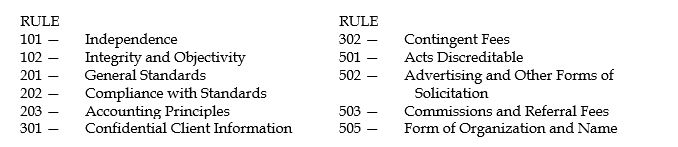 1.Discriminates in employment.
2.Makes recommendations but not the decisions in an MCS engagement for a nonpublic client.
3.Permits a non-CPA to be the chairman of the board of a CPA firm organized as a professional corporation.
4.Fails to make inquiries in a review of interim financial information.
5.Accepts a commission from a vendor, with the permission of the audit client, for
recommending the vendor's product.
6.Indicates that he will perform the audit of a city's united fund charity for a nominal fee.
7.Transfers working papers, with the client's permission, to the client's new auditors.
8.Subordinates his judgment in favor of the client in tax practice when there is little support for the client's position.
9.Indicates the number of partners, CPAs and offices in his or her firm in an advertisement.
10.States that the fee in a tax case will be based on the amount of tax saving realized.
11.Fails to conform to a recently issued SAS, which has an immaterial effect on the financial statements.
12.A personnel manager in the office doing the audit of a client has a financial interest in the client.
13.Fails to adequately plan and supervise an MCS engagement.
14.Agrees to serve as an honorary director of a charitable foundation.
15.Knowingly misrepresents facts in an engagement.
1.Discriminates in employment.
2.Makes recommendations but not the decisions in an MCS engagement for a nonpublic client.
3.Permits a non-CPA to be the chairman of the board of a CPA firm organized as a professional corporation.
4.Fails to make inquiries in a review of interim financial information.
5.Accepts a commission from a vendor, with the permission of the audit client, for
recommending the vendor's product.
6.Indicates that he will perform the audit of a city's united fund charity for a nominal fee.
7.Transfers working papers, with the client's permission, to the client's new auditors.
8.Subordinates his judgment in favor of the client in tax practice when there is little support for the client's position.
9.Indicates the number of partners, CPAs and offices in his or her firm in an advertisement.
10.States that the fee in a tax case will be based on the amount of tax saving realized.
11.Fails to conform to a recently issued SAS, which has an immaterial effect on the financial statements.
12.A personnel manager in the office doing the audit of a client has a financial interest in the client.
13.Fails to adequately plan and supervise an MCS engagement.
14.Agrees to serve as an honorary director of a charitable foundation.
15.Knowingly misrepresents facts in an engagement.
(Essay)
4.8/5 (88)
(88) Trial board hearings are generally held by subboards comprised of at least how many board members?
(Multiple Choice)
4.7/5 (93)
(93) The AICPA's Code of Professional Conduct prohibits contingent fees from:
(Multiple Choice)
4.8/5 (84)
(84) Listed below are individuals identified under Rule 101 - Independence. Identify whether each of these individuals would be classified as a Covered Members, Covered Members' Immediate Family, or Covered Members' Close Relative.
1.Parents
2.Dependents
3.Spouse
4.Any member of the engagement team
5.Brothers and sisters
6.Partners who are in the same office as the lead partner on the engagement
7.Individuals who participate in quality control activities for the firm
8.Nondependent children
9.The firm, its benefit plans, and entities controlled by covered members
10.Those who evaluate the partners' performance and compensations, including members of compensation committees.
REQUIRED: For each statement, identify the principle to which it relates.
(Essay)
4.8/5 (76)
(76) Besides consideration of all of the other principles, in deciding whether to provide specific services, which of the following is also required by the Scope and Nature of Services principle:
(Multiple Choice)
5.0/5 (80)
(80) Rule 301? Confidential Client Information contains explicit exceptions for all of the following efforts by a member except to:
(Multiple Choice)
4.9/5 (76)
(76) A member can permit non-CPAs to carry out acts in his behalf that, if carried out by the member, would violate the rules.
(True/False)
4.7/5 (77)
(77) Under Rule 101 in the AICPA's Code of Professional Conduct, independence would not be required in which of the following types of engagements?
(Multiple Choice)
4.8/5 (76)
(76) With some important exceptions, Rule 301 requires the member to obtain specific consent of the AICPA before disclosing confidential client information.
(True/False)
4.8/5 (68)
(68) 
Filters
- Essay(0)
- Multiple Choice(0)
- Short Answer(0)
- True False(0)
- Matching(0)