



 Chat with AI
Exam 10: Pure Competition in the Short Run

Exam 1: Limits, Alternatives, and Choices339 Questions
Exam 2: The Market System and the Circular Flow187 Questions
Exam 3: Demand, Supply, and Market Equilibrium296 Questions
Exam 4: Market Failures: Public Goods and Externalities175 Questions
Exam 5: Governments Role and Government Failure258 Questions
Exam 6: Elasticity221 Questions
Exam 7: Utility Maximization186 Questions
Exam 8: Behavioral Economics248 Questions
Exam 9: Businesses and the Costs of Production222 Questions
Exam 10: Pure Competition in the Short Run160 Questions
Exam 11: Pure Competition in the Long Run178 Questions
Exam 12: Pure Monopoly204 Questions
Exam 13: Monopolistic Competition156 Questions
Exam 14: Oligopoly and Strategic Behavior260 Questions
Exam 15: Technology, Rd, and Efficiency228 Questions
Exam 16: The Demand for Resources231 Questions
Exam 17: Wage Determination276 Questions
Exam 18: Rent, Interest, and Profit180 Questions
Exam 19: Natural Resource and Energy Economics280 Questions
Exam 20: Public Finance: Expenditures and Taxes210 Questions
Exam 21: Antitrust Policy and Regulation226 Questions
Exam 22: Agriculture: Economics and Policy190 Questions
Exam 23: Income Inequality, Poverty, and Discrimination265 Questions
Exam 24: Health Care240 Questions
Exam 25: Immigration188 Questions
Exam 26: An Introduction to Macroeconomics199 Questions
Exam 27: Measuring Domestic Output and National Income223 Questions
Exam 28: Economic Growth245 Questions
Exam 29: Business Cycles, Unemployment, and Inflation286 Questions
Exam 30: Basic Macroeconomic Relationships223 Questions
Exam 31: The Aggregate Expenditures Model199 Questions
Exam 32: Aggregate Demand and Aggregate Supply227 Questions
Exam 33: Fiscal Policy, Deficits, and Debt250 Questions
Exam 34: Money, Banking, and Financial Institutions231 Questions
Exam 35: Money Creation177 Questions
Exam 36: Interest Rates and Monetary Policy360 Questions
Exam 37: Financial Economics255 Questions
Exam 38: Extending the Analysis of Aggregate Supply160 Questions
Exam 39: Current Issues in Macro Theory and Policy225 Questions
Exam 40: International Trade205 Questions
Exam 41: The Balance of Payments, Exchange Rates, and Trade Deficits206 Questions
Exam 42: The Economics of Developing Countries245 Questions
Select questions type


The total revenue of a purely competitive firm from selling 6 units of output is $48.Based on this information, the unit price of the output must be
(Multiple Choice)
4.9/5  (82)
(82) As long as an additional unit of output yields a marginal revenue larger than its marginal cost, it will be adding to total profits of the firm.
(True/False)
4.8/5 (79)
(79) If a purely competitive firm is producing at the P = MC output and realizing an economic profit, at that output
(Multiple Choice)
4.9/5 (71)
(71) Which of the following is a reason why individual firms under pure competition would not find it gainful to advertise their product?
(Multiple Choice)
4.9/5 (91)
(91) 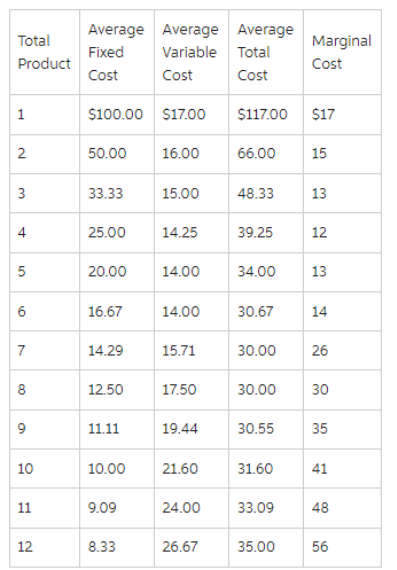 The accompanying table gives cost data for a firm that is selling in a purely competitive market.If the market price for the firm's product is $12, the competitive firm should produce
 (Multiple Choice)
4.8/5 (75)
(75) Mutual interdependence would tend to limit control over price in which market model?
(Multiple Choice)
5.0/5 (71)
(71) In which market model are the conditions of entry the most difficult?
(Multiple Choice)
4.9/5 (75)
(75) In which market model are the conditions of entry into the market easiest?
(Multiple Choice)
4.9/5 (69)
(69) An industry comprising 40 firms, none of which has more than 3 percent of the total market for a differentiated product, is an example of
(Multiple Choice)
4.9/5 (89)
(89) A competitive firm will produce in the short run so long as its price exceeds its average fixed cost.
(True/False)
4.8/5 (65)
(65) In the short run, a purely competitive seller will shut down if
(Multiple Choice)
4.9/5 (93)
(93) In contrast to American firms, Japanese firms frequently make lifetime employment commitments to their workers and agree not to lay them off when product demand is weak.Other things being equal, we would expect Japanese firms to
(Multiple Choice)
4.7/5 (92)
(92) If the firm produces an output level below its break-even point, then the firm will earn negative economic profits.
(True/False)
4.8/5 (81)
(81) If a purely competitive firm is producing at some output level less than the profit-maximizing output, then
(Multiple Choice)
4.8/5 (72)
(72) 
Filters
- Essay(0)
- Multiple Choice(0)
- Short Answer(0)
- True False(0)
- Matching(0)