



 Chat with AI
Exam 10: Monopolistic Competition and Oligopoly

Exam 1: Welcome to Economics42 Questions
Exam 2: Choice in a World of Scarcity36 Questions
Exam 3: Demand and Supply38 Questions
Exam 4: Labor and Financial Markets42 Questions
Exam 5: Elasticity45 Questions
Exam 6: Consumer Choices70 Questions
Exam 7: Cost and Industry Structure67 Questions
Exam 8: Perfect Competition66 Questions
Exam 9: Monopoly69 Questions
Exam 10: Monopolistic Competition and Oligopoly79 Questions
Exam 11: Monopoly and Antitrust Policy96 Questions
Exam 12: Environmental Protection and Negative Externalities99 Questions
Exam 13: Positive Externalities and Public Goods81 Questions
Exam 14: Poverty and Economic Inequality60 Questions
Exam 15: Issues in Labor Markets: Unions, Discrimination, Immigration73 Questions
Exam 16: Information, Risk, and Insurance80 Questions
Exam 17: Financial Markets67 Questions
Exam 18: Public Economy46 Questions
Exam 19: International Trade46 Questions
Exam 20: Globalization and Protectionism43 Questions
Select questions type


Which of the following would be classified as a differentiated product produced by a monopolistic competitor?
(Multiple Choice)
4.9/5  (86)
(86) The first step to be undertaken by a profit-maximizing monopolistic competitor wanting to decide what price to charge is to
(Multiple Choice)
4.7/5 (79)
(79) Joe owns a restaurant. Many of the restaurants that he competes with recently closed, shifting his perceived demand curve. The following 2 tables show his old and new perceived demand curves.

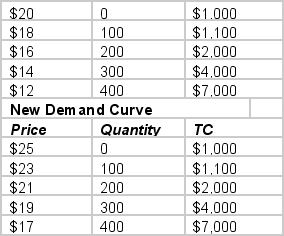 Assume that Joe can only choose from the quantities of output given in the table. By how much does the price that he charges change after the restaurants leave the market?
 (Multiple Choice)
4.9/5 (76)
(76) When entry occurs in a monopolistically competitive industry,
(Multiple Choice)
4.9/5 (69)
(69) A monopolistic competitor has the following information about cost and demand.
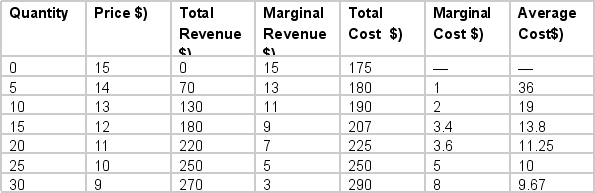
 Then, in the long run equilibrium, the firm will sell this good at what price?
 (Multiple Choice)
4.9/5 (94)
(94) Briefly explain what quantity a profit-maximizing monopolistic competitor will seek, as well as why or why not this type of competitive firm is productively efficient.
(Essay)
4.7/5 (81)
(81) When exit occurs in a monopolistically competitive industry the
(Multiple Choice)
4.8/5 (85)
(85) The following table shows the demand curve and cost information for a firm that is a monopoly.
 If they maximize their profits, what will their revenue equal?
 (Multiple Choice)
4.7/5 (79)
(79) List at least five examples of some intangible aspects that differentiate products.
(Essay)
4.9/5 (92)
(92) Briefly compare and contrast the perceived demand curve for a monopolistically competitive firm and a perfectly competitive firm.
(Essay)
4.8/5 (68)
(68) In the framework of monopolistic competition, advertising works because it causes
(Multiple Choice)
4.8/5 (94)
(94) Briefly compare and contrast the perceived demand curve for a monopolistic competitor and a monopolist.
(Essay)
4.8/5 (71)
(71) In the framework of an oligopoly, what strategy can work like a silent form of cooperation?
(Multiple Choice)
4.8/5 (75)
(75) A monopolistically competitive firm may earn abnormally high profits in the
(Multiple Choice)
5.0/5 (71)
(71) Briefly describe what an oligopoly is, as well as the circumstances that could allow oligopolists to earn their highest profits.
(Essay)
4.8/5 (85)
(85) A successful advertising campaign may allow competing monopolists to
(Multiple Choice)
4.8/5 (75)
(75) Briefly contrast the level that a monopolistically competitive firm will tend to produce at and the price it will charge with that of a perfectly competitive firm.
(Essay)
4.9/5 (84)
(84) A monopolistic competitor has the following information about cost and demand.
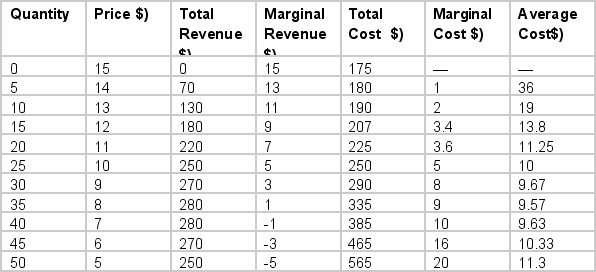 What will this firm's profits equal in the long run?
 (Multiple Choice)
4.7/5 (81)
(81) 
Filters
- Essay(0)
- Multiple Choice(0)
- Short Answer(0)
- True False(0)
- Matching(0)