



 Chat with AI
Exam 11: Monopoly and Antitrust Policy

Exam 1: Welcome to Economics42 Questions
Exam 2: Choice in a World of Scarcity36 Questions
Exam 3: Demand and Supply38 Questions
Exam 4: Labor and Financial Markets42 Questions
Exam 5: Elasticity45 Questions
Exam 6: Consumer Choices70 Questions
Exam 7: Cost and Industry Structure67 Questions
Exam 8: Perfect Competition66 Questions
Exam 9: Monopoly69 Questions
Exam 10: Monopolistic Competition and Oligopoly79 Questions
Exam 11: Monopoly and Antitrust Policy96 Questions
Exam 12: Environmental Protection and Negative Externalities99 Questions
Exam 13: Positive Externalities and Public Goods81 Questions
Exam 14: Poverty and Economic Inequality60 Questions
Exam 15: Issues in Labor Markets: Unions, Discrimination, Immigration73 Questions
Exam 16: Information, Risk, and Insurance80 Questions
Exam 17: Financial Markets67 Questions
Exam 18: Public Economy46 Questions
Exam 19: International Trade46 Questions
Exam 20: Globalization and Protectionism43 Questions
Select questions type


The fundamental belief behind the market-oriented US economy is that firms are in the best position to know if their actions will
(Multiple Choice)
4.8/5  (76)
(76) The term _______ refers to a situation where the firms supposedly being regulated end up playing a large role in setting the regulations that they will follow.
(Multiple Choice)
4.9/5 (77)
(77) There have been two especially important shifts in how markets are defined in recent decades: one involves _______ and the other involves _______.
(Multiple Choice)
4.7/5 (85)
(85) Briefly compare and contrast cost-plus regulation and price cap regulation.
(Essay)
4.8/5 (79)
(79) Briefly explain regulation in the case of a natural monopoly. Provide 3 common examples of regulation. Briefly discuss the benefits of privatization set out in the text and explain what is required for privatization of a nationalized asset in order for privatization to work well.
(Essay)
4.9/5 (75)
(75) Why would regulators find that a proposed merger is likely to lessen competition?
(Multiple Choice)
4.8/5 (66)
(66) The four-firm _______ measures the percentage share of the total sales in the Industry that is accounted for by the largest four firms.
(Multiple Choice)
4.8/5 (84)
(84) In the 1980s, the FTC followed guidelines stipulating that, should a proposed merger result in an HHI of less than 1,000,
(Multiple Choice)
4.8/5 (96)
(96) The term _______ refers to the percentage share of a firm's total sales in the market.
(Multiple Choice)
5.0/5 (66)
(66) What is the maximum value that can be reached using the HHI?
(Multiple Choice)
4.8/5 (91)
(91) Antitrust laws were created to give government the power to
(Multiple Choice)
5.0/5 (92)
(92) A business _______ occurs when, for practical purposes, one firm purchases another.
(Multiple Choice)
4.8/5 (74)
(74) What was created by the U.S. government in 1914 to specifically define what types of competition were legally unfair?
(Multiple Choice)
4.8/5 (71)
(71) When the regulator sets a price that a firm cannot exceed over the next few years, the regulator is enforcing
(Multiple Choice)
4.9/5 (78)
(78) City Gas is a natural monopoly that supplies natural gas to a particular city. Its cost and demand information are given below.
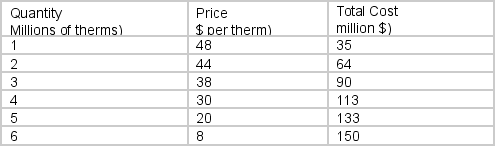 If the government decides to regulate this natural monopoly by forcing them to produce at the point where the demand curve intersects marginal cost, then the firm will make a _______ and _______ continue in the long run.
 (Multiple Choice)
4.9/5 (80)
(80) Firms operating under cost-plus regulation have an incentive to generate high costs by building huge factories or employing lots of staff,
(Multiple Choice)
4.8/5 (83)
(83) Following the commencement of deregulation of US airline industry in the 1970s, reduced airfares saved consumers billions of dollar a year however, the more recent string of airline mergers has
(Multiple Choice)
4.8/5 (69)
(69) Which of the following is a valid criticism of the reduction of competition that results from corporate mergers?
(Multiple Choice)
4.7/5 (77)
(77) 
Filters
- Essay(0)
- Multiple Choice(0)
- Short Answer(0)
- True False(0)
- Matching(0)