



 Chat with AI
Exam 8: Why Do Economies Grow?

Exam 1: Introduction: What Is Economics?118 Questions
Exam 2: The Key Principles of Economics144 Questions
Exam 3: Exchange and Markets111 Questions
Exam 4: Demand, Supply, and Market Equilibrium172 Questions
Exam 5: Measuring a Nation's Production and Income152 Questions
Exam 6:Unemployment and Inflation155 Questions
Exam 7:The Economy at Full Employment148 Questions
Exam 8: Why Do Economies Grow?167 Questions
Exam 9: Aggregate Demand and Aggregate Supply160 Questions
Exam 10: Fiscal Policy133 Questions
Exam 11: The Income-Expenditure Model193 Questions
Exam 12: Investment and Financial Markets150 Questions
Exam 13: Money and the Banking System170 Questions
Exam 14: The Federal Reserve and Monetary Policy149 Questions
Exam 15: Modern Macroeconomics: From the Short Run to the Long Run152 Questions
Exam 16: The Dynamics of Inflation and Unemployment149 Questions
Exam 17: Macroeconomic Policy Debates147 Questions
Exam 18: International Trade and Public Policy155 Questions
Exam 19: The World of International Finance150 Questions
Select questions type


Suppose the annual growth rate of GDP in Nepal is 5 percent. In 35 years, GDP in Nepal will double
(Multiple Choice)
4.9/5  (67)
(67) Recall the Application about the possibilities of transformative economic growth in authoritarian and participatory political institutions to answer the following question(s).
-According to this Application, economist Daron Acemoglu categorizes which of the following as participatory institutions?
(Multiple Choice)
4.9/5 (75)
(75) If real GDP is 100 in year 1, and grows at a rate of 3 percent per year for 9 years, what will the GDP be in 9 years?
(Essay)
4.8/5 (98)
(98) If a country runs a trade deficit to finance increased current consumption, it will have to increase consumption in the future to pay back its borrowings.
(True/False)
4.8/5 (83)
(83) Suppose the growth rate of GDP in the United States is 4.2 percent. If 2.9 percent and 1.3 percent of GDP growth are due, respectively, to capital and labor growth, the amount resulting from technological progress is
(Multiple Choice)
4.9/5 (80)
(80) The substantial increase in clear property rights has severely impeded growth in many developing countries.
(True/False)
4.8/5 (83)
(83) 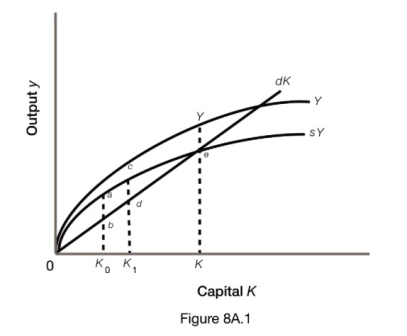 -Refer to Figure 8A.1. Capital deepening occurs as long as
 (Multiple Choice)
4.7/5 (69)
(69) Convergence refers to closing the gap in ________ between poorer countries and richer countries.
(Multiple Choice)
4.9/5 (78)
(78) Recall the Application about the relationship between economic growth and inequality to answer the following question(s).
-According to this Application, Berg and Ostrey found that
(Multiple Choice)
4.7/5 (75)
(75) Suppose that real GDP starts at 200 and grows at a rate of 9 percent per year for two years. In the third year real GDP would be
(Multiple Choice)
5.0/5 (83)
(83) Which of the following uses of tax revenues collected by the government leads to increased capital deepening in the United States?
(Multiple Choice)
4.9/5 (79)
(79) Nations that borrow from abroad to support current investment will
(Multiple Choice)
4.9/5 (81)
(81) Suppose that for a given firm, the increase in output resulting from the last worker hired is less than the increase in output of the previous worker hired. This is an example of
(Multiple Choice)
4.8/5 (75)
(75) Suppose you were interested in increasing technological progress in your country. Suggest some ways to do it.
(Essay)
4.8/5 (84)
(84) Which of the following is NOT an example of technological progress?
(Multiple Choice)
4.9/5 (82)
(82) If a nation with a low level of GDP per capita converges to a richer nation, the poor nation
(Multiple Choice)
4.9/5 (73)
(73) Capital deepening is the only mechanism by which economies can grow.
(True/False)
4.8/5 (101)
(101) 
Filters
- Essay(0)
- Multiple Choice(0)
- Short Answer(0)
- True False(0)
- Matching(0)