



 Chat with AI
Exam 8: Why Do Economies Grow?

Exam 1: Introduction: What Is Economics?118 Questions
Exam 2: The Key Principles of Economics144 Questions
Exam 3: Exchange and Markets111 Questions
Exam 4: Demand, Supply, and Market Equilibrium172 Questions
Exam 5: Measuring a Nation's Production and Income152 Questions
Exam 6:Unemployment and Inflation155 Questions
Exam 7:The Economy at Full Employment148 Questions
Exam 8: Why Do Economies Grow?167 Questions
Exam 9: Aggregate Demand and Aggregate Supply160 Questions
Exam 10: Fiscal Policy133 Questions
Exam 11: The Income-Expenditure Model193 Questions
Exam 12: Investment and Financial Markets150 Questions
Exam 13: Money and the Banking System170 Questions
Exam 14: The Federal Reserve and Monetary Policy149 Questions
Exam 15: Modern Macroeconomics: From the Short Run to the Long Run152 Questions
Exam 16: The Dynamics of Inflation and Unemployment149 Questions
Exam 17: Macroeconomic Policy Debates147 Questions
Exam 18: International Trade and Public Policy155 Questions
Exam 19: The World of International Finance150 Questions
Select questions type


In a simple economy without government or foreign trade, any income not consumed is called
(Multiple Choice)
4.9/5  (86)
(86) If a firm increases its capital stock per person while holding constant the number of workers employed, the firm is said to experience
(Multiple Choice)
4.7/5 (88)
(88) Suppose consumers save 3 percent of their incomes. If the government collects 1 dollar in taxes from each taxpayer, private saving will ________ per taxpayer.
(Multiple Choice)
4.8/5 (85)
(85) Recall the Application about the effect of global warming on economic growth to answer the following question(s).
-According to this Application, a one degree Celsius rise in temperature
(Multiple Choice)
4.8/5 (76)
(76) Recall the Application about cultural factors in England and their relevance to the Industrial Revolution to answer the following question(s). In studying the economic history of England before the Industrial Revolution, Professor Gregory Clark found that children of the more affluent members of English society were more likely to survive than those of the less affluent. Coupled with the slow growth of population over several centuries, this differential survival of the wealthy had the effect of creating downward mobility for the rich, as their sons and daughter increasingly populated the society.
-According to the Application, the cultural changes in England allowed individuals to take advantage of
(Multiple Choice)
4.8/5 (76)
(76) Explain the two basic mechanisms that increase GDP per capita over the long term.
(Essay)
4.8/5 (76)
(76) 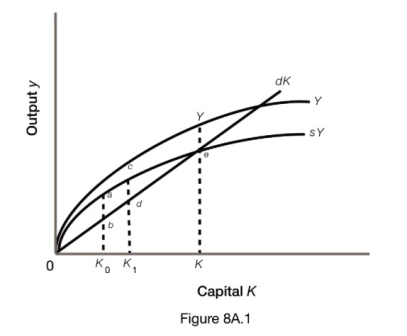 -Refer to Figure 8A.1. The stock of capital no longer increases once the economy reaches point
 (Multiple Choice)
4.8/5 (93)
(93) Technological innovations are not necessarily major scientific breakthroughs.
(True/False)
4.9/5 (84)
(84) Suppose real GDP was 100 in year 1 and 105 in year 2. The growth rate of real GDP is
(Multiple Choice)
4.9/5 (80)
(80) Recall the Application about adapting growth accounting to new developments in the economy to answer the following question(s).
-Recall the Application. Intangible capital includes all of the following EXCEPT
(Multiple Choice)
4.9/5 (75)
(75) At a 3.5 percent annual growth rate it would take 20 years for GDP per capita to double.
(True/False)
4.8/5 (75)
(75) All of the following can cause technological progress EXCEPT
(Multiple Choice)
5.0/5 (85)
(85)
-Refer to Figure 8A.1. When the economy reaches K, total saving is represented by point ________ and depreciation is represented by point ________.
-Refer to Figure 8A.1. When the economy reaches K, total saving is represented by point ________ and depreciation is represented by point ________. (Multiple Choice)
5.0/5 (85)
(85) Eventually the process of capital deepening comes to a halt as depreciation catches up with total saving.
(True/False)
4.8/5 (72)
(72) According to this Application, ________ regimes have difficulty coping with the changes arising from sustained technological progress.
(Multiple Choice)
4.9/5 (83)
(83) If the stock of capital of a nation is ________ while the population ________, the nation can produce more output, but output per worker falls.
(Multiple Choice)
4.8/5 (88)
(88) In developing countries, the highest returns are from investing in
(Multiple Choice)
4.8/5 (87)
(87) 
Filters
- Essay(0)
- Multiple Choice(0)
- Short Answer(0)
- True False(0)
- Matching(0)