



 Chat with AI
Exam 3: Exchange and Markets

Exam 1: Introduction: What Is Economics?118 Questions
Exam 2: The Key Principles of Economics144 Questions
Exam 3: Exchange and Markets111 Questions
Exam 4: Demand, Supply, and Market Equilibrium172 Questions
Exam 5: Measuring a Nation's Production and Income152 Questions
Exam 6:Unemployment and Inflation155 Questions
Exam 7:The Economy at Full Employment148 Questions
Exam 8: Why Do Economies Grow?167 Questions
Exam 9: Aggregate Demand and Aggregate Supply160 Questions
Exam 10: Fiscal Policy133 Questions
Exam 11: The Income-Expenditure Model193 Questions
Exam 12: Investment and Financial Markets150 Questions
Exam 13: Money and the Banking System170 Questions
Exam 14: The Federal Reserve and Monetary Policy149 Questions
Exam 15: Modern Macroeconomics: From the Short Run to the Long Run152 Questions
Exam 16: The Dynamics of Inflation and Unemployment149 Questions
Exam 17: Macroeconomic Policy Debates147 Questions
Exam 18: International Trade and Public Policy155 Questions
Exam 19: The World of International Finance150 Questions
Select questions type


Consider two individuals, Celia and Sondra, who produce bracelets and pendants. Celia's and Sondra's hourly productivity are as follows:
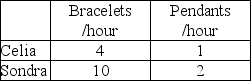 Who has the absolute advantage or comparative advantage in the production of bracelets or pendants?
 (Essay)
4.8/5  (69)
(69) Specialization and exchange result from differences in productivity that lead to
(Multiple Choice)
5.0/5 (81)
(81) Table 3.3
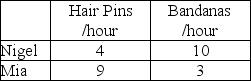 -Consider two individuals, Nigel and Mia, who produce hair pins and bandanas. Nigel's and Mia's hourly productivity are shown in Table 3.3. Mia's opportunity cost of producing one bandana is
 (Multiple Choice)
4.8/5 (98)
(98) In a market economy, what specifies the terms of exchange, facilitating exchange between strangers?
(Multiple Choice)
4.9/5 (82)
(82) Adam Smith used the metaphor of the "invisible hand" to explain how
(Multiple Choice)
4.8/5 (72)
(72) Table 3.4
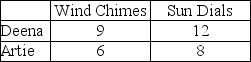 -Consider two individuals, Artie and Deena, who produce wind chimes and sun dials. Artie's and Deena's weekly productivity are shown in Table 3.4. Which of the following is true?
 (Multiple Choice)
4.9/5 (81)
(81) Table 3.1
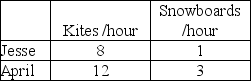 -Consider two individuals, Jesse and April, who hand paint kites and snowboards. Table 3.1 shows how much of each good Jesse and April can paint in one hour. Jesse's opportunity cost of painting one kite is painting
 (Multiple Choice)
4.8/5 (83)
(83) Table 3.1
-The ability of one person or nation to produce a good at a lower opportunity cost than another is called a(n)
-The ability of one person or nation to produce a good at a lower opportunity cost than another is called a(n) (Multiple Choice)
4.8/5 (80)
(80) Table 3.2
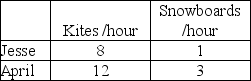 -Consider two individuals, Jesse and April, who hand paint kites and snowboards. Table 3.2 shows how much of each good Jesse and April can paint in one hour. Which of the following is true?
 (Multiple Choice)
4.9/5 (77)
(77) Recall the Application about the market for meteorites to answer the following question(s).
-According to the Application, people in Morocco bring meteorites picked up in the desert to local dealers, who then sell them to the public through Websites. This process is a description of
(Multiple Choice)
4.7/5 (78)
(78) 
Filters
- Essay(0)
- Multiple Choice(0)
- Short Answer(0)
- True False(0)
- Matching(0)