



 Chat with AI
Exam 3: Exchange and Markets

Exam 1: Introduction: What Is Economics?118 Questions
Exam 2: The Key Principles of Economics144 Questions
Exam 3: Exchange and Markets111 Questions
Exam 4: Demand, Supply, and Market Equilibrium172 Questions
Exam 5: Measuring a Nation's Production and Income152 Questions
Exam 6:Unemployment and Inflation155 Questions
Exam 7:The Economy at Full Employment148 Questions
Exam 8: Why Do Economies Grow?167 Questions
Exam 9: Aggregate Demand and Aggregate Supply160 Questions
Exam 10: Fiscal Policy133 Questions
Exam 11: The Income-Expenditure Model193 Questions
Exam 12: Investment and Financial Markets150 Questions
Exam 13: Money and the Banking System170 Questions
Exam 14: The Federal Reserve and Monetary Policy149 Questions
Exam 15: Modern Macroeconomics: From the Short Run to the Long Run152 Questions
Exam 16: The Dynamics of Inflation and Unemployment149 Questions
Exam 17: Macroeconomic Policy Debates147 Questions
Exam 18: International Trade and Public Policy155 Questions
Exam 19: The World of International Finance150 Questions
Select questions type


To explore the rationale for specialization, economists use the
(Multiple Choice)
4.8/5  (84)
(84) Recall the Application about productivity in the nation of Latvia in the 1990s to answer the following question(s).
-According to this Application, in the 1990s EU countries had ________ in the production of all products compared to Latvia.
(Multiple Choice)
4.9/5 (68)
(68) Recall the Application about the role of government in promoting civil liberties to answer the following question(s).
-According to the Application, moving from a country with relatively weak civil liberties to one with relatively strong civil liberties, the economic rate of return on World Bank development projects
(Multiple Choice)
4.9/5 (69)
(69) Table 3.2
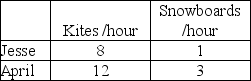 -Consider two individuals, Jesse and April, who hand paint kites and snowboards. Table 3.2 shows how much of each good Jesse and April can paint in one hour. Which of the following is true?
 (Multiple Choice)
4.8/5 (70)
(70) In which system are decisions made by thousands of people who have information about resources, production technology and consumer desires?
(Multiple Choice)
4.8/5 (76)
(76) The prices of the products in the World War II POW camps, measured in terms of cigarettes, reflected the products'
(Multiple Choice)
4.8/5 (84)
(84) In a market-based economy, only the government can reduce economic uncertainty.
(True/False)
4.8/5 (66)
(66) Imports are products produced in the home country and sold in another country.
(True/False)
4.9/5 (69)
(69) An economy in which people exchange goods and services in a market is called a
(Multiple Choice)
4.9/5 (74)
(74) Table 3.1
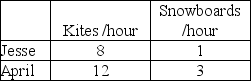 -Consider two individuals, Jesse and April, who hand paint kites and snowboards. Table 3.1 shows how much of each good Jesse and April can paint in one hour. April's opportunity cost of painting one kite is painting
 (Multiple Choice)
4.7/5 (78)
(78) An individual or country that has a comparative advantage in the production of one good
(Multiple Choice)
4.9/5 (89)
(89) Recall the Application about productivity in the nation of Latvia in the 1990s to answer the following question(s).
-According to this Application, workers in the EU were more productive than workers in Latvia in the 1990s, yet EU nations still purchased products from Latvia. This is because Latvia ________ in the production of the products it sold to EU nations.
(Multiple Choice)
4.8/5 (74)
(74) When a U.S. company shifts some of its production to Mexico, it is engaging in
(Multiple Choice)
4.9/5 (73)
(73) Table 3.3
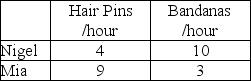 -Consider two individuals, Nigel and Mia, who produce hair pins and bandanas. Nigel's and Mia's hourly productivity are shown in Table 3.3. Which of the following is true?
 (Multiple Choice)
4.8/5 (77)
(77) 
Filters
- Essay(0)
- Multiple Choice(0)
- Short Answer(0)
- True False(0)
- Matching(0)