



 Chat with AI
Exam 18: The Structural Basis of Cellular Information: DNA, Chromosomes, and the Nucleus

Exam 1: A Preview of the Cell35 Questions
Exam 2: The Chemistry of the Cell36 Questions
Exam 3: The Macromolecules of the Cell31 Questions
Exam 4: Cells and Organelles37 Questions
Exam 5: Bioenergetics: The Flow of Energy in the Cell38 Questions
Exam 6: Enzymes: The Catalysts of Life35 Questions
Exam 7: Membranes: Their Structure, Function, and Chemistry35 Questions
Exam 8: Transport Across Membranes: Overcoming the Permeability Barrier35 Questions
Exam 9: Chemotrophic Energy Metabolism: Glycolysis and Fermentation34 Questions
Exam 10: Chemotrophic Energy Metabolism: Aerobic Respiration34 Questions
Exam 11: Phototrophic Energy Metabolism: Photosynthesis35 Questions
Exam 12: The Endomembrane System and Peroxisomes40 Questions
Exam 13: Signal Transduction Mechanisms: I Electrical and Synaptic Signaling in Neurons30 Questions
Exam 14: Signal Transduction Mechanisms: Ii Messengers and Receptors39 Questions
Exam 15: Cytoskeletal Systems38 Questions
Exam 16: Cellular Movement: Motility and Contractility40 Questions
Exam 17: Beyond the Cell: Cell Adhesion, Cell Junctions, and Extracellular Structures35 Questions
Exam 18: The Structural Basis of Cellular Information: DNA, Chromosomes, and the Nucleus34 Questions
Exam 19: The Cell Cycle, Dna Replication, and Mitosis33 Questions
Exam 20: Sexual Reproduction, Meiosis, and Genetic Recombination35 Questions
Exam 21: Gene Expression: I the Genetic Code and Transcription37 Questions
Exam 22: Gene Expression: II Protein Synthesis and Sorting38 Questions
Exam 23: The Regulation of Gene Expression35 Questions
Exam 24: Cancer Cells37 Questions
Select questions type


With which organelle membrane would you expect to find the receptor protein importin?
(Multiple Choice)
4.9/5  (88)
(88) Using the Sanger method of DNA sequencing, results in the figure below are obtained following gel electrophoresis of the DNA fragments. 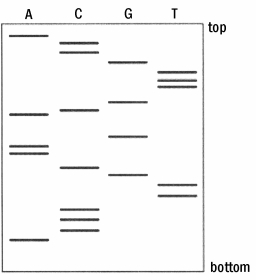 A total of 21 nucleotides has been sequenced. What is the sequence of these nucleotides?
 (Multiple Choice)
4.8/5 (61)
(61) A variety of E. coli clones have been isolated, the DNA has been extracted, digested with restriction enzymes, denatured, separated by gel electrophoresis, and transferred to nylon membrane by the Southern blot procedure. A radioactive probe is used that hybridizes with a gene of interest. The DNA corresponding to a single clone yields a single DNA band after probing the blot. Based on this information only,
(Multiple Choice)
4.9/5 (80)
(80) Which of the following is the correct order of the levels of DNA packaging in eukaryotic chromosomes?
(Multiple Choice)
5.0/5 (82)
(82) In 1928, Frederick Griffith's experiments with Streptococcus pneumoniae suggested that
(Multiple Choice)
4.9/5 (76)
(76) The specific field of study that examines the gene products of a genome is known as
(Multiple Choice)
4.8/5 (74)
(74) Eukaryotic- like (possessing a defined nucleus)cells were obtained from a Martian soil sample. The nucleus was carefully isolated and the chromatin obtained. The fibers had a "beads on a string" appearance, suggesting some type of "histones." Following digestion with micrococcal nuclease, protein removal, and gel electrophoresis, DNA fragments were obtained that are multiples of 280 base pairs in length. Longer incubation with micrococcal nuclease prior to protein removal results in fragments 200 base pairs in length. The amount of DNA that is wrapped around the "core histones" is therefore
(Multiple Choice)
4.9/5 (72)
(72) In the Sanger method of DNA sequencing, incorporation of the nucleotides stops because
(Multiple Choice)
4.8/5 (81)
(81) DNA isolated from Aspergillis has an adenine content of 25%. Based upon this information, what is the %G + C within the Aspergillis DNA?
(Multiple Choice)
4.8/5 (71)
(71) Which of the following are components of Chargaff's rules of bases?
(Multiple Choice)
4.9/5 (74)
(74) Avery, MacLeod, and McCarty (1944)demonstrated that DNA was the molecule of heredity by treating heat killed Streptococcus pneumoniae S (smooth)strain with DNase, thereby preventing transfer of the "transforming substance" from the killed S strain to the live R (rough)strain when the two were mixed together and injected into mice. Another way that one could demonstrate transformation in bacteria would be to extract DNA from
(Multiple Choice)
4.9/5 (79)
(79) In experiments designed as those of Hershey and Chase (1952), 35S was added to virus replicating within its bacterial host. The new virions were carefully isolated and used to infect fresh bacterial cells in the absence of any radioisotopes. Where would you expect to find the 35S radioisotope?
(Multiple Choice)
4.9/5 (87)
(87) demonstrated that there were equivalent amounts of adenine and thymine, and equivalent amounts of guanine and cytosine.
(Short Answer)
4.7/5 (88)
(88) 
Filters
- Essay(0)
- Multiple Choice(0)
- Short Answer(0)
- True False(0)
- Matching(0)