



 Chat with AI
Exam 9: Accounting Changes

Exam 1: Current Liabilities and Contingencies81 Questions
Exam 2: Non-Current Financial Liabilities97 Questions
Exam 3: Equities78 Questions
Exam 4: Complex Financial Instruments100 Questions
Exam 5: Earnings Per Share91 Questions
Exam 6: Pensions and Other Employee Future Benefits69 Questions
Exam 7: Accounting for Leases43 Questions
Exam 8: Accounting for Income Taxes78 Questions
Exam 9: Accounting Changes39 Questions
Exam 10: Statement of Cash Flows75 Questions
Select questions type


For a construction contract where the company uses the percentage of completion method and there is a change in the estimated total cost of the contract from 12 million to 13 million, the accountant should do the following:
(Multiple Choice)
4.7/5  (67)
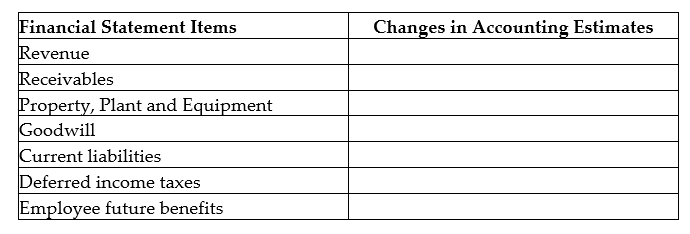
(67) For the following financial statement accounts, provide a description of a change in accounting estimates.
(Essay)
4.8/5 (85)
(85) What is the essential characteristic that distinguishes a change in accounting policy from either an error correction or a change in estimate?
(Essay)
4.8/5 (84)
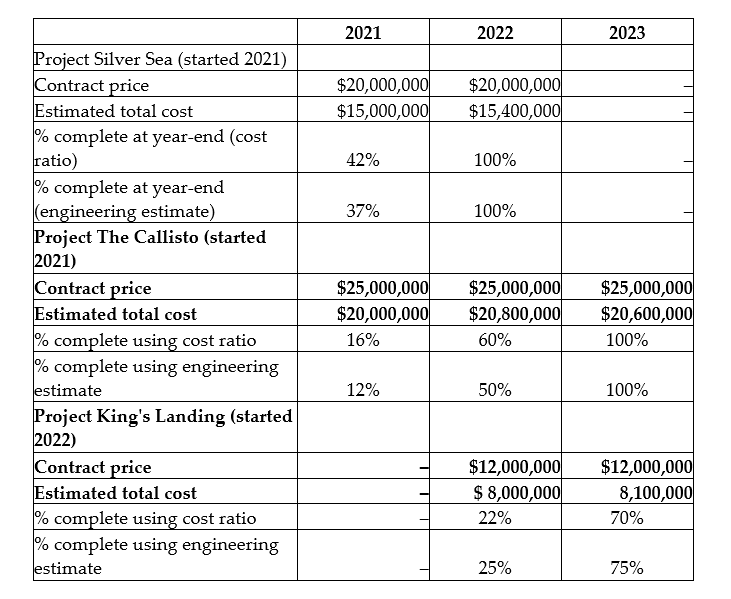
(84) Sawatsky & Company Ltd is involved in the construction of top class luxury condos in Vancouver, Canada. Until the end of 2022, the company used the cost ratio method to estimate the percentage complete. After that point, the company switched to using estimates from architectural engineers to estimate the degree of completion. To prepare the financial report for the 2023 fiscal year, you have gathered the following data on projects that were in progress at the end of fiscal years 2021, 2022, and 2023:
 Required:
a. Compute the amount of revenue and cost of sales that was recognized in 2021 and 2022 using the old accounting policy.
b. Compute the amount of revenue and cost of sales that should be recognized in each year using the new accounting policy.
c. Record the adjusting journal entries to adjust revenue to reflect the change in accounting policy from using the cost ratio to using engineering estimates. The general ledger accounts for 2023 have not yet been closed. Ignore income tax effects.
Required:
a. Compute the amount of revenue and cost of sales that was recognized in 2021 and 2022 using the old accounting policy.
b. Compute the amount of revenue and cost of sales that should be recognized in each year using the new accounting policy.
c. Record the adjusting journal entries to adjust revenue to reflect the change in accounting policy from using the cost ratio to using engineering estimates. The general ledger accounts for 2023 have not yet been closed. Ignore income tax effects. (Essay)
4.7/5 (72)
(72) Which statement is correct about a correction of an error from prior periods?
(Multiple Choice)
4.8/5 (81)
(81) A company changes the depreciation for a piece of equipment from 20% declining- balance to units-of-production. Describe a plausible circumstance that would support this change as one of the following: (i)an error, (ii)a change in estimate, or (iii)a change in accounting policy.
(Essay)
4.8/5 (82)
(82) For a company using the straight-line method of depreciation that changes the estimated useful life from 20 years to 15 years remaining as at the beginning of the year, the accountant should do the following:
(Multiple Choice)
4.9/5 (78)
(78) A retailer increases bad debts expense from 2.5% to 3% of credit sales. Given this information, which of the following statements is correct?
(Multiple Choice)
4.7/5 (81)
(81) How many balance sheets are required by IAS 1 when there is a change in accounting policy and why?
(Essay)
4.9/5 (72)
(72) What is the essential characteristic that distinguishes an error correction from a change in estimate?
(Essay)
4.9/5 (81)
(81) For a company using the straight-line method of depreciation that changes the estimated useful life from 20 years to 15 years as at the beginning of the year, the accountant should do (or not do)the following:
(Multiple Choice)
4.8/5 (84)
(84) For the following types of accounting changes, identify the relevant criteria for each accounting change by selecting "yes," "no," or "n/a" (not applicable). 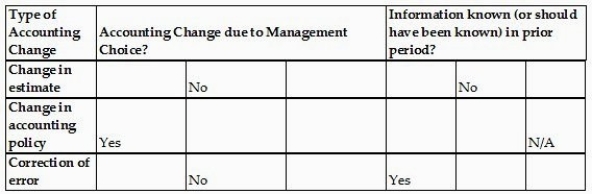
(Essay)
4.7/5 (66)
(66) An analysis of a company's inventory indicates that inventory at the end of 2020 was understated by $30,000 due to an inventory count error. Inventory at the end of 2021 was correctly stated. The company uses the periodic system of inventory and its fiscal year-end is December 31. Given this information, which of the following statements is correct?
(Multiple Choice)
4.9/5 (78)
(78) Why is the prospective treatment conceptually appropriate for changes in estimates?
(Essay)
4.8/5 (87)
(87) Why is the retrospective approach conceptually appropriate for changes in accounting policy?
(Essay)
4.9/5 (82)
(82) What types of accounting changes are treated retrospectively and why?
(Essay)
4.9/5 (63)
(63) 
Filters
- Essay(0)
- Multiple Choice(0)
- Short Answer(0)
- True False(0)
- Matching(0)