



 Chat with AI
Exam 17: Partnership

Exam 1: Accounting Concepts and Procedures125 Questions
Exam 2: Debits and Credits: Analyzing and Recording Business Transactions125 Questions
Exam 3: Beginning the Accounting Cycle125 Questions
Exam 4: The Accounting Cycle Continued126 Questions
Exam 5: The Accounting Cycle Completed126 Questions
Exam 6: Banking Procedure and Control of Cash125 Questions
Exam 7: Calculating Pay and Payroll Taxes: the Beginning of the Payroll Process138 Questions
Exam 8: Paying, Recording, and Reporting Payroll and Payroll Taxes:113 Questions
Exam 9: Sales and Cash Receipts125 Questions
Exam 10: Purchases and Cash Payments110 Questions
Exam 11: Preparing a Worksheet for a Merchandise Company123 Questions
Exam 12: Completion of the Accounting Cycle for a Merchandise Company125 Questions
Exam 13: Accounting for Bad Debts120 Questions
Exam 14: Notes Receivable and Notes Payable132 Questions
Exam 15: Accounting for Merchandise Inventory125 Questions
Exam 16: Accounting for Property, Plant, Equipment, and Intangible Assets147 Questions
Exam 17: Partnership130 Questions
Exam 18: Corporations: Organizations and Stock124 Questions
Exam 19: Corporations: Stock Values, Dividends, Treasury Stocks,122 Questions
Exam 20: Corporations and Bonds Payable138 Questions
Exam 21: Statement of Cash Flows125 Questions
Exam 22: Analyzing Financial Statements124 Questions
Exam 23: The Voucher System133 Questions
Exam 24: Departmental Accounting140 Questions
Exam 25: Manufacturing Accounting126 Questions
Select questions type


Partner B invested inventory using the retail selling price for valuation. Some of the inventory is unsold at period end. This error would cause:
(Multiple Choice)
4.8/5  (76)
(76) The income/loss agreement was ignored when closing the income summary and all income was distributed evenly. This error would cause:
(Multiple Choice)
4.8/5 (81)
(81) The two types of allowances that may be considered before the division of profits and losses are:
(Multiple Choice)
4.9/5 (72)
(72) After several years of business, Abel, Barney, and Cole are liquidating. The following are post-closing account balances. 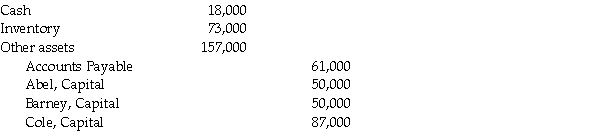 Non-cash assets are sold for $275,000. Profits and losses are shared equally.
Record the payment of the liabilities.
Non-cash assets are sold for $275,000. Profits and losses are shared equally.
Record the payment of the liabilities. (Essay)
4.9/5 (72)
(72) A partner that is personally liable for all of the debts of the partnership is known as:
(Multiple Choice)
4.8/5 (88)
(88) If the retiring partner's interest is sold to one of the remaining partners, the retiring partner's equity is split equally between the remaining partners.
(True/False)
4.9/5 (75)
(75) Kim and John formed a partnership in 2015. John invested $140,000 and Kim invested $90,000. The partnership had $100,000 in income during 2017. There is no agreement as to how income is divided. Kim and John's share is:
(Multiple Choice)
4.8/5 (84)
(84) A statement of partner's equity is the same as a statement of owner's equity except:
(Multiple Choice)
4.9/5 (95)
(95) Partners Jessica and Jill receive salary allowances of $8,000 and $17,000, respectively. They share income and losses in a 3:1 ratio for Jessica and Jill, respectively. If the partnership suffers a $23,000 loss, by how much would Jessica's capital decrease?
(Multiple Choice)
4.8/5 (85)
(85) If Sam invests $11,000 cash in a partnership, Cash is debited and Sam, Capital is credited, $11,000.
(True/False)
4.8/5 (74)
(74) Prepare the journal entry to record the partners' investment in the company.
Palmer invests $3,000 cash and equipment on his books at $6,000 with accumulated depreciation of $500. The fair market value of the equipment is $6,000. Evans is investing $6,000 cash and $1,000 accounts payable.
(Essay)
4.9/5 (79)
(79) What is the closing entry to allocate net income of $48,000 to Sara, Ellen, and Mary? Respective capital balances are $50,000, $81,000, and $24,000. No agreement was made for division of income. (Round any intermediate calculations to two decimal places, and your final answers to the nearest dollar.)
(Multiple Choice)
4.7/5 (78)
(78) The partnership of Smith and Jones, who have average capital balances of $17,000 and $23,000, respectively, earned $90,000 net income. Under each of the following independent situations, calculate the distribution of the $90,000.
a) No agreement was established.
b) Share based on their average capital balances.
(Short Answer)
4.8/5 (73)
(73) A partnership is defined by the Generally Accepted Accounting Principles.
(True/False)
4.8/5 (83)
(83) Partners Brian, Josh, and Chad have average capital balances of $11,000, $10,000, and $90,000, respectively. Net income for the year is $20,000. Salary allowances are $19,000 for Brian and $8,000 for Josh. Chad gets 10% interest on his capital balance with the remainder being divided at a 1:1:2 ratio for Brian, Josh, and Chad, respectively. What is Brian's capital balance after distributing the net income? (Assume no change in capital balances during the year.)
(Multiple Choice)
4.9/5 (70)
(70) An interest allowance is based on a partner's individual investment of capital.
(True/False)
4.8/5 (96)
(96) Indicate the account(s) to be debited and credited to record the following transactions.
-The business provided services on credit.
Debit ________ Credit ________
(Multiple Choice)
4.9/5 (80)
(80) Jim wants to invest cash so that he will have a one-third interest in Tom and Steve's company. The capital balances are $12,000 Tom, $23,000 Steve. The admission of Jim would be to:
(Multiple Choice)
4.9/5 (83)
(83) Applying the ratio based on investment method, compute Tom and Troy's share of net income if Tom invested $300,000 and Troy invested $500,000. Net income was $130,000. (Round any intermediate calculations to two decimal places, and your final answers to the nearest dollar.)
(Multiple Choice)
4.8/5 (73)
(73) 
Filters
- Essay(0)
- Multiple Choice(0)
- Short Answer(0)
- True False(0)
- Matching(0)