



 Chat with AI
Exam 12: Completion of the Accounting Cycle for a Merchandise Company

Exam 1: Accounting Concepts and Procedures125 Questions
Exam 2: Debits and Credits: Analyzing and Recording Business Transactions125 Questions
Exam 3: Beginning the Accounting Cycle125 Questions
Exam 4: The Accounting Cycle Continued126 Questions
Exam 5: The Accounting Cycle Completed126 Questions
Exam 6: Banking Procedure and Control of Cash125 Questions
Exam 7: Calculating Pay and Payroll Taxes: the Beginning of the Payroll Process138 Questions
Exam 8: Paying, Recording, and Reporting Payroll and Payroll Taxes:113 Questions
Exam 9: Sales and Cash Receipts125 Questions
Exam 10: Purchases and Cash Payments110 Questions
Exam 11: Preparing a Worksheet for a Merchandise Company123 Questions
Exam 12: Completion of the Accounting Cycle for a Merchandise Company125 Questions
Exam 13: Accounting for Bad Debts120 Questions
Exam 14: Notes Receivable and Notes Payable132 Questions
Exam 15: Accounting for Merchandise Inventory125 Questions
Exam 16: Accounting for Property, Plant, Equipment, and Intangible Assets147 Questions
Exam 17: Partnership130 Questions
Exam 18: Corporations: Organizations and Stock124 Questions
Exam 19: Corporations: Stock Values, Dividends, Treasury Stocks,122 Questions
Exam 20: Corporations and Bonds Payable138 Questions
Exam 21: Statement of Cash Flows125 Questions
Exam 22: Analyzing Financial Statements124 Questions
Exam 23: The Voucher System133 Questions
Exam 24: Departmental Accounting140 Questions
Exam 25: Manufacturing Accounting126 Questions
Select questions type


Identify the category(s) of each of the accounts below.
Current Asset
Plant and Equipment
Current Liabilities
Long-Term Liabilities 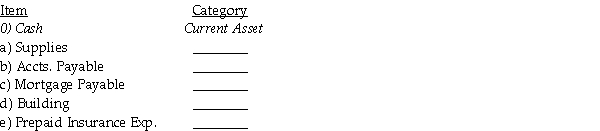

Free
(Essay)
4.9/5  (77)
(77) Correct Answer: Verified
If Net Sales is $10,500, Cost of Goods Sold is $5,400, Gross Profit is $5,100 and Operating Expenses are $1,800, what is the Net Income from Operations?
Free
(Multiple Choice)
4.7/5 (80)
(80) Correct Answer:Verified
VerifiedB
Determine the ending Capital balance of a business having:
Beginning Capital of $75,000
No investments or withdrawals
Beginning inventory of $10,000
Net Purchases of $100,000
Ending inventory of $12,000
Operating expenses of $70,000
Net sales $107,000
$ ________
(Short Answer)
4.9/5 (73)
(73) For each of the following, identify in Column 1 the category to which the account belongs, in Column 2 the normal balance for the account, in Column 3 the financial statement on which the account balance is reported, and in Column 4 the account's nature (permanent/temporary).
-
(Essay)
4.8/5 (76)
(76) The ending merchandise inventory was understated. This error would cause:
(Multiple Choice)
5.0/5 (82)
(82) The Statement of Owner's Equity ending capital is equal to the capital on the worksheet.
(True/False)
4.7/5 (74)
(74) Discuss the purpose of a classified balance sheet. Include a description of the major balance sheet classifications including: current assets, plant and equipment, current liabilities, and long-term liabilities.
(Essay)
4.8/5 (91)
(91) How is Income Summary closed if the company had a net income?
(Multiple Choice)
4.8/5 (75)
(75) For each of the following, identify in Column 1 the category to which the account belongs, in Column 2 the normal balance for the account, in Column 3 the financial statement on which the account balance is reported, and in Column 4 the account's nature (permanent/temporary).
-
(Essay)
4.8/5 (75)
(75) The entry to close the expense account(s) was entered in reverse-Income Summary was credited and the expense account(s) was/were debited. This error would cause:
(Multiple Choice)
4.7/5 (84)
(84) Barnes' Shoes allows a customer a discount from the original price for a defective product; Barnes issues the customer a(n):
(Multiple Choice)
4.8/5 (75)
(75) The Statement of Owner's Equity is the same for a service business as for a merchandise business.
(True/False)
4.8/5 (82)
(82) Gross profit equals Net Sales minus Inventory Available for Sale.
(True/False)
4.9/5 (78)
(78) The entry to adjust salaries was done twice. This error would cause:
(Multiple Choice)
5.0/5 (86)
(86) For each of the following, identify in Column 1 the category to which the account belongs, in Column 2 the normal balance for the account, in Column 3 the financial statement on which the account balance is reported, and in Column 4 the account's nature (permanent/temporary).
-
(Essay)
4.8/5 (73)
(73) 
Filters
- Essay(0)
- Multiple Choice(0)
- Short Answer(0)
- True False(0)
- Matching(0)