



 Chat with AI
Exam 18: Corporations: Organizations and Stock

Exam 1: Accounting Concepts and Procedures125 Questions
Exam 2: Debits and Credits: Analyzing and Recording Business Transactions125 Questions
Exam 3: Beginning the Accounting Cycle125 Questions
Exam 4: The Accounting Cycle Continued126 Questions
Exam 5: The Accounting Cycle Completed126 Questions
Exam 6: Banking Procedure and Control of Cash125 Questions
Exam 7: Calculating Pay and Payroll Taxes: the Beginning of the Payroll Process138 Questions
Exam 8: Paying, Recording, and Reporting Payroll and Payroll Taxes:113 Questions
Exam 9: Sales and Cash Receipts125 Questions
Exam 10: Purchases and Cash Payments110 Questions
Exam 11: Preparing a Worksheet for a Merchandise Company123 Questions
Exam 12: Completion of the Accounting Cycle for a Merchandise Company125 Questions
Exam 13: Accounting for Bad Debts120 Questions
Exam 14: Notes Receivable and Notes Payable132 Questions
Exam 15: Accounting for Merchandise Inventory125 Questions
Exam 16: Accounting for Property, Plant, Equipment, and Intangible Assets147 Questions
Exam 17: Partnership130 Questions
Exam 18: Corporations: Organizations and Stock124 Questions
Exam 19: Corporations: Stock Values, Dividends, Treasury Stocks,122 Questions
Exam 20: Corporations and Bonds Payable138 Questions
Exam 21: Statement of Cash Flows125 Questions
Exam 22: Analyzing Financial Statements124 Questions
Exam 23: The Voucher System133 Questions
Exam 24: Departmental Accounting140 Questions
Exam 25: Manufacturing Accounting126 Questions
Select questions type


Jane Kathryn has 30,000 shares outstanding of $10 par value, 10% preferred stock and 100,000 shares outstanding $5 par value common stock. In the first 3 years of operations, the company paid dividends in Year 1, $0; Year 2, $40,000; Year 3, $100,000. Calculate the dividend paid to preferred and common stockholders under the following independent situations:
a) Preferred is non-cumulative and nonparticipating.  b) Preferred is cumulative and nonparticipating.
 c) Preferred is cumulative and participating.

b) Preferred is cumulative and nonparticipating.
c) Preferred is cumulative and participating. (Essay)
4.8/5  (73)
(73) Elegant Corporation received subscriptions for 100 shares of its $105 par value common stock for $124 per share. The entry to record the receipt of the subscriptions would include a:
(Multiple Choice)
4.8/5 (84)
(84) Journalize the following stock transactions for Rick Corporation.
July 22 Issued 10,000 shares of $6 par common stock for $45,000 cash.
28 Issued 6,000 shares of $4 par common stock for $35,000 cash.
31 Issued 4,000 shares of $10 par, 7% preferred stock for $50,000 cash.
(Essay)
4.7/5 (77)
(77) Korgen Company sells common stock at par value, and records a:
(Multiple Choice)
4.8/5 (96)
(96) The account that is a current asset on balance sheet representing the amount due on stock subscriptions is:
(Multiple Choice)
5.0/5 (82)
(82) Which of the following is NOT one of the procedural steps for calculating dividends with cumulative, fully participating preferred stock?
(Multiple Choice)
4.9/5 (75)
(75) A type of preferred stock that entitles its holders an opportunity to share in additional dividends with common stockholders is known as:
(Multiple Choice)
4.9/5 (87)
(87) The Zonga Corporation Stockholders' Equity section includes the following: 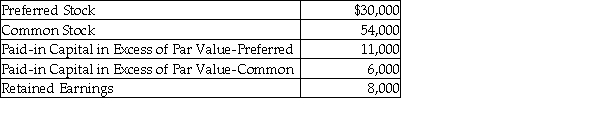 Total paid-in capital is:
 (Multiple Choice)
5.0/5 (82)
(82) If stock shares are sold at more than their par value, the excess money is called:
(Multiple Choice)
4.7/5 (70)
(70) Birch Company issued 200 shares of common stock with a par value of $10 per share in exchange for equipment with a fair market value of $4,000. Record the journal entry for the stock issuance.
(Essay)
4.9/5 (70)
(70) Journalize the transactions for the stock subscription plan for Oro Company. On March 1, Oro received subscriptions for 120 shares of $15 par value common stock at $20 per share. The buyer will pay two equal installments on April 1 and July 1. Assume all payments are made as scheduled and the company issues the stock on August 1.
(Essay)
4.7/5 (94)
(94) The journal entry to record the final installment from a common stock subscription is:
(Multiple Choice)
4.9/5 (83)
(83) Journalize the transactions for the stock subscription plan for Poplar Company. On April 1, Poplar received subscriptions for 250 shares of $20 par value common stock at $26 per share. The buyer will pay two equal installments on May 1 and July 1. Assume all payments are made as scheduled and the company issues the stock after the July 1 collection.
(Essay)
4.8/5 (91)
(91) Identify the account types used in recording transactions related to a stock subscription plan: Subscriptions Receivable-Common Stock; Common Stock Subscribed, Paid-In Capital in Excess of Par Value-Common, Common Stock, Cash. Also list the financial statement where the accounts are found.
(Essay)
4.9/5 (85)
(85) No-par value is placed on stock certificate when the stock has no-par value and no stated value.
(True/False)
4.7/5 (73)
(73) When a corporation has only one class of capital stock, it will be common stock.
(True/False)
4.9/5 (69)
(69) The entry to record selling 2,000 shares of no-par common stock with no stated value at $180 per share would be to:
(Multiple Choice)
4.8/5 (81)
(81) 
Filters
- Essay(0)
- Multiple Choice(0)
- Short Answer(0)
- True False(0)
- Matching(0)