



 Chat with AI
Exam 16: Investments

Exam 1: Accounting in Action240 Questions
Exam 2: The Recording Process207 Questions
Exam 3: Adjusting the Accounts261 Questions
Exam 4: Completing the Accounting Cycle239 Questions
Exam 5: Accounting for Merchandising Operations246 Questions
Exam 6: Inventories232 Questions
Exam 7: Accounting Information Systems150 Questions
Exam 8: Fraud, Internal Control, and Cash230 Questions
Exam 9: Accounting for Receivables239 Questions
Exam 10: Plant Assets, Natural Resources, and Intangible Assets305 Questions
Exam 11: Current Liabilities and Payroll Accounting218 Questions
Exam 12: Accounting for Partnerships210 Questions
Exam 13: Corporations: Organization and Capital Stock Transactions204 Questions
Exam 14: Corporations: Dividends, Retained Earnings, and Income Reporting191 Questions
Exam 15: Long-Term Liabilities209 Questions
Exam 16: Investments188 Questions
Exam 17: Statement of Cash Flows215 Questions
Exam 18: Financial Statement Analysis224 Questions
Exam 19: Managerial Accounting206 Questions
Exam 20: Job Order Costing204 Questions
Exam 21: Process Costing195 Questions
Exam 22: Cost-Volume-Profit215 Questions
Exam 23: Budgetary Planning214 Questions
Exam 24: Budgetary Control and Responsibility Accounting213 Questions
Exam 25: Standard Costs and Balanced Scorecard244 Questions
Exam 26: Incremental Analysis and Capital Budgeting217 Questions
Exam 27: Time Value of Money72 Questions
Select questions type


Information pertaining to long-term stock investments in 2017 by Bell Corporation follows:
Acquired 18% of the 250000 shares of common stock of Kansas Company at a total cost of $8 per share on January 1 2017. On July 1 Kansas Company declared and paid a cash dividend of $2 per share. On December 31 Kansas's reported net income was $654000 for the year.
Obtained significant influence over Toto Company by buying 30% of Toto's 100000 outstanding shares of common stock at a total cost of $22 per share on January 1 2017. On June 15 Toto Company declared and paid a cash dividend of $1.50 per share. On December 31 Toto's reported net income was $280000.
Instructions
Prepare all necessary journal entries for 2017 for Bell Corporation.
(Essay)
4.9/5  (74)
(74) A decline in the fair value of a trading security is recorded by debiting an unrealized loss account and crediting the Fair Value Adjustment account.
(True/False)
4.8/5 (88)
(88) Dividends received on stock investments of less than 20% should be credited to the Stock Investments account.
(True/False)
4.9/5 (70)
(70) Securities bought and held primarily for sale in the near term to generate income on short-term price differences are
(Multiple Choice)
4.9/5 (96)
(96) Match the items below by entering the appropriate code letter in the space provided. 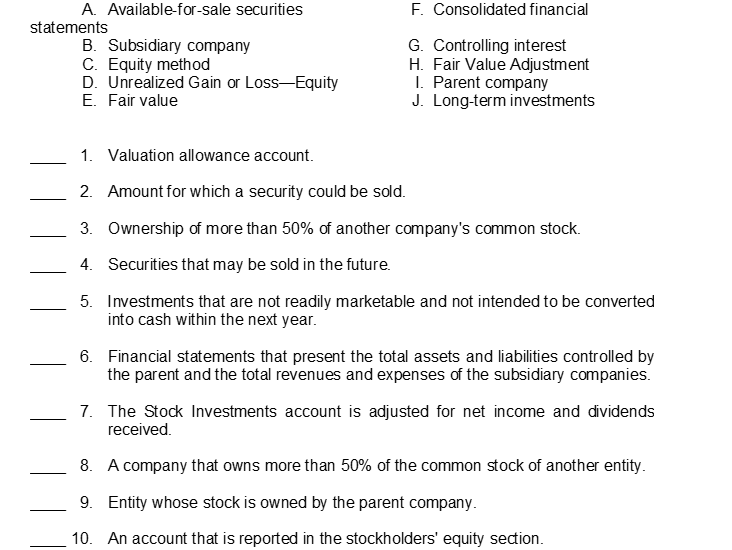
(Essay)
4.9/5 (80)
(80) If the cost method is used to account for a long-term investment in common stock dividends received should be
(Multiple Choice)
4.9/5 (83)
(83) If the fair value of an available-for-sale security exceeds its cost the security should be written up to fair value and a realized gain should be recognized.
(True/False)
4.8/5 (71)
(71) What purposes are served by reporting Unrealized Gains (Losses)-Equity in the stockholders' equity section?
(Essay)
4.9/5 (74)
(74) Available-for-sale securities are securities bought and held primarily for sale in the near term to generate income on short-term price differences.
(True/False)
4.9/5 (84)
(84) On January 2 Penny Company purchased 45 10% $1000 Mikel Company bonds for $45000 cash. Interest is payable annually on January 1. Journalize the entries to record the purchase of the bonds and the accrual of the annual interest on December 31.
(Essay)
4.9/5 (66)
(66) The balance in the Unrealized Gain or Loss-Equity account will
(Multiple Choice)
4.9/5 (76)
(76) Under the cost method the investment is recorded at cost and revenue is recognized only when cash dividends are received.
(True/False)
4.9/5 (72)
(72) Ban Co. purchased 50 5% Waylan Company bonds on January 1 2016 for $50500 cash. Interest is payable annually on January 1. The entry to record the January 1 2017 annual interest payment would include a
(Multiple Choice)
4.8/5 (83)
(83) Which of the following is not a true statement about the accounting for debt investments?
(Multiple Choice)
4.9/5 (80)
(80) "Intent to convert" does not include an investment used as a resource that will be used whenever the need for cash arises.
(True/False)
4.8/5 (84)
(84) If an investor owns between 20% and 50% of an investee's common stock it is presumed that the investor has significant influence on the investee.
(True/False)
4.9/5 (79)
(79) 
Filters
- Essay(0)
- Multiple Choice(0)
- Short Answer(0)
- True False(0)
- Matching(0)