



 Chat with AI
Exam 25: Standard Costs and Balanced Scorecard

Exam 1: Accounting in Action240 Questions
Exam 2: The Recording Process207 Questions
Exam 3: Adjusting the Accounts261 Questions
Exam 4: Completing the Accounting Cycle239 Questions
Exam 5: Accounting for Merchandising Operations246 Questions
Exam 6: Inventories232 Questions
Exam 7: Accounting Information Systems150 Questions
Exam 8: Fraud, Internal Control, and Cash230 Questions
Exam 9: Accounting for Receivables239 Questions
Exam 10: Plant Assets, Natural Resources, and Intangible Assets305 Questions
Exam 11: Current Liabilities and Payroll Accounting218 Questions
Exam 12: Accounting for Partnerships210 Questions
Exam 13: Corporations: Organization and Capital Stock Transactions204 Questions
Exam 14: Corporations: Dividends, Retained Earnings, and Income Reporting191 Questions
Exam 15: Long-Term Liabilities209 Questions
Exam 16: Investments188 Questions
Exam 17: Statement of Cash Flows215 Questions
Exam 18: Financial Statement Analysis224 Questions
Exam 19: Managerial Accounting206 Questions
Exam 20: Job Order Costing204 Questions
Exam 21: Process Costing195 Questions
Exam 22: Cost-Volume-Profit215 Questions
Exam 23: Budgetary Planning214 Questions
Exam 24: Budgetary Control and Responsibility Accounting213 Questions
Exam 25: Standard Costs and Balanced Scorecard244 Questions
Exam 26: Incremental Analysis and Capital Budgeting217 Questions
Exam 27: Time Value of Money72 Questions
Select questions type


The overhead variances measure whether overhead costs Are Effectively Managed Were Used Effectively
A) Controllable Controllable and Volume
B) Controllable Volume
C) Controllable and Volume Controllable
D) Volume Controllable
(Short Answer)
4.9/5  (80)
(80) The overhead controllable variance is calculated as the difference between actual overhead costs incurred and the budgeted
(Multiple Choice)
4.8/5 (87)
(87) Engines Done Right Co. is trying to establish the standard labor cost of a typical engine tune-up. The following data have been collected from time and motion studies conducted over the past month. Actual time spent on the tune-up 1.0 hour Hourly wage rate \ 16 Payroll taxes 10\% of wage rate Setup and downtime 10\% of actual labor time Cleanup and rest periods 20\% of actual labor time Fringe benefits 25\% of wage rate Instructions
(a) Determine the standard direct labor hours per tune-up
(b) Determine the standard direct labor hourly rate.
(c) Determine the standard direct labor cost per tune-up.
(d) If a tune-up took 1.5 hours at the standard hourly rate what was the direct labor quantity variance?
(Essay)
4.9/5 (94)
(94) If the labor quantity variance is unfavorable and the cause is inefficient use of direct labor the responsibility rests with the
(Multiple Choice)
4.8/5 (86)
(86) The standard number of hours that should have been worked for the output attained is 10000 direct labor hours and the actual number of direct labor hours worked was 10500. If the direct labor price variance was $10500 unfavorable and the standard rate of pay was $12 per direct labor hour what was the actual rate of pay for direct labor?
(Multiple Choice)
4.9/5 (73)
(73) Which department is usually responsible for a labor price variance attributable to misallocation of workers?
(Multiple Choice)
4.9/5 (83)
(83) Atkins Inc. produces a product requiring 8 pounds of material at $1.50 per pound. Atkins produced 10000 units of this product during 2016 resulting in a $30000 unfavorable materials quantity variance. How many pounds of direct material did Atkins use during 2016?
(Multiple Choice)
4.7/5 (74)
(74) Star Industries computes variances as a basis for evaluating the performance of managers responsible for controlling costs. For several months the labor quantity variance has been unfavorable. Briefly explain what could be causing the unfavorable labor quantity variance and indicate what type of corrective action if any might be taken.
(Essay)
4.9/5 (78)
(78) Dillon has a standard of 2 hours of labor per unit at $12 per hour. In producing 2000 units Dillon used 3850 hours of labor at a total cost of $46970. Dillon's labor quantity variance is
(Multiple Choice)
5.0/5 (67)
(67) Which of the following is not considered an advantage of using standard costs?
(Multiple Choice)
4.9/5 (71)
(71) Riggins Inc. manufactures one product called tybos. The company uses a standard cost system and sells each tybo for $8. At the start of monthly production Riggins estimated 9500 tybos would be produced in March. Riggins has established the following material and labor standards to produce one tybo: Standard Quantity Standard Price Direct materials 2.5 pounds \ 3 per pound Direct labor 0.6 hours \ 10 per hour During March 2016 the following activity was recorded by the company relating to the production of tybos:
1. The company produced 9000 units during the month.
2. A total of 24000 pounds of materials were purchased at a cost of $66000.
3. A total of 24000 pounds of materials were used in production.
4. 5000 hours of labor were incurred during the month at a total wage cost of $55000.
Instructions
Calculate the following variances for March for Riggins Inc.
(a) Materials price variance
(b) Materials quantity variance
(c) Labor price variance
(d) Labor quantity variance
(Essay)
4.8/5 (78)
(78) The per-unit standards for direct labor are 2 direct labor hours at $15 per hour. If in producing 1800 units the actual direct labor cost was $48000 for 3000 direct labor hours worked the total direct labor variance is
(Multiple Choice)
4.9/5 (70)
(70) If a company issues raw materials to production at a cost of $18900 when the standard cost is $18300 it will
(Multiple Choice)
4.8/5 (89)
(89) Caroline Inc. planned to produce 20000 units of product and work 100000 direct labor hours in 2016. Manufacturing overhead at the 100000 direct labor hours level of activity was estimated to be: Variable manufacturing overhead \ 700,000 Fixed manufacturing overhead 300,000 Total manufacturing overhead \ 1,000,000 At the end of 2016 19000 units of product were actually produced and 98000 actual direct labor hours were worked. Total actual overhead costs for 2016 were $935000.
Instructions
(a) Compute the total overhead variance.
(b) Compute the overhead controllable variance.
(c) Compute the overhead volume variance.
(Essay)
4.9/5 (86)
(86) Hector Company has developed the following standard costs for its product for 2016: 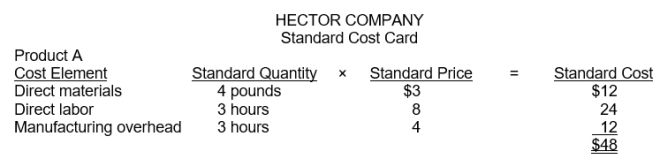 The company expected to produce 30000 units of Product A in 2017 and work 90000 direct labor hours.
Actual results for 2017 are as follows:
31000 units of Product A were produced.
Actual direct labor costs were $746200 for 91000 direct labor hours worked.
Actual direct materials purchased and used during the year cost $346500 for 126000 pounds.
Actual variable overhead incurred was $155000 and actual fixed overhead incurred was $205000.
Instructions
Compute the following variances showing all computations to support your answers. Indicate whether the variances are favorable or unfavorable.
(a) Materials quantity variance.
(b) Total direct labor variance.
(c) Direct labor quantity variance.
(d) Direct materials price variance.
(e) Total overhead variance.
The company expected to produce 30000 units of Product A in 2017 and work 90000 direct labor hours.
Actual results for 2017 are as follows:
31000 units of Product A were produced.
Actual direct labor costs were $746200 for 91000 direct labor hours worked.
Actual direct materials purchased and used during the year cost $346500 for 126000 pounds.
Actual variable overhead incurred was $155000 and actual fixed overhead incurred was $205000.
Instructions
Compute the following variances showing all computations to support your answers. Indicate whether the variances are favorable or unfavorable.
(a) Materials quantity variance.
(b) Total direct labor variance.
(c) Direct labor quantity variance.
(d) Direct materials price variance.
(e) Total overhead variance. (Essay)
5.0/5 (80)
(80) Clark Company manufactures a product with a standard direct labor cost of two hours at $18.00 per hour. During July 2000 units were produced using 4200 hours at $18.30 per hour. The labor quantity variance was
(Multiple Choice)
4.8/5 (80)
(80) There could be instances where the production department is responsible for a direct materials price variance.
(True/False)
4.9/5 (76)
(76) The starting point for determining the causes of an unfavorable materials price variance is the purchasing department.
(True/False)
4.8/5 (72)
(72) 
Filters
- Essay(0)
- Multiple Choice(0)
- Short Answer(0)
- True False(0)
- Matching(0)