



 Chat with AI
Exam 10: Static and Flexible Budgets

Exam 1: The Role of Accounting Information in Ethical Management Decision Making100 Questions
Exam 2: Cost Concepts, Behaviour, and Estimation129 Questions
Exam 3: Cost-Volume-Profit Analysis147 Questions
Exam 4: Relevant Information for Decision Making135 Questions
Exam 5: Job Costing133 Questions
Exam 6: Process Costing114 Questions
Exam 7: Activity-Based Costing and Management132 Questions
Exam 8: Measuring and Assigning Support Department Costs115 Questions
Exam 9: Joint Product and By-Product Costing121 Questions
Exam 10: Static and Flexible Budgets128 Questions
Exam 11: Standard Costs and Variance Analysis128 Questions
Exam 12: Strategic Investment Decisions37 Questions
Exam 13: Pricing Decisions109 Questions
Exam 14: Strategic Management of Costs111 Questions
Exam 15: Measuring and Assigning Costs for Income Statements88 Questions
Exam 16: Performance Evaluation and Compensation39 Questions
Select questions type


(Appendix 10A) Gold Company has the following balances at December 31, 20x4: Cash $6,000; accounts receivable $34,000 ($10,000 from November and $24,000 from December); merchandise inventory $40,000; and accounts payable $20,000 (for merchandise purchases only). Budgeted sales follow: January \ 50,000 February 90,000 March 60,000 April 100,000 Other data:
*Sales are 40% cash, 50% collected during the following month, and 10% collected during the second month after sale. A 3% cash discount is given on cash sales.
*Cost of goods sold is 40% of sales.
*Ending inventory must be 140% of the next month's cost of sales.
*Purchases are paid 70% in month of purchase and 30% in the following month.
*The selling and administrative cost function is: $6,000 + $0.2 × sales. This includes $1,000 for amortization.
*All costs are paid in the month incurred.
*Minimum cash balance requirement is $6,000.
Cash receipts for April will be:
(Multiple Choice)
4.7/5  (72)
(72) The manufacturing overhead budget:
I. Compares revenue to overhead
II. Forecasts overhead costs per unit for cost of goods sold calculations
III. Forecasts total overhead costs
(Multiple Choice)
4.8/5 (66)
(66) BNN Corporation expects to operate at a profit in its next fiscal year. Which of the following statements about its budgeted income statement is true?
(Multiple Choice)
5.0/5 (84)
(84) To prepare a budgeted income statement, managers draw data from the revenue budget, the cost of goods sold budget, and the cash budget.
(True/False)
4.8/5 (78)
(78) Horton Company produces and sells two products: round and square tables. In August 20x4, the budget projected the following for 20x5: 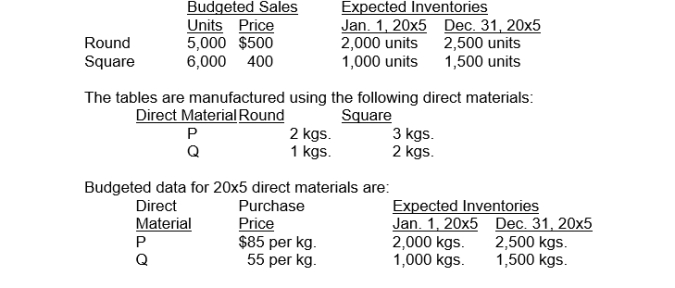 Budgeted data for 20x5 direct labour and overhead are:
Direct labour:
Round 4 hours per unit at $6 per hour
Square 6 hours per unit at $8 per hour
Overhead: $4 per direct labour hour
Total budgeted production of tables in 20x5 is:
Budgeted data for 20x5 direct labour and overhead are:
Direct labour:
Round 4 hours per unit at $6 per hour
Square 6 hours per unit at $8 per hour
Overhead: $4 per direct labour hour
Total budgeted production of tables in 20x5 is: (Multiple Choice)
4.9/5 (87)
(87) The direct manufacturing labour budget:
I. Is stated in direct labour hours and cost
II. Is only stated in direct labour cost
III. Includes hours and costs of supervisors
(Multiple Choice)
4.9/5 (86)
(86) The master budget includes two components: an operating budget and a time budget.
(True/False)
4.7/5 (83)
(83) TFS Corporation, a retail company selling hotel furniture, has just completed its master budget for the next fiscal year. Ending inventory is budgeted at 20% of cost of goods available for sale. Selected data from that process appear in the table below: Beginning inventory \ 10,000 Budgeted purchases 25,000 Expected revenue 150,000 Inflows of cash 120,000 Support departments costs 30,000 Total cash outflows 80,000 TFS' actual income for the next fiscal year will be:
(Multiple Choice)
4.9/5 (80)
(80) TNR Corporation is preparing its budgeted income statement for the month of August. Budgeted sales are $18,000. Cost of goods sold is twice the amount of operating costs, and operating costs plus cost of goods sold equals 40% of net income. Return on sales (net income / sales) is anticipated to be 50%. TNR does not have any nonoperating items on its income statement.
TNR's expected income tax rate is:
(Multiple Choice)
4.9/5 (71)
(71) When an organization implements activity-based budgeting, managers must identify activities for:
(Multiple Choice)
4.9/5 (70)
(70) The principles of activity-based costing can be applied to the budgeting process.
(True/False)
4.9/5 (80)
(80) When evaluating actual results at the end of an accounting period, the static budget provides an appropriate benchmark for actual operations.
(True/False)
4.9/5 (69)
(69) Kaizen budgeting is designed to improve quality and reduce cost over time.
(True/False)
4.7/5 (81)
(81) The Dilly Company marks up all merchandise at 25% of gross purchase price. All purchases are made on account with terms of 1/10, (1% discount if paid in 10 days) net/60 (full amount due within 60 days). Purchase discounts, which are recorded as miscellaneous income, are always taken. Normally, 60% of each month's purchases are paid for in the first month after purchase, whereas the other 40% are paid during the first 10 days of the first month after purchase. Inventories of merchandise at the end of each month are kept at 30% of the next month's forecasted cost of goods sold.
Terms for sales on account are 2/10 (2% discount if paid within 10 days), net/30 (full amount due in 30 days). Cash sales are not subject to discount. Fifty percent of each month's sales on account are collected during the month of sale, 45% are collected in the succeeding month, and the remainder is usually uncollectible. Seventy percent of the collections in the month of sale are subject to discount, and 10% of the collections in the succeeding month are subject to discount (2%).
Forecasted sales data and cost of sales for selected months are as follows: Sales on Account (Gross) Cash Sales Cost of Goods sold December \ 1,900,000 \ 400,000 \ 1,840,000 January 1,500,000 250,000 1,400,000 February 1,700,000 350,000 1,640,000 March 1,600,000 300,000 1,520,000
Forecasted ending inventory for the month of December is:
(Multiple Choice)
4.8/5 (67)
(67) Budget assumptions are gathered from:
I. Last year's budgets
II. Department heads with information about next year's plans
III. Future expectations
(Multiple Choice)
4.9/5 (89)
(89) All of the following are potential adjustments to flexible budgets except:
(Multiple Choice)
4.7/5 (71)
(71) Korn, Inc., projects sales for its first three months of operation as follows: October November December Credit sales \ 100,000 \ 150,000 \ 200,000 Cash sales 40,000 60,000 50,000 Tota \ 140,000 \ 210,000 \2 50,000
Inventory on October 1 is $40,000. Subsequent beginning inventories should be 40% of that month's cost of goods sold. Goods are priced at 140% of their cost. 50% of purchases are paid for in the month of purchase; the balance is paid in the following month. It is expected that 50% of credit sales will be collected in the month following sale, 30% in the second month following the sale, and the balance the third month. A 5% discount is given if payment is received in the month following sale.
What is the projected cost of purchases for October?
(Multiple Choice)
4.9/5 (69)
(69) The budgeted income statement:
I. Accumulates information from the supporting budgets
II. Is based only on last year's income statement
III. Is prepared a few weeks before the actual income statement is prepared for the period
(Multiple Choice)
4.9/5 (92)
(92) One disadvantage of participative budgeting is employees' tendency to set targets too high to impress management with their motivation.
(True/False)
4.8/5 (93)
(93) 
Filters
- Essay(0)
- Multiple Choice(0)
- Short Answer(0)
- True False(0)
- Matching(0)