



 Chat with AI
Exam 10: Static and Flexible Budgets

Exam 1: The Role of Accounting Information in Ethical Management Decision Making100 Questions
Exam 2: Cost Concepts, Behaviour, and Estimation129 Questions
Exam 3: Cost-Volume-Profit Analysis147 Questions
Exam 4: Relevant Information for Decision Making135 Questions
Exam 5: Job Costing133 Questions
Exam 6: Process Costing114 Questions
Exam 7: Activity-Based Costing and Management132 Questions
Exam 8: Measuring and Assigning Support Department Costs115 Questions
Exam 9: Joint Product and By-Product Costing121 Questions
Exam 10: Static and Flexible Budgets128 Questions
Exam 11: Standard Costs and Variance Analysis128 Questions
Exam 12: Strategic Investment Decisions37 Questions
Exam 13: Pricing Decisions109 Questions
Exam 14: Strategic Management of Costs111 Questions
Exam 15: Measuring and Assigning Costs for Income Statements88 Questions
Exam 16: Performance Evaluation and Compensation39 Questions
Select questions type


The ending inventories budget is typically expressed in terms of costs, while the production budget is typically expressed in units.
(True/False)
4.7/5  (79)
(79) An operating budget is the component of a master budget that contains management's plans for revenues, production, and operating costs.
(True/False)
5.0/5 (85)
(85) When managers intentionally set budgeted costs too low and budgeted revenues too high, they are creating budgetary slack.
(True/False)
4.8/5 (87)
(87) The Dilly Company marks up all merchandise at 25% of gross purchase price. All purchases are made on account with terms of 1/10, (1% discount if paid in 10 days) net/60 (full amount due within 60 days). Purchase discounts, which are recorded as miscellaneous income, are always taken. Normally, 60% of each month's purchases are paid for in the first month after purchase, whereas the other 40% are paid during the first 10 days of the first month after purchase. Inventories of merchandise at the end of each month are kept at 30% of the next month's forecasted cost of goods sold.
Terms for sales on account are 2/10 (2% discount if paid within 10 days), net/30 (full amount due in 30 days). Cash sales are not subject to discount. Fifty percent of each month's sales on account are collected during the month of sale, 45% are collected in the succeeding month, and the remainder is usually uncollectible. Seventy percent of the collections in the month of sale are subject to discount, and 10% of the collections in the succeeding month are subject to discount (2%).
Forecasted sales data and cost of sales for selected months are as follows: Sales on Account (Gross) Cash Sales Cost of Goods sold December \ 1,900,000 \ 400,000 \ 1,840,000 January 1,500,000 250,000 1,400,000 February 1,700,000 350,000 1,640,000 March 1,600,000 300,000 1,520,000
(Appendix 10A) Forecasted total collections from customers during February are:
(Multiple Choice)
4.9/5 (82)
(82) (Appendix 10A) Which of the following items is least likely to be included in a cash budget?
(Multiple Choice)
4.7/5 (78)
(78) Table Top produces tables sold to discount stores. The table tops are manufactured in Canada by Table Top, but the table legs are manufactured in a plant in Nogales, Mexico. The assembly department attaches the four purchased table legs to the table top. It takes 20 minutes of labour to assemble a table. The company follows a policy of producing enough tables to insure that 40% of next month's sales are in the finished goods inventory. Table Top also purchases sufficient raw materials to insure that raw materials inventory is 60% of the following month's scheduled production. Table Top's sales budget in units for the next quarter is as follows: July 2,300 August 2,500 September 2,100 Table Top's ending inventories in units for June 30, 20x5 are: Finished goods 1,900 Raw materials (legs) 4,000
Assume the required production for August and September is 1,600 and 1,800 units, respectively, and the July 31, 20x5 raw materials inventory is 4,200 units. The number of table legs to be purchased in August is:
(Multiple Choice)
4.9/5 (79)
(79) (Appendix 10A) Conner Company is a medium-sized toy distributor. Experience has shown that 30% of sales are collected within the month of sale, 60% is collected the month after the sale, and 10% is collected two months after the sale. Inventory on hand at the end of a month is to be 70% of the next month's budgeted sales. Cost of goods sold is 50% of the selling price. Payment for purchases is made in the month after purchase. All other costs are paid in the month incurred. Budgeted amounts are as follows: March April May June July August Sales \ 10,000 \ 20,000 \ 30,000 \ 30,000 \ 50,000 \ 40,00 Cost Wages 1,500 2,000 2,500 1,500 Rent 500 500 500 500 Other 400 500 600 500 Cash receipts for the month of May are expected to be:
(Multiple Choice)
4.8/5 (84)
(84) January February March April Sales \ 26,400 \ 23,100 \ 33,000 \ 25,000 Production in units 990 1,440 1,710 1,200 Sales are 30% cash and 70% on account, and 60% of credit sales are collected in the month of the sale. In the month after the sale, 30% of credit sales are collected. The remainder is collected two months after the sale. It takes 4 kilograms of direct material to produce a finished unit, and direct materials cost $5 per kilogram. All direct materials purchases are on account, and are paid as follows: 40% in the month of the purchase, 50% the following month, and 10% in the second month following the purchase. Ending direct materials inventory for each month is 40% of the next month's production needs. January's beginning materials inventory is 1,080 kilograms. Suppose that both accounts receivable and accounts payable are zero at the beginning of January.
(Appendix 10A) Total cash sales for the January - March quarter are
(Multiple Choice)
4.9/5 (71)
(71) Participative budgeting involves customers and managers at all levels in the organization.
(True/False)
4.9/5 (76)
(76) Bend Company's projected sales budget for the next four months is as follows: Units January 70,000 February 90,000 March 55,000 April 65,000 Beginning inventory for the year is 27,000 units. Ending inventory for each month should be 30% of the next month's sales.
How many units need to be available for sale in February?
(Multiple Choice)
4.8/5 (82)
(82) Horton Company produces and sells two products: round and square tables. In August 20x4, the budget projected the following for 20x5: 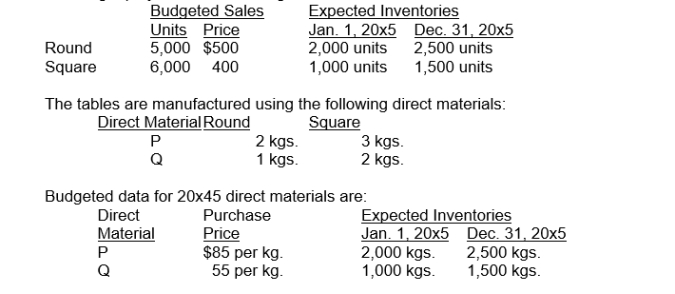 Budgeted data for 20x5 Direct labour and overhead are:
Direct labour:
Round 4 hours per unit at $6 per hour
Square 6 hours per unit at $8 per hour
Overhead: $4 per direct labour hour
The cost of purchases for direct material P for 20x5 is:
Budgeted data for 20x5 Direct labour and overhead are:
Direct labour:
Round 4 hours per unit at $6 per hour
Square 6 hours per unit at $8 per hour
Overhead: $4 per direct labour hour
The cost of purchases for direct material P for 20x5 is: (Multiple Choice)
4.7/5 (75)
(75) January February March April Sales \ 26,400 \ 23,100 \ 33,000 \ 25,000 Production in units 990 1,440 1,710 1,200
Sales are 30% cash and 70% on account, and 60% of credit sales are collected in the month of the sale. In the month after the sale, 30% of credit sales are collected. The remainder is collected two months after the sale. It takes 4 kilograms of direct material to produce a finished unit, and direct materials cost $5 per kilogram. All direct materials purchases are on account, and are paid as follows: 40% in the month of the purchase, 50% the following month, and 10% in the second month following the purchase. Ending direct materials inventory for each month is 40% of the next month's production needs. January's beginning materials inventory is 1,080 kilograms. Suppose that both accounts receivable and accounts payable are zero at the beginning of January.
The ending direct materials inventory for March is:
(Multiple Choice)
4.8/5 (63)
(63) Which of the following is prepared periodically, reflecting planning changes for a specific future time frame?
(Multiple Choice)
4.8/5 (84)
(84) Korn Inc., projects sales for its first three months of operation as follows: October November December Credit sales \ 100,000 \ 150,000 \ 200,000 Cash sales 40,000 60,000 50,000 Tota \ 140,000 \ 210,000 \2 50,000
Inventory on October 1 is $40,000. Subsequent beginning inventories should be 40% of that month's cost of goods sold. Goods are priced at 140% of their cost. 50% of purchases are paid for in the month of purchase; the balance is paid in the following month. It is expected that 50% of credit sales will be collected in the month following sale, 30% in the second month following the sale, and the balance the third month. A 5% discount is given if payment is received in the month following sale.
(Appendix 10A) What are the anticipated cash receipts for November?
(Multiple Choice)
4.9/5 (82)
(82) Bend Company's projected sales budget for the next four months is as follows: Units January 70,000 February 90,000 March 55,000 April 65,000 Beginning inventory for the year is 27,000 units. Ending inventory for each month should be 30% of the next month's sales.
How many units should the company produce in January?
(Multiple Choice)
4.8/5 (79)
(79) (Appendix 10A) Conner Company is a medium-sized toy distributor. Experience has shown that 30% of sales are collected within the month of sale, 60% is collected the month after the sale, and 10% is collected two months after the sale. Inventory on hand at the end of a month is to be 70% of the next month's budgeted sales. Cost of goods sold is 50% of the selling price. Payment for purchases is made in the month after purchase. All other costs are paid in the month incurred. Budgeted amounts are as follows: March April May June July August Sales \ 10,000 \ 20,000 \ 30,000 \ 30,000 \ 50,000 \ 40,00 Cost Wages 1,500 2,000 2,500 1,500 Rent 500 500 500 500 Other 400 500 600 500
Cash disbursements in July for purchases are expected to be:
(Multiple Choice)
4.9/5 (85)
(85) 
Filters
- Essay(0)
- Multiple Choice(0)
- Short Answer(0)
- True False(0)
- Matching(0)