



 Chat with AI
Exam 11: Standard Costs and Variance Analysis

Exam 1: The Role of Accounting Information in Ethical Management Decision Making100 Questions
Exam 2: Cost Concepts, Behaviour, and Estimation129 Questions
Exam 3: Cost-Volume-Profit Analysis147 Questions
Exam 4: Relevant Information for Decision Making135 Questions
Exam 5: Job Costing133 Questions
Exam 6: Process Costing114 Questions
Exam 7: Activity-Based Costing and Management132 Questions
Exam 8: Measuring and Assigning Support Department Costs115 Questions
Exam 9: Joint Product and By-Product Costing121 Questions
Exam 10: Static and Flexible Budgets128 Questions
Exam 11: Standard Costs and Variance Analysis128 Questions
Exam 12: Strategic Investment Decisions37 Questions
Exam 13: Pricing Decisions109 Questions
Exam 14: Strategic Management of Costs111 Questions
Exam 15: Measuring and Assigning Costs for Income Statements88 Questions
Exam 16: Performance Evaluation and Compensation39 Questions
Select questions type


Hyteck, Inc. is a capital intensive firm. Indirect costs make up nearly 70% of the product costs. The company has no direct material costs because customers provide the direct materials used for each job. To plan and control such costs, the firm employs flexible budgets and standard costs. Overhead rates, based on direct labour hours, are derived from the master budget. Master Actual Budget Results Units produced 2,000 1,820 Direct labour hours 10,000 9,200 Fixed overhead \ 100,000 \ 98,000 Variable overhead \ 160,000 \ 150,000 Direct labour \ 100,000 \ 90,000 The fixed overhead production volume variance was:
(Multiple Choice)
4.8/5  (88)
(88) Mason, Inc. uses a standard costing system. Overhead costs are allocated based on direct labour hours. The standard variable overhead and fixed overhead rates are $1 and $5 per direct labour hour, respectively. Data relevant for the current period include: 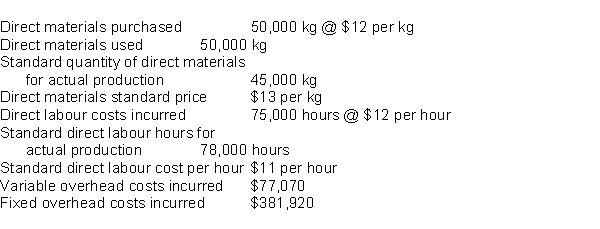 The variable overhead spending variance is:
 (Multiple Choice)
4.8/5 (80)
(80) Which of the following statements regarding tradeoffs among variances is true?
(Multiple Choice)
4.9/5 (81)
(81) Variances can be caused by:
I. Out-of-control operations
II. Better-than-expected operations
III. Inappropriate benchmarks
(Multiple Choice)
4.9/5 (72)
(72) Bellingham, Inc. incurred the following during a recent period: Actual Standard Machine hours 1,350 1,425 Units produced 570 570 Variable overhead costs \ 2,775 \ 2,850 The variable overhead spending variance equals:
(Multiple Choice)
5.0/5 (85)
(85) Everett, Inc. budgeted $1,488,000 for total overhead. The standard variable overhead rate was $2 per direct labour hour, or $6 per unit, based on an anticipated activity level of 600,000 direct labour hours. During the year 220,000 units were produced. Fixed overhead costs incurred were $300,000. The variable overhead budget variance was $19,800 unfavourable, and the actual variable overhead rate was $2.10 per direct labour hour.
The standard direct labour hours allowed were:
(Multiple Choice)
4.7/5 (69)
(69) Brodie Co. uses a standard job cost system and a denominator volume of 25,000 direct labour hours for allocating overhead. The actual output was 12,000 units, which cost $185,700 for direct labour (23,000 hours), $27,525 for variable overhead, and $136,400 for fixed overhead. The standard variable overhead per unit is $2 (2 hours @ $1 per hour), and the standard fixed overhead per unit is $10 (2 hours @ $5 per hour). All variances are immaterial and are closed to Cost of Goods Sold at the end of the period.
The entry to close the variable overhead variances includes a:
(Multiple Choice)
4.9/5 (83)
(83) The total standard cost for a unit of output is the sum of the standard costs for the resources used in production.
(True/False)
4.9/5 (94)
(94) Cryolite uses a standard costing system to gauge results for their single product. 70,000 kilograms of direct materials were purchased for $385,000. Two kilograms of direct materials are needed to produce one unit of product. In March, the company produced 12,000 units. The standard cost allowed for direct material was $120,000, and there was an unfavourable direct materials efficiency variance of $2,500.
The direct materials price variance for March is:
(Multiple Choice)
4.7/5 (61)
(61) Burkett Company uses a standard cost system. Indirect costs were budgeted at $200,000 plus $15 per direct labour hour. The overhead rate is based on 10,000 hours. Actual results were: Standard direct labour hours 9,000 Actual direct labour hours 10,000 Fixed overhead \ 190,000 Variable overhead \ 185,000 The variable overhead efficiency variance was:
(Multiple Choice)
4.9/5 (79)
(79) Burkett Company uses a standard cost system. Indirect costs were budgeted at $200,000 plus $15 per direct labour hour. The overhead rate is based on 10,000 hours. Actual results were: Standard direct labour hours 9,000 Actual direct labour hours 10,000 Fixed overhead \ 190,000 Variable overhead \ 185,000 The fixed overhead production volume variance was:
(Multiple Choice)
4.7/5 (78)
(78) A standard cost variance is a difference between a standard cost and an actual cost.
(True/False)
4.7/5 (83)
(83) If the total variances in the accounting information system are favourable, accountants must adjust some accounts by decreasing costs during the closing process.
(True/False)
4.8/5 (84)
(84) Cryolite uses a standard costing system to gauge results for their single product. 70,000 kilograms of direct materials were purchased for $385,000. Two kilograms of direct materials are needed to produce one unit of product. In March, the company produced 12,000 units. The standard cost allowed for direct material was $120,000, and there was an unfavourable direct materials efficiency variance of $2,500.
Cryolite's standard cost for one kilogram of direct material is:
(Multiple Choice)
4.9/5 (85)
(85) Brodie Co. uses a standard job cost system and a denominator volume of 25,000 direct labour hours for allocating overhead. The actual output was 12,000 units, which cost $185,700 for direct labour (23,000 hours), $27,525 for variable overhead, and $136,400 for fixed overhead. The standard variable overhead per unit is $2 (2 hours @ $1 per hour), and the standard fixed overhead per unit is $10 (2 hours @ $5 per hour). All variances are immaterial and are closed to Cost of Goods Sold at the end of the period.
The entry to close the fixed overhead variances includes a:
(Multiple Choice)
4.9/5 (100)
(100) During the period Richeleau produced 1,000 units of product. The flexible budget for standard costs is: Direct materials \ 43,000 Direct labour 67,000 Variable overhead 30,000 Fixed overhead 25,000 Variances for the period are: Direct materials price 400 Direct materials efficiency 500 Direct labour price 600 Direct labour efficiency 200 Variable overhead spending 300 Variable overhead efficiency 100 Fixed overhead spending 500 Fixed overhead production volume 1,000 The direct materials inventory increased during the period by 1,000 (at standard cost). What was the actual cost of direct materials purchased during the period?
(Multiple Choice)
4.9/5 (84)
(84) Accountants investigate manufacturing overhead spending variances to determine:
(Multiple Choice)
4.9/5 (73)
(73) Because managers use estimates in calculating overhead allocation rates, they are likely to experience:
(Multiple Choice)
4.9/5 (88)
(88) 
Filters
- Essay(0)
- Multiple Choice(0)
- Short Answer(0)
- True False(0)
- Matching(0)