



 Chat with AI
Exam 11: Standard Costs and Variance Analysis

Exam 1: The Role of Accounting Information in Ethical Management Decision Making100 Questions
Exam 2: Cost Concepts, Behaviour, and Estimation129 Questions
Exam 3: Cost-Volume-Profit Analysis147 Questions
Exam 4: Relevant Information for Decision Making135 Questions
Exam 5: Job Costing133 Questions
Exam 6: Process Costing114 Questions
Exam 7: Activity-Based Costing and Management132 Questions
Exam 8: Measuring and Assigning Support Department Costs115 Questions
Exam 9: Joint Product and By-Product Costing121 Questions
Exam 10: Static and Flexible Budgets128 Questions
Exam 11: Standard Costs and Variance Analysis128 Questions
Exam 12: Strategic Investment Decisions37 Questions
Exam 13: Pricing Decisions109 Questions
Exam 14: Strategic Management of Costs111 Questions
Exam 15: Measuring and Assigning Costs for Income Statements88 Questions
Exam 16: Performance Evaluation and Compensation39 Questions
Select questions type


Fixed overhead costs are not expected to vary with production volumes. Therefore, production volume variances:
(Multiple Choice)
4.9/5  (81)
(81) During the middle of the fiscal year, AWR Corporation unexpectedly revised its estimate of a plant asset's life from 5 years to 7 years. That revision is most likely to lead to:
(Multiple Choice)
4.8/5 (78)
(78) Burkett Company uses a standard cost system. Indirect costs were budgeted at $200,000 plus $15 per direct labour hour. The overhead rate is based on 10,000 hours. Actual results were: Standard direct labour hours 9,000 Actual direct labour hours 10,000 Fixed overhead \ 190,000 Variable overhead \ 185,000 The over- or underapplied overhead was:
(Multiple Choice)
4.8/5 (85)
(85) Given the following account balances at the end of the first year of operations: Direct materials inventory \ 60,000 Work in process inventory 120,000 Finished goods inventory 180,000 Cost of goods sold 600,000 Direct material price variance 65,000 Direct material efficiency 195,000 Assuming that variances are considered material, the entry and amount of the direct material efficiency variance allocated to work in process inventory is:
(Multiple Choice)
4.8/5 (78)
(78) Hyteck, Inc. is a capital intensive firm. Indirect costs make up nearly 70% of the product costs. The company has no direct material costs because customers provide the direct materials used for each job. To plan and control such costs, the firm employs flexible budgets and standard costs. Overhead rates, based on direct labour hours, are derived from the master budget. Master Actual Budget Results Units produced 2,000 1,820 Direct labour hours 10,000 9,200 Fixed overhead \ 100,000 \ 98,000 Variable overhead \ 160,000 \ 150,000 Direct labour \ 100,000 \ 90,000 The budget variance for variable overhead was:
(Multiple Choice)
5.0/5 (77)
(77) Mason, Inc. uses a standard costing system. Overhead costs are allocated based on direct labour hours. The standard variable overhead and fixed overhead rates are $1 and $5 per direct labour hour, respectively. Data relevant for the current period include: 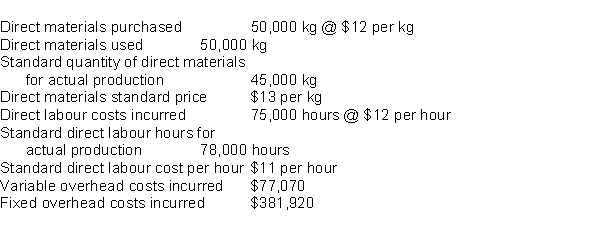 The direct labour price variance is:
 (Multiple Choice)
4.8/5 (82)
(82) Variance analysis is used for monitoring and performance evaluation.
(True/False)
4.8/5 (78)
(78) Pardee, Inc. completed operations for the week and the accountant was preparing to make journal entries necessary to prepare a set of interim financial statements. Unfortunately, he discovered some of the data concerning direct materials had been lost. He was able to find the following: Efficiency variance \ 4,500 Unfavourable Standard price \ 10 per unit Actual units purchased 9,000 Inventory decrease 1,000 units Budget variance \ 900 Favourable The standard quantity of direct materials allowed for the month was:
(Multiple Choice)
4.8/5 (81)
(81) The direct materials efficiency variance tells managers about the efficiency of the purchasing process.
(True/False)
4.8/5 (69)
(69) During the period Richeleau produced 1,000 units of product. The flexible budget for standard costs is: Direct materials \ 43,000 Direct labour 67,000 Variable overhead 30,000 Fixed overhead 25,000 Variances for the period are: Direct materials price 400 Direct materials efficiency 500 Direct labour price 600 Direct labour efficiency 200 Variable overhead spending 300 Variable overhead efficiency 100 Fixed overhead spending 500 Fixed overhead production volume 1,000 The actual cost of direct labour incurred was:
(Multiple Choice)
4.9/5 (80)
(80) Unreasonable standards may be the cause of direct materials variances, but not of direct labour variances.
(True/False)
4.9/5 (73)
(73) White, Inc. produces a chemical product whose primary component is purchased on credit and any discounts are always taken. The following material and labour elements make up the costs of the product: Purchase price for material \ 30 per litre Freight and handling \ 130 per 100 litres Each container of the chemical product contains 5.7 quarts of material. During the process 5% of the material is lost due to waste. Each container of product also requires 1.2 hours of labour. Each day 2 hours are taken for set-up, cleaning, and breaks. Also, the wage rate is $15 per hour and fringes/payroll taxes are 20% of wages. Clients can take a 3% discount if they pay invoices within 10 days; otherwise, the entire invoice amount is due within 30 days. 1 litre equals 4 quarts. The company has an 8-hour work day and makes 5 containers each day per employee.
The standard hours per finished unit is:
(Multiple Choice)
5.0/5 (81)
(81) Baldwin, Inc uses a standard job cost system and purchased 25,000 kg of material at $6 per kg, and used it all. The standard amount allowed for the output achieved is 22,500 kg, and the standard price is $6.50 per kg. The company also incurred 37,500 direct labour hours for $450,000. The standard hourly price was $11 per hour, and 39,000 hours were allowed at standard. Assuming all variances are immaterial, answer the following questions:
The entry to record the direct material efficiency variance will include a;
(Multiple Choice)
4.9/5 (73)
(73) Dem Mfg. has gathered the following data in preparing to record their direct labour payroll costs for the week: Actual hours morked 18,500 Standard hours allowed 20,000 Total direct labour variance \ 8,300 Direct labour price variance \ 3,700 The standard direct labour price was:
(Multiple Choice)
4.9/5 (76)
(76) Given the following account balances at the end of the first year of operations: Work in process inventory \ 90,000 Finished goods inventory 165,000 Cost of goods sold 495,000 Direct labour price variance 35,000 Direct labour efficiency variance 17,000 Assuming that variances are considered material, the entry and amount of direct labour variances allocated to the Finished Goods Inventory is:
(Multiple Choice)
4.9/5 (71)
(71) Everett, Inc. budgeted $1,488,000 for total overhead. The standard variable overhead rate was $2 per direct labour hour, or $6 per unit, based on an anticipated activity level of 600,000 direct labour hours. During the year 220,000 units were produced. Fixed overhead costs incurred were $300,000. The variable overhead budget variance was $19,800 unfavourable, and the actual variable overhead rate was $2.10 per direct labour hour.
The fixed overhead allocated was:
(Multiple Choice)
4.8/5 (79)
(79) Unattainable standards are likely to lead to:
I. Errors in the accounting information system
II. Favourable variances
III. Unfavourable variances
(Multiple Choice)
4.9/5 (72)
(72) The production manager of CLR Corporation calculated a material and unfavourable variance of $4,000 with respect to the cost of direct materials. Which of the following is a likely next step for the production manager?
(Multiple Choice)
4.9/5 (76)
(76) The difference between actual capacity used and budgeted capacity can be reflected in which variance?
(Multiple Choice)
4.9/5 (80)
(80) 
Filters
- Essay(0)
- Multiple Choice(0)
- Short Answer(0)
- True False(0)
- Matching(0)