



 Chat with AI
Exam 4: Accounting for Merchandising Businesses

Exam 1: The Role of Accounting in Business98 Questions
Exam 2: Basic Accounting Systems: Cash Basis99 Questions
Exam 3: Basic Accounting Systems: Accrual Basis119 Questions
Exam 4: Accounting for Merchandising Businesses154 Questions
Exam 5: Internal Control and Cash108 Questions
Exam 6: Receivables and Inventories104 Questions
Exam 7: Fixed Assets, Natural Resources, and Intangible Assets96 Questions
Exam 8: Liabilities and Stockholders Equity135 Questions
Exam 9: Metric Analysis of Financial Statements82 Questions
Exam 10: Accounting for Manufacturing Operations112 Questions
Exam 11: Cost-Volume-Profit Analysis129 Questions
Exam 12: Differential Analysis and Product Pricing102 Questions
Exam 13: Budgeting and Standard Costs178 Questions
Exam 14: Performance Evaluation for Decentralized Operations137 Questions
Exam 15: Capital Investment Analysis109 Questions
Select questions type


If merchandise sold on account is returned to the seller, the seller may inform the customer of the details by issuing a:
(Multiple Choice)
4.9/5  (77)
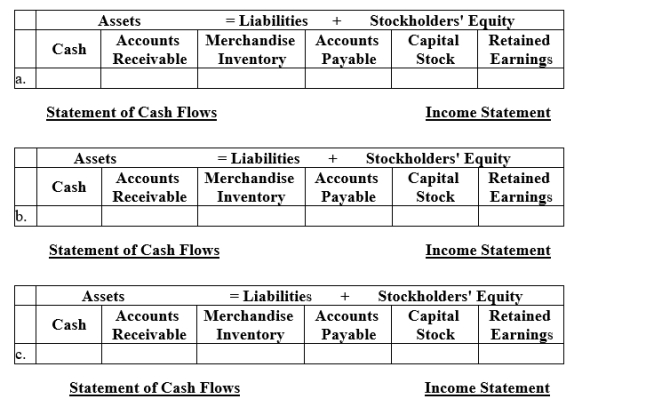
(77) Merchandise with a list price of $7,500 and a cost of $7,000 is sold on account, terms 1/10, n/30.Prior to payment, merchandise with a list price of $1,000 and a cost of $800 is returned.The correct amount is paid within the discount period.
Record the following transactions, using the integrated financial statement framework that follows:
(a)Sold the merchandise.
(b)Received the returned merchandise
(c)Received the amount owed.
(Essay)
4.9/5 (81)
(81) The cost of goods sold is subtracted from sales to arrive at _____.
(Multiple Choice)
4.8/5 (79)
(79) In recording the cost of merchandise sold for cash using a perpetual inventory system, the effect on the accounts is:
(Multiple Choice)
4.9/5 (88)
(88) Office salaries, depreciation of office equipment, and office supplies are examples of what type of expense?
(Multiple Choice)
4.9/5 (80)
(80) When merchandise that was sold on account is returned, which accounts are affected?
(Multiple Choice)
4.9/5 (72)
(72) If the buyer is to pay the delivery expense of delivering merchandise, delivery terms are stated as:
(Multiple Choice)
4.8/5 (84)
(84) Merchandise not sold at the end of the period is reported as:
(Multiple Choice)
4.8/5 (84)
(84) Under the perpetual inventory system, the cost of merchandise sold is recorded when sales are made.
(True/False)
4.8/5 (77)
(77) Expenses that are incurred directly or entirely in connection with the sale of merchandise are classified as:
(Multiple Choice)
4.7/5 (84)
(84) Which of the following is an example of an administrative expense?
(Multiple Choice)
4.7/5 (84)
(84) If payment is due by the end of the month in which the sale is made, the invoice terms are expressed as n/eom.
(True/False)
4.7/5 (86)
(86) For the perpetual inventory system, which of the following effects does not occur upon the return from a customer of merchandise sold on account?
(Multiple Choice)
4.7/5 (72)
(72) In case of merchandise return, the inventory account is increased by the amount of cost of the goods returned, and:
(Multiple Choice)
4.8/5 (93)
(93) A criticism of the single-step income statement is that gross profit and income from operations are not readily available for analysis.
(True/False)
4.7/5 (88)
(88) The merchandise inventory account is found on the balance sheet.
(True/False)
4.9/5 (77)
(77) When the seller offers a sales discount, even if borrowing has to be done, it is generally advantageous for the buyer to pay within the discount period.
(True/False)
4.8/5 (74)
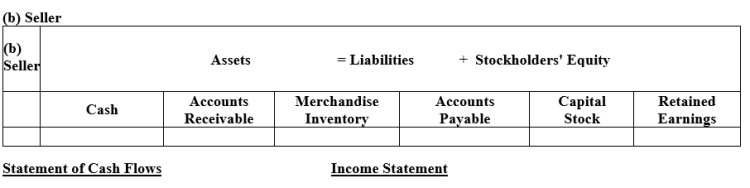
(74) Based on the information below, illustrate the effects on the accounts and financial statements of the Seller and the Buyer.Both use a perpetual inventory system.
(a)Seller sells Buyer on account merchandise costing $300 for $500, terms 2/10, net 30, FOB destination.The transportation charge is $50.
(b)Buyer returns as defective $100 worth of the $500 merchandise received.The seller's cost is $60.
(c)Buyer pays within the discount period.





(Essay)
5.0/5 (79)
(79) Sales discounts are granted by the seller to customers for payment at the end of the month.
(True/False)
4.8/5 (78)
(78) 
Filters
- Essay(0)
- Multiple Choice(0)
- Short Answer(0)
- True False(0)
- Matching(0)