



 Chat with AI
Exam 6: Cost Of Goods Sold and Inventory

Exam 1: Accounting and The Financial Statements236 Questions
Exam 2: The Accounting Information System179 Questions
Exam 3: Accrual Accounting197 Questions
Exam 4: Internal Control And Cash207 Questions
Exam 5: Sales And Receivables130 Questions
Exam 6: Cost Of Goods Sold and Inventory232 Questions
Exam 7: Operating Assets193 Questions
Exam 8: Current and Contingent Liabilities184 Questions
Exam 9: Long Term Liabilities159 Questions
Exam 10: Stockholders Apos Equity237 Questions
Exam 11: The Statement Of Cash Flows205 Questions
Exam 12: Financial Statement Analysis223 Questions
Exam 13: Finance and Stock Market Equilibrium119 Questions
Select questions type


Differentiate between the record keeping required for sales and cost of goods sold under a perpetual versus a periodic inventory system.
(Essay)
4.9/5  (82)
(82) Match the terms with the descriptions related to merchandise sales and purchases.
-The buyer must pay the shipping costs.
(Multiple Choice)
4.9/5 (78)
(78) Vaden Company uses the periodic inventory system. The data presented below is from the company's accounting records for the year ended December 31: 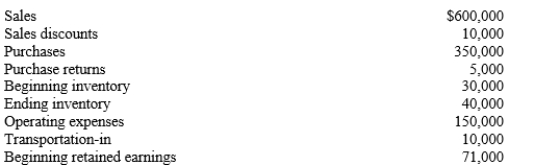 Calculate the company's cost of goods sold for the year.
 (Essay)
4.9/5 (82)
(82) Match the terms with the descriptions provided.
-The amount that the inventory would increase or decrease if the company had used FIFO instead of LIFO.
(Multiple Choice)
5.0/5 (80)
(80) During a period of increasing purchase prices, which inventory costing method will yield the lowest cost of goods sold?
(Multiple Choice)
4.8/5 (83)
(83) When inventories are written down due to the application of the lower of cost or market (LCM) rule, which of the following is usually increased?
(Multiple Choice)
4.9/5 (79)
(79) A departure from the cost basis of accounting may be necessary when the ____________________ of the inventory is less than its cost to the company.
(Short Answer)
4.7/5 (73)
(73) Items should be included as part of the company's inventory if they are
(Multiple Choice)
4.8/5 (86)
(86) When merchandise is sold FOB destination, the seller is responsible for the shipping costs.
(True/False)
4.9/5 (90)
(90) Which of the following statements is false regarding the choice between alternative inventory costing methods?
(Multiple Choice)
4.8/5 (82)
(82) Match the terms with the descriptions provided.
-The difference between a company's net sales and its cost of goods sold.
(Multiple Choice)
4.8/5 (87)
(87) Which of the following statements is true regarding just-in-time inventory management?
(Multiple Choice)
4.9/5 (82)
(82) Match the inventory-related accounts to costs that may be included in inventories for retailers and manufacturers.
-Cost of material, labor, and other production-related costs incurred to date in unfinished goods.
(Multiple Choice)
4.9/5 (73)
(73) Satoor, Inc.Satoor, Inc., which uses a periodic inventory system, purchased merchandise from Taye Company on July 7 for $15,000. The credit terms were 1/10, n/30. The goods were shipped FOB shipping point on July 7. Satoor, Inc. received the merchandise on July 10 and paid the amount due on July 15.
-Refer to the information provided for Satoor, Inc. Who is responsible for payment of the transportation costs on the merchandise sold?
(Multiple Choice)
5.0/5 (89)
(89) Match the terms with the descriptions provided.
-In the periodic inventory system, the account used to record the cost of merchandise acquired for resale.
(Multiple Choice)
4.8/5 (83)
(83) Noland, Inc. uses the LIFO method of inventory costing and is facing the possibility of a LIFO liquidation for the current year. Merchandise purchase prices have increased since the LIFO method was adopted. If the company does not purchase additional merchandise before year-end, which one of the following effects will occur as a result of a LIFO liquidation?
(Multiple Choice)
4.8/5 (65)
(65) When the market value of inventory items has declined below their cost, which method would be the most appropriate in complying with GAAP?
(Multiple Choice)
4.9/5 (82)
(82) Match the costs that might be included as part of the cost of inventory to the listed accounting treatment. (Choices may be used more than once.)
-Returned goods to the seller.
(Multiple Choice)
4.8/5 (88)
(88) Cost of goods sold is the difference between costs of goods available for sale and ending inventory.
(True/False)
4.7/5 (82)
(82) Match the inventory-related accounts to costs that may be included in inventories for retailers and manufacturers.
-Costs of completed items that have been sold to customers.
(Multiple Choice)
4.8/5 (83)
(83) 
Filters
- Essay(0)
- Multiple Choice(0)
- Short Answer(0)
- True False(0)
- Matching(0)