



 Chat with AI
Exam 23: Performance Evaluation for Decentralized Operations

Exam 1: Introduction to Accounting and Business234 Questions
Exam 2: Analyzing Transactions240 Questions
Exam 3: The Adjusting Process210 Questions
Exam 4: Completing the Accounting Cycle197 Questions
Exam 5: Accounting for Merchandising Businesses233 Questions
Exam 6: Inventories205 Questions
Exam 7: Sarbanes-Oxley, Internal Control, and Cash187 Questions
Exam 8: Receivables196 Questions
Exam 9: Fixed Assets and Intangible Assets226 Questions
Exam 10: Current Liabilities and Payroll194 Questions
Exam 11: Corporations: Organization, Stock Transactions, and Dividends207 Questions
Exam 12: Long-Term Liabilities: Bonds and Notes174 Questions
Exam 13: Investments and Fair Value Accounting167 Questions
Exam 14: Statement of Cash Flows187 Questions
Exam 15: Financial Statement Analysis199 Questions
Exam 16: Managerial Accounting Concepts and Principles202 Questions
Exam 17: Job Order Costing195 Questions
Exam 18: Process Cost Systems198 Questions
Exam 19: Cost Behavior and Cost-Volume-Profit Analysis225 Questions
Exam 20: Variable Costing for Management Analysis160 Questions
Exam 21: Budgeting197 Questions
Exam 22: Performance Evaluation Using Variances From Standard Costs175 Questions
Exam 23: Performance Evaluation for Decentralized Operations217 Questions
Exam 24: Differential Analysis, Product Pricing, and Activity-Based Costing176 Questions
Exam 25: Capital Investment Analysis188 Questions
Exam 26: Cost Allocation and Activity-Based Costing110 Questions
Exam 27: Lean Principles, Lean Accounting, and Activity Analysis137 Questions
Select questions type


ABC Corporation has three service departments with the following costs and activity base:  ABC has three operating divisions, Micro, Macro and Super. Their revenue, cost and activity information are as follows: Micro Macro Super Direct revenues \ 700,000 \ 850,000 \ 650,000 Direct operating expenses 50,000 70,000 100,000 Number of copies made 20,000 30,000 50,000 Number of invoices processed 700 800 500 Number of employees 130 145 125
-What is the service department charge rate for the Personnel Department?
ABC has three operating divisions, Micro, Macro and Super. Their revenue, cost and activity information are as follows: Micro Macro Super Direct revenues \ 700,000 \ 850,000 \ 650,000 Direct operating expenses 50,000 70,000 100,000 Number of copies made 20,000 30,000 50,000 Number of invoices processed 700 800 500 Number of employees 130 145 125
-What is the service department charge rate for the Personnel Department? (Multiple Choice)
4.9/5  (85)
(85) Materials used by the Layton Company's Division 1 are currently purchased from outside supplier at $58 per unit. Division 2 is able to supply Division 1 with 22,000 units at a variable cost of $46 per unit. The two divisions have recently negotiated a transfer price of $50 per unit for the 20,000 units.
a) By how much will each division's income increase as a result of this transfer?
b) What is the total increase in income for Layton?
(Essay)
4.8/5 (74)
(74) Most manufacturing plants are considered cost centers because they have control over
(Multiple Choice)
4.8/5 (79)
(79) An activity base is used to charge service department expenses. Match each of the following activity bases with the appropriate department a-h).
-Number of computers in department
(Multiple Choice)
4.9/5 (79)
(79) If income from operations for a division is $6,000, invested assets are $25,000, and sales are $30,000, the investment turnover is 1.2.
(True/False)
4.9/5 (71)
(71) To calculate income from operations, total service department charges are
(Multiple Choice)
4.7/5 (77)
(77) If the profit margin for a division is 11% and the investment turnover is 1.5, the rate of return on investment is 7.3%.
(True/False)
4.9/5 (85)
(85) Match each of the following phrases as describing a) an advantage, b) a disadvantage, or c) neither of decentralization.
-Responsibilities delegated to unit managers
(Multiple Choice)
4.8/5 (73)
(73) The objective of transfer pricing is to encourage each division manager to transfer goods and services between divisions if overall company income can be increased by doing so.
(True/False)
4.8/5 (91)
(91) The ratio of income from operations to sales is termed the profit margin component of the rate of return on investment.
(True/False)
4.8/5 (82)
(82) In evaluating the profit center manager, the income from operations should be compared
(Multiple Choice)
4.8/5 (75)
(75) Using the data from the Terrace Industries, determine the divisional income from operations for Districts 1 & 2. 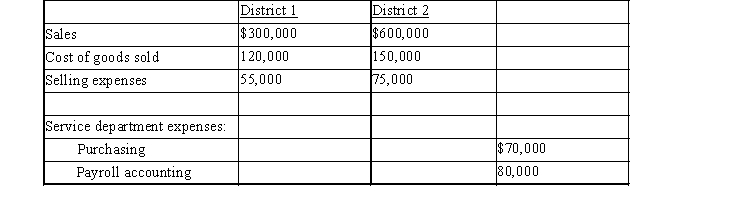 Allocate service department expenses proportional to the sales of each district.
 (Essay)
4.8/5 (74)
(74) If income from operations for a division is $120,000, sales are $975,000, and invested assets are $750,000, the investment turnover is 1.3.
(True/False)
4.8/5 (75)
(75) The minimum accepted divisional income from operations is set by top management by establishing a maximum rate of return considered acceptable for invested assets.
(True/False)
4.8/5 (76)
(76) Operating expenses incurred for the entire business as a unit that are not subject to the control of individual department managers are called indirect expenses.
(True/False)
4.9/5 (81)
(81) Responsibility accounting reports that are given to lower level managers are usually very detailed, in turn, higher level managers will be given a summary report.
(True/False)
4.8/5 (85)
(85) Blaser Corporation had $275,000 in invested assets, sales of $330,000, income from operations amounting to $33,000 and a desired minimum rate of return of 7.5%. The rate of return on investment for Blaser Corporation is
(Multiple Choice)
4.7/5 (66)
(66) Which of the following is not a commonly used approach to setting transfer prices?
(Multiple Choice)
5.0/5 (84)
(84) Materials used by Best Bread Company in producing Division A's product are currently purchased from outside suppliers at a cost of $30 per unit. However, the same materials are available from Division B. Division B has unused capacity and can produce the materials needed by Division A at a variable cost of $20 per unit.
a) If a transfer price of $25 per unit is established and 60,000 units of material are transferred, with no reductions in Division B's current sales, how much would Best Bread Company's total income from operations increase?
b) Assuming transfer price of $25 per unit is established and 60,000 units of material are transferred, with no reductions in Division B's current sales, how much would the income from operations of Division A increase?
c) Assuming transfer price of $25 per unit is established and 60,000 units of material are transferred, with no reductions in Division B's current sales, how much would the income from operations of Division B increase?
d) If the negotiated price approach is used, what would be the range of acceptable transfer prices?
(Essay)
4.9/5 (76)
(76) 
Filters
- Essay(0)
- Multiple Choice(0)
- Short Answer(0)
- True False(0)
- Matching(0)