



 Chat with AI
Exam 17: Job Order Costing

Exam 1: Introduction to Accounting and Business234 Questions
Exam 2: Analyzing Transactions240 Questions
Exam 3: The Adjusting Process210 Questions
Exam 4: Completing the Accounting Cycle197 Questions
Exam 5: Accounting for Merchandising Businesses233 Questions
Exam 6: Inventories205 Questions
Exam 7: Sarbanes-Oxley, Internal Control, and Cash187 Questions
Exam 8: Receivables196 Questions
Exam 9: Fixed Assets and Intangible Assets226 Questions
Exam 10: Current Liabilities and Payroll194 Questions
Exam 11: Corporations: Organization, Stock Transactions, and Dividends207 Questions
Exam 12: Long-Term Liabilities: Bonds and Notes174 Questions
Exam 13: Investments and Fair Value Accounting167 Questions
Exam 14: Statement of Cash Flows187 Questions
Exam 15: Financial Statement Analysis199 Questions
Exam 16: Managerial Accounting Concepts and Principles202 Questions
Exam 17: Job Order Costing195 Questions
Exam 18: Process Cost Systems198 Questions
Exam 19: Cost Behavior and Cost-Volume-Profit Analysis225 Questions
Exam 20: Variable Costing for Management Analysis160 Questions
Exam 21: Budgeting197 Questions
Exam 22: Performance Evaluation Using Variances From Standard Costs175 Questions
Exam 23: Performance Evaluation for Decentralized Operations217 Questions
Exam 24: Differential Analysis, Product Pricing, and Activity-Based Costing176 Questions
Exam 25: Capital Investment Analysis188 Questions
Exam 26: Cost Allocation and Activity-Based Costing110 Questions
Exam 27: Lean Principles, Lean Accounting, and Activity Analysis137 Questions
Select questions type


Activity-based costing is a method of accumulating and allocating costs by department.
(True/False)
5.0/5  (82)
(82) A difference in quantity of materials used on two comparable jobs may be caused by
(Multiple Choice)
4.9/5 (70)
(70) A manufacturer may employ a job order cost system for some of its products and a process cost system for others.
(True/False)
4.8/5 (81)
(81) During April, Cavy Company incurred factory overhead as follows: Indirect materials \ 11,000 Factory supervisi on labor 4,000 Utilities 500 Depreciation fact ory) 700 Small tools 300 Equipment rental 750 Record the entry for factory overhead incurred during April.
(Essay)
4.9/5 (79)
(79) Match each of the following phrases with the term a-e) that it most closely describes it. Each term will be used only once.
-prepared when materials that have been ordered are received and inspected
(Multiple Choice)
4.7/5 (76)
(76) Match the costs that follow to the type of product cost a-c) or designate as not a product cost d).
-president's salary
(Multiple Choice)
5.0/5 (90)
(90) Which of the following would most likely use a job order costing system?
(Multiple Choice)
5.0/5 (79)
(79) The direct labor and overhead costs of providing services to clients are accumulated in a work in process account.
(True/False)
4.8/5 (92)
(92) Period costs are costs that are incurred for the production requirements of a certain period.
(True/False)
5.0/5 (81)
(81) Which of the following is not a characteristic of a job order costing system?
(Multiple Choice)
4.9/5 (86)
(86) When Job 117 was completed, direct materials totaled $4,400; direct labor, $5,600; and factory overhead, $2,400. A total of 1,000 units were produced at a per-unit cost of
(Multiple Choice)
4.9/5 (89)
(89) A widely used activity base for developing factory overhead rates in highly automated settings is
(Multiple Choice)
4.8/5 (85)
(85) A summary of the materials requisitions completed during a period serves as the basis for transferring the cost of the materials from the controlling account in the general ledger to the controlling accounts for
(Multiple Choice)
4.9/5 (69)
(69) Six selected transactions for the current month are indicated by letters in the following T accounts in a job order cost accounting system: 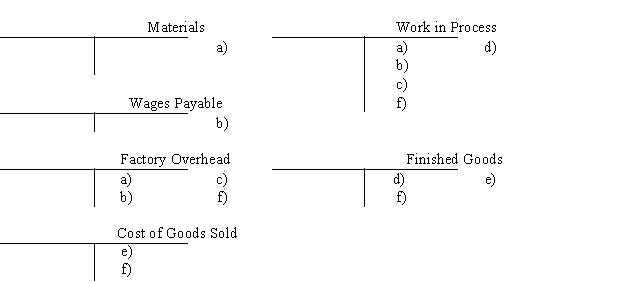 Describe each of the six transactions.
 (Essay)
4.8/5 (80)
(80) Match each of the following phrases with the term a-e) that it most closely describes it. Each term will be used only once.
-the process by which factory overhead is assigned to a cost object
(Multiple Choice)
4.9/5 (75)
(75) In the job order costing system, the finished goods account is the controlling account for the factory overhead ledger.
(True/False)
4.8/5 (93)
(93) In a factory with several processing departments, a single factory overhead rate may not provide accurate product costs and effective cost control.
(True/False)
4.8/5 (76)
(76) 
Filters
- Essay(0)
- Multiple Choice(0)
- Short Answer(0)
- True False(0)
- Matching(0)