



 Chat with AI
Exam 8: Receivables

Exam 1: Introduction to Accounting and Business234 Questions
Exam 2: Analyzing Transactions240 Questions
Exam 3: The Adjusting Process210 Questions
Exam 4: Completing the Accounting Cycle197 Questions
Exam 5: Accounting for Merchandising Businesses233 Questions
Exam 6: Inventories205 Questions
Exam 7: Sarbanes-Oxley, Internal Control, and Cash187 Questions
Exam 8: Receivables196 Questions
Exam 9: Fixed Assets and Intangible Assets226 Questions
Exam 10: Current Liabilities and Payroll194 Questions
Exam 11: Corporations: Organization, Stock Transactions, and Dividends207 Questions
Exam 12: Long-Term Liabilities: Bonds and Notes174 Questions
Exam 13: Investments and Fair Value Accounting167 Questions
Exam 14: Statement of Cash Flows187 Questions
Exam 15: Financial Statement Analysis199 Questions
Exam 16: Managerial Accounting Concepts and Principles202 Questions
Exam 17: Job Order Costing195 Questions
Exam 18: Process Cost Systems198 Questions
Exam 19: Cost Behavior and Cost-Volume-Profit Analysis225 Questions
Exam 20: Variable Costing for Management Analysis160 Questions
Exam 21: Budgeting197 Questions
Exam 22: Performance Evaluation Using Variances From Standard Costs175 Questions
Exam 23: Performance Evaluation for Decentralized Operations217 Questions
Exam 24: Differential Analysis, Product Pricing, and Activity-Based Costing176 Questions
Exam 25: Capital Investment Analysis188 Questions
Exam 26: Cost Allocation and Activity-Based Costing110 Questions
Exam 27: Lean Principles, Lean Accounting, and Activity Analysis137 Questions
Select questions type


At the end of the current year, Accounts Receivable has a balance of $550,000; Allowance for Doubtful Accounts has a credit balance of $5,500; and sales for the year total $2,500,000. An analysis of receivables estimates uncollectible receivables as $25,000.
Determine a) the amount of the adjusting entry for bad debt expense; b) the adjusted balances of Accounts Receivable, Allowance for Doubtful Accounts, and Bad Debt Expense; and c) the net realizable value of accounts receivable.
(Essay)
4.8/5  (91)
(91) The receivable that is usually evidenced by a formal, written instrument of credit is an)
(Multiple Choice)
4.8/5 (73)
(73) When a company uses the allowance method of accounting for uncollectible receivables, which entry would not be found in the general journal?
(Multiple Choice)
4.9/5 (87)
(87) Match each description to the appropriate term a-d). Each term may be used more than once.
-With this method, there is no allowance account.
(Multiple Choice)
4.8/5 (95)
(95) For each of the following notes receivables held by Winter Company, determine the interest revenue to be reported on the income statements. Round answers to nearest whole dollar. 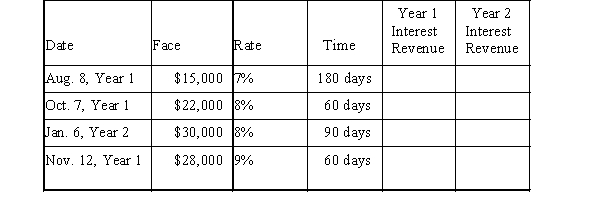
(Essay)
4.7/5 (78)
(78) Match each description to the appropriate term a-i).
-A list of customer accounts sorted by age classes
(Multiple Choice)
4.8/5 (76)
(76) At the end of the current year, Accounts Receivable has a balance of $550,000; Allowance for Doubtful Accounts has a credit balance of $5,500; and sales for the year total $2,500,000. An analysis of receivables estimates uncollectible receivables as $25,000. Determine the net realizable value of accounts receivable after adjustment. Hint: Determine the amount of the adjusting entry for bad debt expense and the adjusted balance of Allowance of Doubtful Accounts.)
(Multiple Choice)
4.8/5 (81)
(81) A partially competed aging of receivables schedule for Lindy Designs' is shown below. Calculate the amount that is estimated to be uncollectible.
a) Determine the amount estimated to be uncollectible by completing the aging of receivables schedule. Round calculations to the nearest dollar. 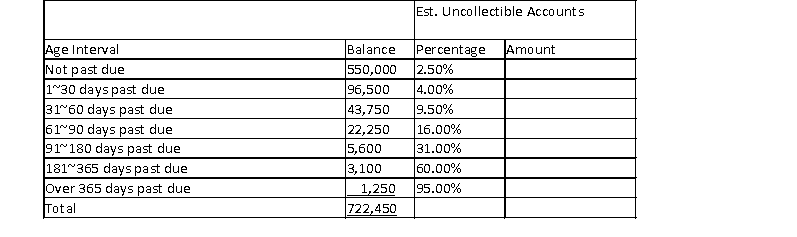 b) If the Allowance for Doubtful Accounts has a credit balance of $9,700, record the adjusting entry for
the bad debt expense for the year.
c) If the Allowance for Doubtful Accounts has a debit balance of $9,700, record the adjusting entry for the bad debt expense for the year.
b) If the Allowance for Doubtful Accounts has a credit balance of $9,700, record the adjusting entry for
the bad debt expense for the year.
c) If the Allowance for Doubtful Accounts has a debit balance of $9,700, record the adjusting entry for the bad debt expense for the year. (Essay)
4.7/5 (90)
(90) Discuss the 1) focus and 2) financial statement emphasis of a) the percent of sales and b) the analysis of receivables methods of estimating bad debts.
(Essay)
4.8/5 (84)
(84) The balance in Allowance for Doubtful Accounts will directly impact the end-of-period adjustment for the bad debt expense when using which of the following methods?
(Multiple Choice)
4.8/5 (69)
(69) The maturity value of a $40,000, 9%, 40-day note receivable dated July 3 is
(Multiple Choice)
4.7/5 (81)
(81) Match each description to the appropriate term a-i).
-A contra asset that represents the amount of estimated uncollectible receivables
(Multiple Choice)
4.7/5 (79)
(79) A 60-day, 12% note for $7,000, dated April 15, is received from a customer on account. The face value of the note is
(Multiple Choice)
4.8/5 (72)
(72) For each of the following notes receivables held by Christensen Company determine the interest revenue to be reported on the income statements for the year ended December 31. Round answers to nearest whole dollar. 
(Essay)
4.9/5 (64)
(64) The two methods of accounting for uncollectible receivables are the allowance method and the
(Multiple Choice)
4.9/5 (78)
(78) Allowance for Doubtful Accounts has a debit balance of $2,300 at the end of the year before adjustment). The company prepares an analysis of customers' accounts and estimates the amount of uncollectible accounts to be $31,900. Which of the following adjusting entries is needed to record the Bad Debt Expense for the year?
(Multiple Choice)
4.9/5 (83)
(83) Sunshine Service Center received a 120-day, 6% note for $40,000, dated April 12 from a customer on account.
a. Determine the due date of the note.
b. Determine the maturity value of the note.
c. Journalize the entry to record the receipt of the payment of the note at maturity.
(Essay)
4.9/5 (69)
(69) The operating expense recorded from uncollectible receivables can be called all of the following except
(Multiple Choice)
4.8/5 (93)
(93) 
Filters
- Essay(0)
- Multiple Choice(0)
- Short Answer(0)
- True False(0)
- Matching(0)