



 Chat with AI
Exam 5: Accounting for Merchandising Businesses

Exam 1: Introduction to Accounting and Business234 Questions
Exam 2: Analyzing Transactions240 Questions
Exam 3: The Adjusting Process210 Questions
Exam 4: Completing the Accounting Cycle197 Questions
Exam 5: Accounting for Merchandising Businesses233 Questions
Exam 6: Inventories205 Questions
Exam 7: Sarbanes-Oxley, Internal Control, and Cash187 Questions
Exam 8: Receivables196 Questions
Exam 9: Fixed Assets and Intangible Assets226 Questions
Exam 10: Current Liabilities and Payroll194 Questions
Exam 11: Corporations: Organization, Stock Transactions, and Dividends207 Questions
Exam 12: Long-Term Liabilities: Bonds and Notes174 Questions
Exam 13: Investments and Fair Value Accounting167 Questions
Exam 14: Statement of Cash Flows187 Questions
Exam 15: Financial Statement Analysis199 Questions
Exam 16: Managerial Accounting Concepts and Principles202 Questions
Exam 17: Job Order Costing195 Questions
Exam 18: Process Cost Systems198 Questions
Exam 19: Cost Behavior and Cost-Volume-Profit Analysis225 Questions
Exam 20: Variable Costing for Management Analysis160 Questions
Exam 21: Budgeting197 Questions
Exam 22: Performance Evaluation Using Variances From Standard Costs175 Questions
Exam 23: Performance Evaluation for Decentralized Operations217 Questions
Exam 24: Differential Analysis, Product Pricing, and Activity-Based Costing176 Questions
Exam 25: Capital Investment Analysis188 Questions
Exam 26: Cost Allocation and Activity-Based Costing110 Questions
Exam 27: Lean Principles, Lean Accounting, and Activity Analysis137 Questions
Select questions type


A business using the perpetual inventory system, with its detailed subsidiary records, does not need to take a physical inventory.
(True/False)
4.8/5  (68)
(68) Merchandise with an invoice price of $6,000 is purchased on September 2 subject to terms of 2/10, n/30, FOB destination. Freight costs paid by the seller totaled $200. What is the required payment if paid on September 12?
(Multiple Choice)
4.9/5 (89)
(89) There is no difference between the recording of cash sales and the recording of MasterCard or VISA sales.
(True/False)
4.9/5 (83)
(83) Using a perpetual inventory system, the entry to record the sale of merchandise on account includes a
(Multiple Choice)
4.9/5 (86)
(86) The ratio of sales to assets measures how effectively a business is using its assets to generate sales.
(True/False)
4.8/5 (96)
(96) Which of the following costs would be included in merchandise inventory?
a) Purchase price
b) Insurance in transit FOB shipping point
c) Freight for delivery FOB shipping point
d) Repair due to negligence of receiving clerk
e) Receiving department employee salary
f) Cost of processing purchase orders
(Essay)
4.7/5 (85)
(85) Under a periodic inventory system, the cost of merchandise on hand at the end of the year is determined by a physical count of the inventory.
(True/False)
4.8/5 (88)
(88) If payment is due by the end of the month in which the sale is made, the invoice terms are expressed as n/30.
(True/False)
4.7/5 (71)
(71) Based on the information below, journalize the entries for the seller and the buyer. Both use a perpetual inventory system.
a) Seller sold merchandise on account to the buyer, $4,750, terms 2/10, net 30, FOB shipping point. The cost of the merchandise is $2,850. The seller prepays the freight of $75.
b) Buyer returns $700 of merchandise as defective. The cost of the merchandise is $420.
c) Buyer pays within the discount period. 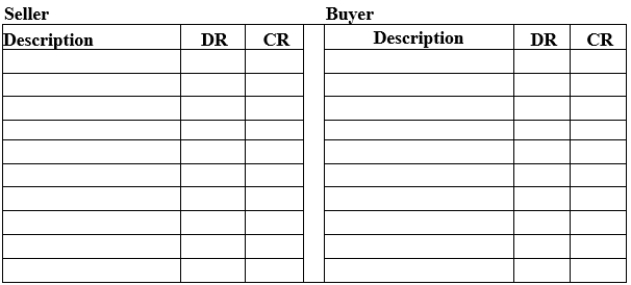
(Essay)
4.9/5 (76)
(76) Journalize the entries to record the following selected transactions:
a) Sold $900 of merchandise on account, subject to 7% sales tax. The cost of the merchandise sold was $510.
b) Paid $436 to the state sales tax department for taxes collected.
(Essay)
4.7/5 (93)
(93) When the seller offers a sales discount, even if borrowing has to be done, it is generally advantageous for the buyer to pay within the discount period.
(True/False)
4.9/5 (87)
(87) Using the following data taken from Hsu's Imports Inc. which uses a periodic inventory system, determine the gross profit to be reported on the income statement for the year ended March 31. Merchandise inventory, April 1 \ 193,250 Merchandise inventory, March 31 180,100 Purchases 1,079,600 Purchases returns and allowances 51,200 Purchases discounts 18,500 Sales 1,860,000 Freight-in 19,250
(Essay)
4.8/5 (77)
(77) ?Journalize the following transactions for Armour Inc. using both the periodic inventory system and the perpetual inventory system, presented in the side-by-side format of the form provided below.
Oct.7 Sold $1,200 of merchandise on credit to Rondo Distributors, terms n/30; the cost of the merchandise was $720.
Oct. 8 Purchased merchandise, $10,000; terms FOB shipping point and 2/15, n/30; with prepaid freight charges of $525 added to the invoice. 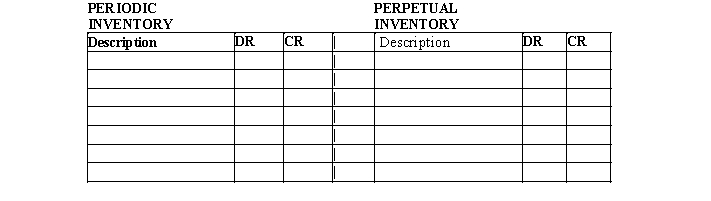
(Essay)
5.0/5 (78)
(78) Merchandise with a list price of $4,200 and costing $2,300 is sold on account, subject to the following terms: FOB destination, 2/10, n/30. The seller prepays the freight costs of $85 debit Delivery Expense for the freight costs). Prior to payment for the goods, the seller issues a credit memo for $750 to the customer for merchandise costing $425 that is returned. Payment is received within the discount period. The company uses a perpetual inventory system.
Record the foregoing transactions of the seller in the sequence indicated below.
a) Sold the merchandise, recognizing the sale and cost of merchandise sold.
b) Paid the freight charges.
c) Issued the credit memo.
d) Received payment from the customer.
(Essay)
4.7/5 (78)
(78) Bountiful Company had sales of $650,000 and cost of merchandise sold of $200,000 during the year. The total assets balance at the beginning of the year was $175,000 and at the end of the year was $167,000. Calculate the ratio of sales to total assets.
(Multiple Choice)
4.8/5 (71)
(71) Under a periodic inventory system, closing entries will include
(Multiple Choice)
4.9/5 (75)
(75) During the current year, merchandise is sold for $86,000 cash and for $93,950 on account. The cost of the merchandise sold is $76,240. What is the amount of the gross profit?
(Essay)
4.9/5 (73)
(73) Using the letter preceding each account, arrange the following selected accounts in the order they would normally appear in a chart of accounts of a company that uses a multiple-step income statement.
a) Accounts Payable
b) Accounts Receivable
c) Merchandise Inventory
d) Miscellaneous Selling Expense
e) Interest Expense
f) Income Summary
g) Misc. Admin. Expense
h) Freight Out
(Short Answer)
4.9/5 (77)
(77) In a merchandising business, sales minus operating expenses equals net income.
(True/False)
4.9/5 (99)
(99) On March 29, customers who owe $10,500 on account to Sonic Sales Company submit payments of $4,250. Journalize this event.

(Essay)
4.7/5 (82)
(82) 
Filters
- Essay(0)
- Multiple Choice(0)
- Short Answer(0)
- True False(0)
- Matching(0)