



 Chat with AI
Exam 3: Market Demand and Supply

Exam 1: Introducing the Economic Way of Thinking251 Questions
Exam 2: Production Possibilities, Opportunity Cost, and Economic Growth202 Questions
Exam 3: Market Demand and Supply412 Questions
Exam 4: Markets in Action253 Questions
Exam 5: Price Elasticity of Demand and Supply280 Questions
Exam 6: Consumer Choice Theory272 Questions
Exam 7: Production Costs243 Questions
Exam 8: Perfect Competition237 Questions
Exam 9: Monopoly168 Questions
Exam 10: Monopolistic Competition and Oligopoly187 Questions
Exam 11: Labor Markets202 Questions
Exam 12: Income Distribution, Poverty, and Discrimination130 Questions
Exam 13: Antitrust and Regulation203 Questions
Exam 14: Environmental Economics106 Questions
Exam 15: International Trade and Finance241 Questions
Exam 16: Economies in Transition108 Questions
Exam 17: Growth and the117 Questions
Select questions type


Exhibit 3A-2 Comparison of Market Efficiency and Deadweight Loss 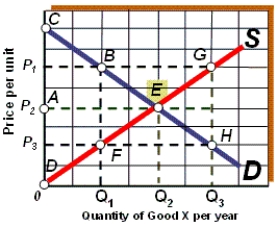 -As shown in Exhibit 3A-2, if the market price falls from P2 to P3, then:
 (Multiple Choice)
4.9/5  (84)
(84) Producer surplus measures the value between the actual selling price and the:
(Multiple Choice)
4.9/5 (70)
(70) In reference to Exhibit 3-5, assume the price of Tucker's Cola is $1.00 per gallon. If the price were to rise to $3.00 per gallon, and all other factors, such as taxes, etc. remained constant, the result would be a(n):
(Multiple Choice)
5.0/5 (63)
(63) Assuming DVDs and DVD players are complements, the effect of an increase in the price of DVD players on the market for DVDs is a(n):
(Multiple Choice)
4.8/5 (78)
(78) Assuming that bus travel is an inferior good, an increase in consumer income, other things being equal, will cause a(n):
(Multiple Choice)
4.9/5 (71)
(71) When economists say the demand for a product has increased, they mean the:
(Multiple Choice)
4.7/5 (78)
(78) Exhibit 3-14 Supply and demand curves 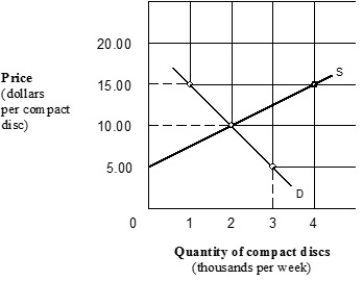 -In Exhibit 3-14, assume that the price of compact discs is $5 each. This price is:
 (Multiple Choice)
4.9/5 (91)
(91) Deadweight loss results from too few or too many resources used in a given market.
(True/False)
5.0/5 (73)
(73) The "other things being equal" clause in the law of demand does not allow which of the following factors to change?
(Multiple Choice)
4.7/5 (74)
(74) Assume that a computer is a normal good. An increase in consumer income, other things being equal, would:
(Multiple Choice)
4.8/5 (85)
(85) Exhibit 3-11 Demand and supply curves 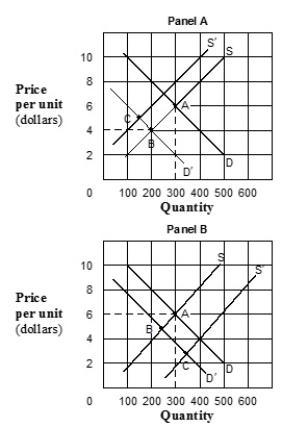 -In Exhibit 3-11, in Panel B the movement from A to C describes a (an):
 (Multiple Choice)
4.7/5 (81)
(81) At a quantity above the equilibrium quantity, which of the following does not exist?
(Multiple Choice)
4.7/5 (74)
(74) Assuming compact discs and cassettes are substitute goods, a decrease in the price of cassettes will cause the demand curve for compact discs to:
(Multiple Choice)
4.9/5 (76)
(76) Other things being equal, a fall in the price of orange juice will decrease the quantity supplied.
(True/False)
4.9/5 (89)
(89) Exhibit 3-6 Milk market Price per Quart Quantity Demanded (Quarts per week) Quantity Supplied (Quarts per week) 0.70 20 180 0.60 60 140 0.50 100 100 0.40 140 60 0.30 180 20
-? In Exhibit 3-6, which of the following are the equilibrium price and equilibrium quantity in the milk market?
(Multiple Choice)
4.9/5 (72)
(72) Exhibit 3A-2 Comparison of Market Efficiency and Deadweight Loss
-As shown in Exhibit 3A-2, if the market price falls from P1 to P2, then area ____ disappears.
-As shown in Exhibit 3A-2, if the market price falls from P1 to P2, then area ____ disappears. (Multiple Choice)
4.9/5 (76)
(76) 
Filters
- Essay(0)
- Multiple Choice(0)
- Short Answer(0)
- True False(0)
- Matching(0)