



 Chat with AI
Exam 3: Market Demand and Supply

Exam 1: Introducing the Economic Way of Thinking251 Questions
Exam 2: Production Possibilities, Opportunity Cost, and Economic Growth202 Questions
Exam 3: Market Demand and Supply412 Questions
Exam 4: Markets in Action253 Questions
Exam 5: Price Elasticity of Demand and Supply280 Questions
Exam 6: Consumer Choice Theory272 Questions
Exam 7: Production Costs243 Questions
Exam 8: Perfect Competition237 Questions
Exam 9: Monopoly168 Questions
Exam 10: Monopolistic Competition and Oligopoly187 Questions
Exam 11: Labor Markets202 Questions
Exam 12: Income Distribution, Poverty, and Discrimination130 Questions
Exam 13: Antitrust and Regulation203 Questions
Exam 14: Environmental Economics106 Questions
Exam 15: International Trade and Finance241 Questions
Exam 16: Economies in Transition108 Questions
Exam 17: Growth and the117 Questions
Select questions type


Exhibit 3A-2 Comparison of Market Efficiency and Deadweight Loss 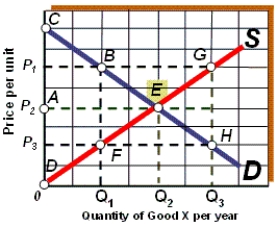 -As shown in Exhibit 3A-2, if the market is in equilibrium, then ____ represents producer surplus.
 (Multiple Choice)
4.7/5  (78)
(78) Total producer surplus is measured by the total area under the equilibrium price and below the supply curve.
(True/False)
4.9/5 (69)
(69) According to the law of supply, price and quantity supplied are inversely related, ceteris paribus.
(True/False)
4.9/5 (70)
(70) Excess quantity demanded for a good creates pressure to push the price of that good down toward the equilibrium price.
(True/False)
4.8/5 (72)
(72) Assuming that automobiles are normal goods, a rise in consumer income, other things being equal, will cause:
(Multiple Choice)
4.8/5 (81)
(81) Which of the following would increase the supply of laptop computers?
(Multiple Choice)
4.9/5 (75)
(75) Which of the following will cause a movement along the supply curve?
(Multiple Choice)
4.8/5 (71)
(71) Producer surplus measures the value between the actual selling price and the profit-maximization price.
(True/False)
4.8/5 (81)
(81) Exhibit 3A-1 Comparison of Market Efficiency and Deadweight Loss 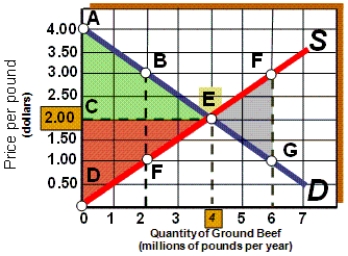 -As shown in Exhibit 3A-1, if the market price falls from $3.00 to $2.00, then:
 (Multiple Choice)
4.9/5 (81)
(81) Assume that oranges and peaches can both be grown on the same type of land, a decrease in the price of peaches, other things being equal, will cause a(n):
(Multiple Choice)
4.9/5 (74)
(74) Other things being equal, the effect of an increase in the price of Coca-Cola would cause a(n):
(Multiple Choice)
4.9/5 (83)
(83) Exhibit 3-12 Supply and demand data
Price Quantity Demanded Quantity Supplied \ 1.00 250 150 1.50 200 200 2.00 150 250 2.50 100 300
-?In Exhibit 3-12, which of the following occurs at a price of $1.00?
(Multiple Choice)
4.7/5 (70)
(70) Assuming that generic brands are inferior goods, an increase in consumer income, other things being equal, will cause a(n):
(Multiple Choice)
4.8/5 (84)
(84) An increase in the demand for peanut butter, a normal good, can be caused by a(n):
(Multiple Choice)
4.9/5 (90)
(90) Suppose seller X is willing to sell one good X for $5, a second good X for $10, a third for $16, a fourth for $25, and the market price is $20. What is seller X's producer surplus?
(Multiple Choice)
4.8/5 (90)
(90) Suppose Gizmo Inc. is willing to sell one gizmo for $10, a second gizmo for $12, a third for $14, and a fourth for $20, and the market price is $20. What is Gizmo Inc.'s producer surplus?
(Multiple Choice)
4.7/5 (86)
(86) Assuming that wheat and corn can both be grown on the same type of land, a decrease in the price of corn, other things being equal, will cause a(n):
(Multiple Choice)
4.9/5 (97)
(97) Other things being equal, an increase in the price of aspirin will decrease the demand for aspirin.
(True/False)
4.9/5 (87)
(87) 
Filters
- Essay(0)
- Multiple Choice(0)
- Short Answer(0)
- True False(0)
- Matching(0)