



 Chat with AI
Exam 8: Cost-Volume-Profit Analysis

Exam 1: Introduction to Management Accounting35 Questions
Exam 2: An Introduction to Cost Terms and Concepts65 Questions
Exam 3: Cost Assignment52 Questions
Exam 4: Accounting Entries for a Job Costing System25 Questions
Exam 5: Process Costing56 Questions
Exam 6: Joint and By-Product Costing65 Questions
Exam 7: Income Effects of Alternative Cost Accumulation Systems42 Questions
Exam 8: Cost-Volume-Profit Analysis59 Questions
Exam 9: Measuring Relevant Costs and Revenues for Decision-Making77 Questions
Exam 10: Activity-Based Costing40 Questions
Exam 11: Activity-Based Costing56 Questions
Exam 12: Decision-Making Under Conditions of Risk and Uncertainty15 Questions
Exam 13: Capital Investment Decisions: Appraisal Methods60 Questions
Exam 14: Capital Investment Decisions: the Impact of Capital Rationing, Taxation, Inflation and Risk22 Questions
Exam 15: The Budgeting Process76 Questions
Exam 16: Management Control Systems60 Questions
Exam 17: Standard Costing and Variance Analysis 181 Questions
Exam 18: Standard Costing and Variance Analysis 2: Further Aspects12 Questions
Exam 19: Divisional Financial Performance Measures48 Questions
Exam 20: Transfer Pricing in Divisionalized Companies43 Questions
Exam 21: Strategic Cost Management101 Questions
Exam 22: Strategic Performance Management29 Questions
Exam 23: Cost Estimation and Cost Behaviour59 Questions
Exam 24: Quantitative Models for the Planning and Control of Inventories40 Questions
Exam 25: The Application of Linear Programming to Management Accounting30 Questions
Select questions type


The Barnes Company manufactures two products. Information about the two product lines is as follows:
Product K Product Y Selling price per unit £80 £30 Variable costs per unit Contribution margin per unit The company expects fixed costs to be £189,000. The firm expects 60 per cent of its sales (in units) to be Product K (a sales mix of 3:2).
Required:
a.Calculate the contribution margin per package.
b.Determine the break-even point in units for Product K and Product Y.
c.Determine the level of sales (in pounds) necessary to generate a before-tax profit of £135,000.
(Essay)
5.0/5  (80)
(80) Management is interested in utilizing the full capacity of production facilities because it
(Multiple Choice)
4.9/5 (74)
(74) Figure 8-6
The following diagram is a cost-volume-profit graph for a manufacturing company: 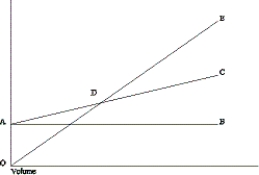 -Refer to Figure 8-6. Select the answer that best describes the labeled item on the diagram.
 (Multiple Choice)
4.7/5 (68)
(68) Which of the following is a TRUE statement about sales mix?
(Multiple Choice)
4.8/5 (71)
(71) Figure 8-4
Dirth Company sells only one product at a regular price of £7.50 per unit. Variable expenses are 60 per cent of sales and fixed expenses are £30,000. Management has decided to decrease the selling price to £6.00 in hopes of increasing its volume of sales.
-Refer to Figure 8-4. What sales pound level is needed to obtain a before-tax profit of £60,000 when the selling price is £6.00 per unit?
(Multiple Choice)
4.9/5 (89)
(89) Chopra Company developed the following income statement using a contribution margin approach: CHOPRA COMPANY PROJECTED INCOME STATEMENT FOR THE CURRENT YEAR ENDING DECEMBER 31 Sales £240,000 Less variable costs: Variable manufacturing costs £60,000 Variable selling costs \_36,000 Total variable costs Contribution margin £144,000 Less fixed costs: Fixed manufacturing costs £85,000 Fixed selling and administrative costs Total fixed costs \_120,000 Operating income £24,000
The projected income statement was based on sales of 12,000 units. Chopra has the capacity to produce 15,000 units during the year.
a.Determine the break-even point in units.
b.The sales manager believes the company could increase sales by 1,000 units if advertising expenditures were increased by £15,000. Determine the effect on income if the company increases advertising expenditures.
c.What is the maximum amount the company could pay for advertising if the advertising would increase sales by 1,000 units?
(Essay)
4.9/5 (74)
(74) On a profit-volume graph, the profit line intersects the horizontal axis at
(Multiple Choice)
4.8/5 (77)
(77) Which of the following assumptions does NOT pertain to cost-volume-profit analysis?
(Multiple Choice)
4.9/5 (76)
(76) In a profit-volume graph, the slope of the profit line represents
(Multiple Choice)
4.8/5 (80)
(80) Figure 8-3
Sarah Smith, a sole proprietor, has the following projected figures for next year: Selling price per unit £150.00 Contributi on margin per unit £45.00 Total fixed costs £630,000
-Refer to Figure 8-3. What selling price per unit is needed to obtain a before-tax profit of £270,000 at a volume of 4,000 units?
(Multiple Choice)
4.7/5 (70)
(70) What is the first step in classifying costs according to behaviour?
(Multiple Choice)
4.9/5 (85)
(85) Using cost-volume-profit analysis, we can conclude that a 20 per cent reduction in variable costs will
(Multiple Choice)
4.9/5 (96)
(96) The Valdez Mug Company manufactures plastic mugs that sell to wholesalers for £4.00 each. Variable and fixed costs are as follows: 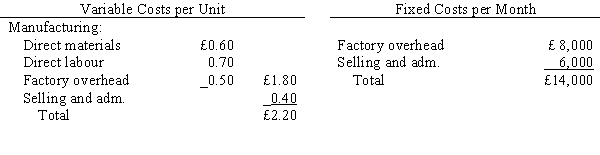 Valdez Mug produced and sold 10,000 cups during April 2011. There were no beginning or ending inventories.
Required:
a.Determine Valdez Mug's monthly break-even point in units.
b.If monthly sales increase by 500 cups, what will be the change in monthly profits?
c.If Valdez Mug is now subject to an income tax of 40 per cent, what pound sales volume is required to earn a monthly after-tax net income of £12,000?
Valdez Mug produced and sold 10,000 cups during April 2011. There were no beginning or ending inventories.
Required:
a.Determine Valdez Mug's monthly break-even point in units.
b.If monthly sales increase by 500 cups, what will be the change in monthly profits?
c.If Valdez Mug is now subject to an income tax of 40 per cent, what pound sales volume is required to earn a monthly after-tax net income of £12,000? (Essay)
5.0/5 (75)
(75) Figure 8-2
Lewis Production Company had the following projected information for 2011: Selling price per unit £150 Variable cost per unit £90 Total fixed costs £300,000
-Refer to Figure 8-2. What is the break-even point in units?
(Multiple Choice)
4.8/5 (88)
(88) A decrease in the sales price in the basic cost-volume-profit model would
(Multiple Choice)
4.8/5 (85)
(85) In a cost-volume-profit graph, the slope of the total cost line represents
(Multiple Choice)
4.8/5 (69)
(69) Supply the missing data in each independent case. Case 1 Case 2 Case 3 Case 4 Case 5 Unit sales 700 300 ? ? ? Sales revenue £42,000 ? ? £58,000 £40,000 Variable cost per unit £45 £1 £15 ? ? Contribution Margin ? £1,200 ? ? £10,000 Fixed costs £7,500 ? £60,000 ? ? Operating income ? £100 ? ? ? Unit contribution margin ? ? ? £1 £2 Break-even point (units) ? ? 5,000 30,000 ? Margin of Safety ? ? 1,000 -1,000 600
(Essay)
4.9/5 (75)
(75) Which of the following assumptions is NOT necessary for cost-volume-profit analysis?
(Multiple Choice)
4.9/5 (74)
(74) 
Filters
- Essay(0)
- Multiple Choice(0)
- Short Answer(0)
- True False(0)
- Matching(0)