



 Chat with AI
Exam 14: Taxes on the Financial Statements

Exam 1: Understanding and Working With the Federal Tax Law74 Questions
Exam 2: Corporations Introduction and Operating Rules100 Questions
Exam 3: Corporations Special Situations105 Questions
Exam 4: Corporations Organization and Capital Structure89 Questions
Exam 5: Corporations Earnings Profits and Dividend Distributions128 Questions
Exam 6: Corporations Redemptions and Liquidations98 Questions
Exam 7: Corporations Reorganizations127 Questions
Exam 8: Consolidated Tax Returns169 Questions
Exam 9: Taxation of International Transactions167 Questions
Exam 10: Partnerships Formation Operation and Basis128 Questions
Exam 11: Partnerships Distributions Transfer of Interests and Terminations132 Questions
Exam 12: S Corporations147 Questions
Exam 13: Comparative Forms of Doing Business129 Questions
Exam 14: Taxes on the Financial Statements172 Questions
Exam 15: Exempt Entities123 Questions
Exam 16: Multi-State Corporate Taxations182 Questions
Exam 17: Tax Practice and Ethics169 Questions
Exam 18: The Federal Gift and Estate Taxes177 Questions
Exam 19: Family Tax Planning132 Questions
Exam 20: Income Taxation of Trusts and Estates166 Questions
Select questions type


Which of the following items are not included in the GAAP financial statement income tax footnote's effective tax rate reconciliation?
(Multiple Choice)
5.0/5  (68)
(68) Only U.S. corporations are included in a combined GAAP financial statement.
(True/False)
4.9/5 (85)
(85) Schedule UTP of the Form 1120 reconciles financial statement net income after tax with a large corporation's taxable income.
(True/False)
4.8/5 (82)
(82) Black, Inc., is a domestic corporation with the following balance sheet for book and tax purposes at the
end of the year. Assume a 35% corporate tax rate and no valuation allowance. 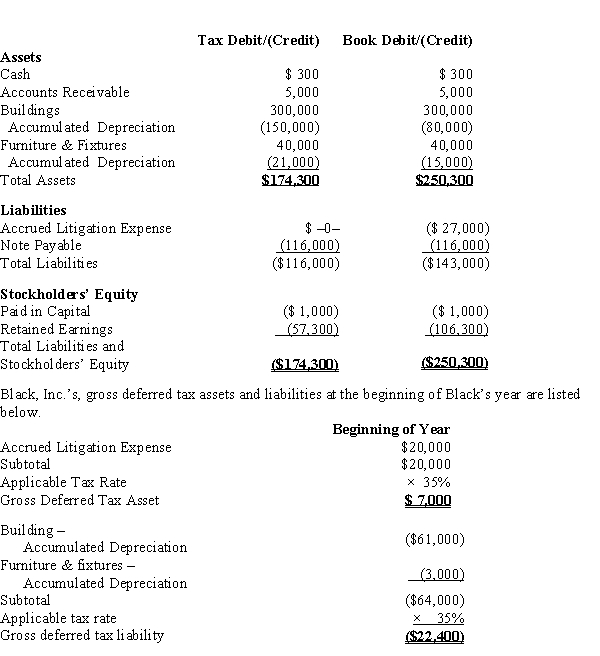
Black, Inc.'s, book income before tax is $6,000. Black records two permanent book-tax differences.
It earned $250 in tax-exempt municipal bond interest, and it incurred $500 in nondeductible meals
and entertainment expense. Determine the net deferred tax asset or net deferred tax liability at year end.
Black, Inc.'s, book income before tax is $6,000. Black records two permanent book-tax differences.
It earned $250 in tax-exempt municipal bond interest, and it incurred $500 in nondeductible meals
and entertainment expense. Determine the net deferred tax asset or net deferred tax liability at year end. (Essay)
4.8/5 (85)
(85) Qute, Inc., earns book net income before tax of $500,000. In computing its book income, Qute deducts $50,000 more in warranty expense for book purposes than is allowed for tax purposes. Qute records no other temporary or permanent book-tax differences. Assuming that the U.S. tax rate is 35% and no valuation allowance is required, what is Qute's total income tax expense reported on its GAAP financial statements?
(Multiple Choice)
4.8/5 (90)
(90) Beach, Inc., a domestic corporation, owns 100% of Mountain, Ltd., a manufacturing facility in Erasmus. Mountain has no operations or activities in the United States. The U.S. tax rate is 35% and the applicable Erasmus tax rate is 10%. For the current year, Beach earns $500,000 in taxable income. Mountain earns $300,000 in taxable income from its operations, pays $30,000 in taxes to Erasmus, and makes no distributions to Beach. What is Beach's effective tax rate for GAAP book purposes, assuming that Beach does not make the permanent reinvestment assumption of ASC 740-30 (APB 23)?
(Multiple Choice)
4.7/5 (83)
(83) Amelia, Inc., is a domestic corporation with the following balance sheet for book and tax purposes at the end of the year. Assume a 34% corporate tax rate and no valuation allowance. 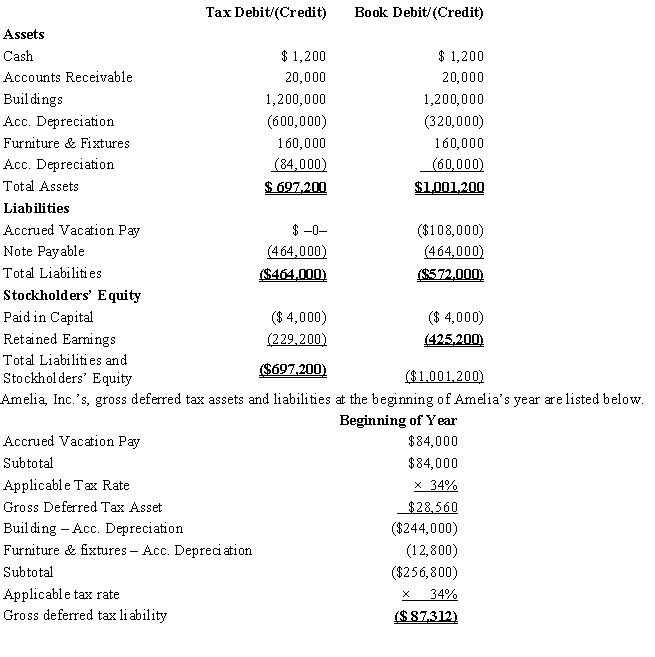 Amelia, Inc.'s, book income before tax is $25,200. Amelia records two permanent book-tax differences. It earned $1,000 in tax-exempt municipal bond interest and $1,840 in nondeductible meals and entertainment expense. Provide the income tax footnote rate reconciliation for Amelia.
 (Essay)
4.8/5 (90)
(90) Clipp, Inc., earns book net income before tax of $600,000. Clipp puts into service a depreciable asset this year, and first year tax depreciation exceeds book depreciation by $120,000. Clipp has recorded no other temporary or permanent book-tax differences. Assuming that the U.S. tax rate is 35%, what is Clipp's deferred income tax liability reported on its GAAP financial statements?
(Multiple Choice)
4.9/5 (71)
(71) PaintCo Inc., a domestic corporation, owns 100% of BrushCo Ltd., an Irish corporation. Assume that the U.S. corporate tax rate is 35% and the Irish rate is 15%. PaintCo is permanently reinvesting BrushCo's earnings outside the United States under ASC 740-30 (APB 23). There is no valuation allowance, and the effective tax rates do not change. PaintCo's book income, permanent and temporary book-tax differences, and current tax expense are reported as follows.
? Paint Co Brush Co Book income before tax \ 600,000 \ 400,000 Permanent differences Meals \& entertainment expense 40,000 -0- Municipal bond interest income (10,000) -0- Temporary differences Tax > book depreciation (100,000) -0- Book > tax bad debt expense 20,000 -0- ?
Provide the GAAP income tax footnote rate reconciliation for PaintCo, using both dollar amounts and percentages.
(Essay)
4.9/5 (92)
(92) Under GAAP, a corporation can defer reporting the U.S. tax expense related to the earnings of foreign subsidiaries, by taking into account its repatriation plans for these earnings.
(True/False)
4.7/5 (75)
(75) Black, Inc., is a domestic corporation with the following balance sheet for book and tax purposes at the end of the year. Assume a 35% corporate tax rate and no valuation allowance. 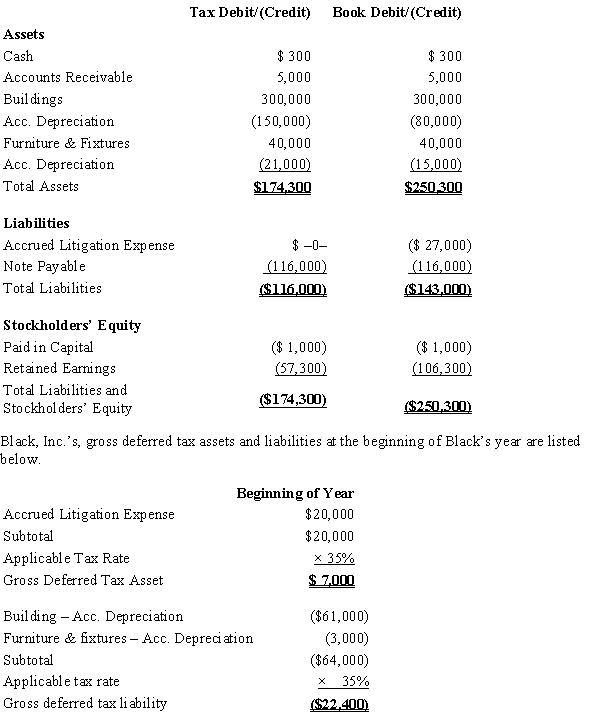 Black, Inc.'s, book income before tax is $6,000. Black records two permanent book-tax differences. It earned $250 in tax-exempt municipal bond interest, and it incurred $500 in nondeductible meals and entertainment expense. Calculate Black's current tax expense.
 (Essay)
4.9/5 (77)
(77) Cold, Inc., reported a $100,000 total tax expense for financial statement purposes in year 1. This total expense consisted of $150,000 in current tax expense and a deferred tax benefit of $50,000. The deferred tax benefit consisted of $90,000 in deferred tax assets reduced by a valuation allowance of $40,000. In year 2, Cold reports $600,000 in book net income before tax. Cold records no other permanent or temporary book-tax differences. At the end of year 2, Cold's auditors determine that the existing valuation allowance of $40,000 should be reduced to zero. What is Cold's total tax expense for year 2?
(Multiple Choice)
4.8/5 (81)
(81) Amelia, Inc., is a domestic corporation with the following balance sheet for book and tax purposes at the end of the year. Assume a 34% corporate tax rate and no valuation allowance. 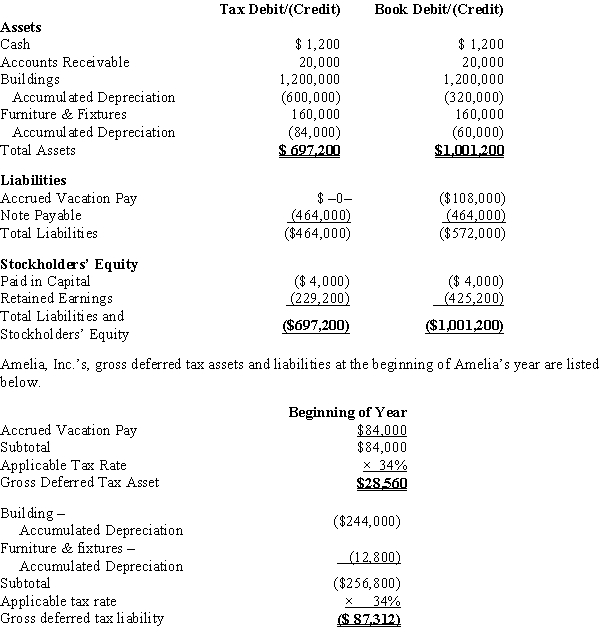 Amelia, Inc.'s, book income before tax is $25,200. Amelia records two permanent book-tax differences.
It earned $1,000 in tax-exempt municipal bond interest and $1,840 in nondeductible meals and
entertainment expense. Provide the journal entry to record Amelia's current tax expense.
Amelia, Inc.'s, book income before tax is $25,200. Amelia records two permanent book-tax differences.
It earned $1,000 in tax-exempt municipal bond interest and $1,840 in nondeductible meals and
entertainment expense. Provide the journal entry to record Amelia's current tax expense. (Essay)
4.9/5 (77)
(77) "Temporary differences" are book-tax differences that appear in both the GAAP financial statements and the Federal income tax return, but not in the same reporting period.
(True/False)
4.9/5 (88)
(88) Amelia, Inc., is a domestic corporation with the following balance sheet for book and tax purposes at the end of the year. Assume a 34% corporate tax rate and no valuation allowance. 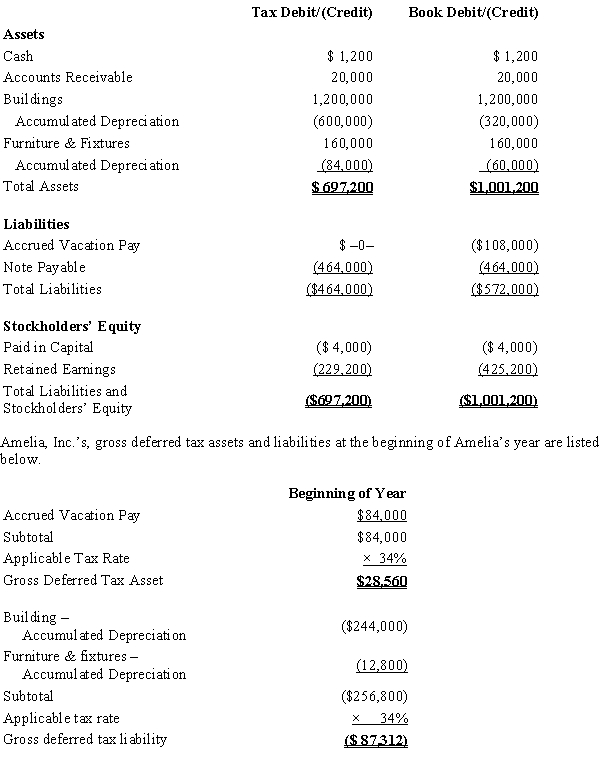 Amelia, Inc.'s, book income before tax is $25,200. Amelia records two permanent book-tax differences.
It earned $1,000 in tax-exempt municipal bond interest and $1,840 in nondeductible meals and
entertainment expense. Calculate Amelia's current tax expense.
Amelia, Inc.'s, book income before tax is $25,200. Amelia records two permanent book-tax differences.
It earned $1,000 in tax-exempt municipal bond interest and $1,840 in nondeductible meals and
entertainment expense. Calculate Amelia's current tax expense. (Essay)
4.9/5 (79)
(79) In the "rate reconciliation" of GAAP tax footnotes, temporary book-tax differences are reconciled between book income as if taxed at U.S. tax rates and the actual book income tax expense.
(True/False)
4.7/5 (81)
(81) A valuation allowance reflects uncertainty that the taxpayer will be able to recover a deferred tax asset.
(True/False)
4.7/5 (82)
(82) Clipp, Inc., earns book net income before tax of $600,000. Clipp puts into service a depreciable asset this year, and first year tax depreciation exceeds book depreciation by $120,000. Clipp has recorded no other temporary or permanent book-tax differences. Assuming that the U.S. tax rate is 35%, what is Clipp's deferred income tax liability reported on its GAAP financial statements?
(Multiple Choice)
4.9/5 (91)
(91) Book-tax differences can be explained in part by examining the objectives underlying financial accounting and taxable income computations. Evaluate this statement.
(Essay)
4.9/5 (87)
(87) A deferred tax liability represents a current tax liability associated with income or expense to be reported in future year GAAP financial statements.
(True/False)
4.9/5 (84)
(84) 
Filters
- Essay(0)
- Multiple Choice(0)
- Short Answer(0)
- True False(0)
- Matching(0)