



 Chat with AI
Exam 14: Taxes on the Financial Statements

Exam 1: Understanding and Working With the Federal Tax Law74 Questions
Exam 2: Corporations Introduction and Operating Rules100 Questions
Exam 3: Corporations Special Situations105 Questions
Exam 4: Corporations Organization and Capital Structure89 Questions
Exam 5: Corporations Earnings Profits and Dividend Distributions128 Questions
Exam 6: Corporations Redemptions and Liquidations98 Questions
Exam 7: Corporations Reorganizations127 Questions
Exam 8: Consolidated Tax Returns169 Questions
Exam 9: Taxation of International Transactions167 Questions
Exam 10: Partnerships Formation Operation and Basis128 Questions
Exam 11: Partnerships Distributions Transfer of Interests and Terminations132 Questions
Exam 12: S Corporations147 Questions
Exam 13: Comparative Forms of Doing Business129 Questions
Exam 14: Taxes on the Financial Statements172 Questions
Exam 15: Exempt Entities123 Questions
Exam 16: Multi-State Corporate Taxations182 Questions
Exam 17: Tax Practice and Ethics169 Questions
Exam 18: The Federal Gift and Estate Taxes177 Questions
Exam 19: Family Tax Planning132 Questions
Exam 20: Income Taxation of Trusts and Estates166 Questions
Select questions type


A deferred tax asset is the expected future tax benefit (savings) associated with income reported in the current year GAAP financial statements.
(True/False)
4.9/5  (88)
(88) At the beginning of the year, the balance sheet of Schrader, Inc., shows a $500,000 deferred tax asset relating to a net operating loss carryforward, offset by a $90,000 valuation allowance. At the end of the year, Schrader's auditors agree to release $20,000 of the allowance. Develop the journal entry to record this change in the valuation allowance.
(Essay)
4.7/5 (71)
(71) Repatriating prior year earnings from a foreign subsidiary located in a low-tax country where ASC 740-30 (APB 23) benefits were previously adopted will decrease a corporation's current year effective tax rate.
(True/False)
4.8/5 (84)
(84) Bryden Corporation is considering two tax planning strategies. Both would produce a $1 million tax savings. One of the strategies would structure the plan so that the $1 million would represent a temporary book-tax difference, while the other would generate a permanent difference. In general, which plan would the Bryden CFO prefer? A stock analyst reviewing the Bryden valuation?
(Essay)
4.8/5 (87)
(87) A valuation allowance expresses on the GAAP balance sheet that there exists uncertainty that the taxpayer will be able to recover a deferred tax asset.
(True/False)
4.9/5 (60)
(60) Yahr, Inc., is a domestic corporation with no subsidiaries. It operates in almost every U.S. state. Yahr records no permanent or temporary book-tax differences this year. Yahr's tax expense on its GAAP financial statements and its tax liability reported on its Federal income tax return are identical.
(True/False)
4.8/5 (82)
(82) South, Inc., earns book net income before tax of $400,000 in year 1. South acquires a depreciable asset in year 1, and first year tax depreciation exceeds book depreciation by $50,000. At the end of year 1, South's deferred tax liability account balance is $17,500. In year 2, South earns $500,000 book net income before tax, and its book depreciation exceeds tax depreciation by $20,000. South records no other temporary or permanent book-tax differences. Assuming that the U.S. tax rate is 35%, what is South's balance in its deferred tax liability account at the end of year 2?
(Multiple Choice)
4.7/5 (76)
(76) Gravel, Inc., earns book net income before tax of $600,000. Gravel puts into service a depreciable asset this year, and first year tax depreciation exceeds book depreciation by $120,000. Gravel has recorded no other temporary or permanent book-tax differences. Assuming that the U.S. tax rate is 35%, what is Gravel's current income tax expense reported on its GAAP financial statements?
(Multiple Choice)
4.7/5 (86)
(86) Never, Inc., earns book net income before tax of $500,000. In computing its book income, Never deducts $50,000 more in warranty expense for book purposes than is allowed for tax purposes. Never records no other temporary or permanent book-tax differences. Assuming that the U.S. tax rate is 35% and no valuation allowance is required, what is Never's deferred income tax asset reported on its GAAP financial statements?
(Multiple Choice)
4.8/5 (83)
(83) Yahr, Inc., is a domestic corporation with no subsidiaries. It operates in almost every U.S. state. Yahr records no permanent or temporary book-tax differences this year. Yahr's tax expense on its GAAP financial statements and its tax liability reported on its Federal income tax return are identical.
(True/False)
5.0/5 (72)
(72) Repatriating prior year earnings from a foreign subsidiary located in a low-tax country where ASC 740-30 (APB 23) benefits were previously adopted will decrease a corporation's current year effective tax rate.
(True/False)
4.9/5 (85)
(85) Amelia, Inc., is a domestic corporation with the following balance sheet for book and tax purposes at the end of the year. Assume a 34% corporate tax rate and no valuation allowance.
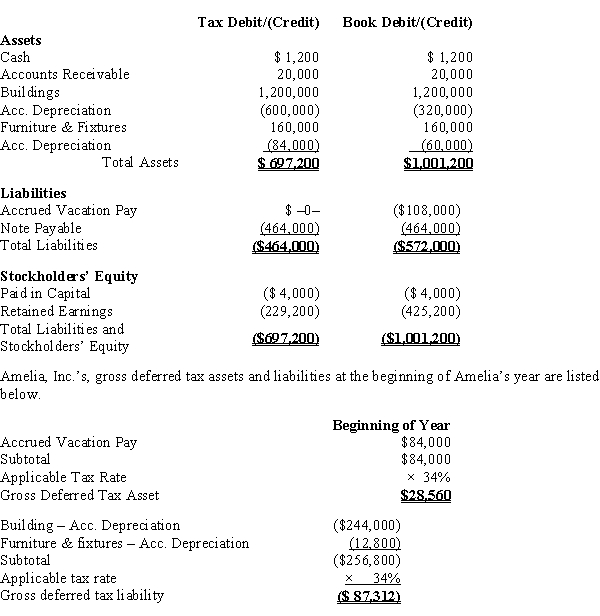 Amelia, Inc.'s, book income before tax is $25,200. Amelia records two permanent book-tax differences. It earned $1,000 in tax-exempt municipal bond interest and $1,840 in nondeductible meals and entertainment expense. Determine the net deferred tax asset or net deferred tax liability at year end.
 (Essay)
4.8/5 (82)
(82) A CFO probably prefers a tax planning strategy that produces a temporary book-tax savings difference to one that produces a permanent difference.
(True/False)
4.8/5 (93)
(93) Purple, Inc., a domestic corporation, owns 100% of Blue, Ltd., a foreign corporation and Yellow, Inc., a domestic corporation. Purple also owns 40% of Green, Inc., a domestic corporation. Purple receives no distributions from any of these corporations. Which of these entities' net income are included in Purple's GAAP income statement for current year financial reporting purposes?
(Multiple Choice)
4.8/5 (71)
(71) "Permanent differences" include items that appear in the Federal income tax return as income or deduction, and in the GAAP financial statements as revenue or expense, but in different reporting periods.
(True/False)
4.8/5 (73)
(73) A deferred tax liability represents a current tax liability associated with income or expense to be reported in future year GAAP financial statements.
(True/False)
4.8/5 (85)
(85) Beach, Inc., a domestic corporation, owns 100% of Mountain, Ltd., a manufacturing facility in Atlantis. Mountain has no operations or activities in the United States. The U.S. tax rate is 35% and the applicable Atlantis tax rate is 10%. For the current year, Beach earns $500,000 in taxable income. Mountain earns $300,000 in taxable income from its operations, pays $30,000 in taxes to Atlantis, and makes no distributions to Beach. What is Beach's effective tax rate for GAAP book purposes, assuming that Beach makes the permanent reinvestment assumption of ASC 740-30 (APB 23)?
(Multiple Choice)
4.7/5 (99)
(99) Under GAAP, a corporation can defer reporting the U.S. tax expense related to the earnings of foreign subsidiaries, by taking into account its repatriation plans for these earnings.
(True/False)
5.0/5 (89)
(89) Hot, Inc.'s primary competitor is Cold, Inc. When comparing relative deferred tax asset and liability accounts with Cold, which of the following benchmarking activities should Hot undertake?
(Multiple Choice)
4.8/5 (64)
(64) Giant uses the "equity method" to account for the operations of its 40% owned subsidiary Little. A portion of Little's profits for the year are included in Giant's GAAP book income.
(True/False)
4.8/5 (92)
(92) 
Filters
- Essay(0)
- Multiple Choice(0)
- Short Answer(0)
- True False(0)
- Matching(0)