



 Chat with AI
Exam 16: Cost-Volume-Profit Analysis

Exam 1: Introduction to Cost Management154 Questions
Exam 2: Basic Cost Management Concepts191 Questions
Exam 3: Cost Behavior187 Questions
Exam 4: Activity-Based Costing202 Questions
Exam 5: Product and Service Costing: Job-Order System142 Questions
Exam 6: Process Costing176 Questions
Exam 7: Allocating Costs of Support Departments and Joint Products160 Questions
Exam 8: Budgeting for Planning and Control206 Questions
Exam 9: Standard Costing: a Functional-Based Control Approach119 Questions
Exam 10: Decentralization: Responsibility Accounting, Performance133 Questions
Exam 11: Strategic Cost Management124 Questions
Exam 12: Activity-Based Management143 Questions
Exam 13: The Balanced Scorecard: Strategic-Based Control114 Questions
Exam 14: Quality and Environmental Cost Management192 Questions
Exam 15: Lean Accounting and Productivity Measurement165 Questions
Exam 16: Cost-Volume-Profit Analysis129 Questions
Exam 17: Activity Resource Usage Model and Tactical Decision Making116 Questions
Exam 18: Pricing and Profitability Analysis150 Questions
Exam 19: Capital Investment120 Questions
Exam 20: Inventory Management: Economic Order Quantity, Jit, and the Theory of Constraints119 Questions
Select questions type


The following data pertain to the three products produced by Beta Corporation: A B C Selling price per unit \ 6.00 \ 8.00 \ 9.00 Variable costs per unit 4.00 4.00 4.00 Contribution margin per unit \ 2.00 \ 4.00 \ 5.00
Fixed costs are $77,000 per month.
Twenty percent of all units sold are Product A, fifty-five percent are Product B, and twenty-five percent are Product C.
What is the monthly break-even point for total units?
(Multiple Choice)
4.9/5  (72)
(72) The following diagram is a cost-volume-profit graph for a manufacturing company: 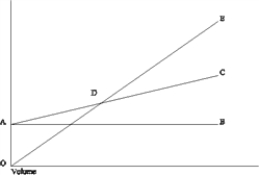 The difference between line AB and line AC (area BAC) is the
 (Multiple Choice)
4.8/5 (74)
(74) Nonesuch Company sells only one product at a regular price of $7.50 per unit. Variable expenses are 60 percent of sales and fixed expenses are $30,000. Management has decided to decrease the selling price to $6.00 in hopes of increasing its volume of sales.
What is the sales dollars level required to break even at the old price of $7.50?
(Multiple Choice)
4.9/5 (84)
(84) Biscuit Company sells its product for $50. In addition, it has a variable cost ratio of 45 percent and total fixed costs of $6,875. What is the break-even point in units for Biscuit Company?
(Multiple Choice)
4.8/5 (76)
(76) Biscuit Company sells its product for $50. In addition, it has a variable cost ratio of 55 percent and total fixed costs of $6,875. How many units must be sold in order to obtain a before-tax profit of $12,000?
(Multiple Choice)
4.9/5 (73)
(73) Increases in sales of low contribution margin products decrease the break-even point.
(True/False)
4.9/5 (76)
(76) When a company sells more units than the break-even point, the __________ are positive.
(Short Answer)
5.0/5 (77)
(77) On a profit-volume graph, the profit line intersects the horizontal axis at
(Multiple Choice)
4.9/5 (92)
(92) The Mildmanner Corporation has the following data for 2018: Selling price per unit \1 5 Variable cost per unit \ 9 Fixed costs \ 45,000 Units sold 10,000 units The margin of safety in units will be (round to the nearest whole unit)
(Multiple Choice)
4.8/5 (76)
(76) Sales × Contribution Margin is a short-cut of what formula?
(Multiple Choice)
4.8/5 (87)
(87) Bronze Company had the following information: Activity Driver Unit Variable Cost Level of Activity Drive Units sold \ 30 -- Setups 1,200 60 Engineering hours 40 1,000 Other data: Total fixed costs (traditional) \ 500,000 Total fixed costs (ABC) \ 200,000 Unit selling price \5 0
What is the break-even point in units using activity-based costing (ABC)?
(Multiple Choice)
4.8/5 (76)
(76) Target after-tax profit must be converted into __________ profit to calculate units or revenue needed.
(Short Answer)
4.9/5 (74)
(74) Jamie Quinn, a sole proprietor, has the following projected figures for next year: Selling price per unit \1 50.00 Contribution margin per unit \4 5.00 Total fixed costs \6 30,000
What selling price per unit is needed to obtain a before-tax profit of $270,000 at a volume of 4,000 units?
(Multiple Choice)
4.9/5 (65)
(65) The Cumberland Company provides the following information: Sales (250,000 units) \6 25,000 Manufacturing costs: Variable 212,500 Fixed 37,500 Selling and administrative costs: Variable 100,000 Fixed 25,000
What is the operating income for Cumberland?
(Multiple Choice)
4.9/5 (81)
(81) Summersville Production Company had the following projected information for the current year: Selling price per unit \ 150 Variable cost per unit \ 90 Total fixed costs \ 300,000
What is the contribution margin ratio?
(Multiple Choice)
4.7/5 (73)
(73) The Cumberland Company provides the following information: Sales (250,000 units) \6 25,000 Manufacturing costs: Variable 212,500 Fixed 37,500 Selling and administrative costs: Variable 100,000 Fixed 25,000
What is the total contribution margin for Cumberland?
(Multiple Choice)
4.8/5 (75)
(75) Symbiosis Company had the following information: Activity Driver Unit Variable Cost Level of Activity Drive Units sold \ 20 -- Setups 1,000 80 Engineering hours 60 2,000 Other data: Total fixed costs (traditional) \ 800,000 Total fixed costs (ABC) \ 400,000 Unit selling price \4 0
Suppose Symbiosis could reduce setup costs by $500 per setup and could reduce the number of engineering hours needed to 1,216.66 hours. How many units must be sold to break even in this case?
(Multiple Choice)
4.8/5 (74)
(74) 
Filters
- Essay(0)
- Multiple Choice(0)
- Short Answer(0)
- True False(0)
- Matching(0)