



 Chat with AI
Exam 14: Definite Integrals: Techniques of Integration

Exam 1: Algebraic Concepts308 Questions
Exam 2: Linear Equations and Functions243 Questions
Exam 3: Quadratic and Other Special Functions113 Questions
Exam 4: Matrices227 Questions
Exam 5: Inequalities and Linear Programming120 Questions
Exam 6: Exponential and Logarithmic Functions108 Questions
Exam 7: Mathematics of Finance131 Questions
Exam 8: Introduction to Probability178 Questions
Exam 9: Further Topics in Probability; Data Description114 Questions
Exam 10: Derivatives248 Questions
Exam 11: Applications of Derivatives172 Questions
Exam 12: Derivatives Continued139 Questions
Exam 13: Indefinite Integrals120 Questions
Exam 14: Definite Integrals: Techniques of Integration185 Questions
Exam 15: Functions of Two or More Variables119 Questions
Select questions type


Equations are given whose graphs enclose a region. Find the area of the region.  ,
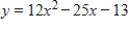 ,
 and

, , and (Multiple Choice)
4.7/5  (74)
(74) Evaluate the improper integral if it converges, or state that it diverges. 
(Multiple Choice)
4.8/5 (84)
(84) Approximate the area under the curve defined by the function  over the interval x = 0 to x = 3 using the right-hand endpoints of three subintervals (rectangles).
 (Multiple Choice)
4.9/5 (57)
(57) Find the shaded area between the given function and the x-axis. 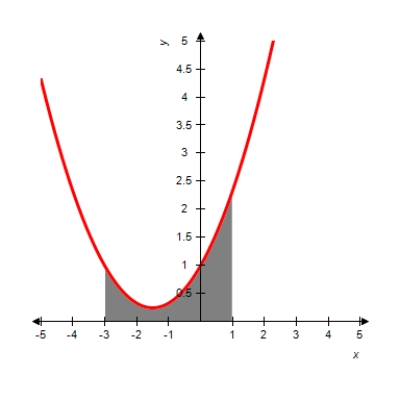
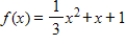
(Multiple Choice)
4.8/5 (72)
(72)  .
Use the function  from
 to
 and n equal subintervals with the function evaluated at the left-hand endpoints of each subinterval. Find
 by using the formula for the sum of the areas of the n rectangles (call this S).
from to and n equal subintervals with the function evaluated at the left-hand endpoints of each subinterval. Find by using the formula for the sum of the areas of the n rectangles (call this S). (Multiple Choice)
4.7/5 (84)
(84) Evaluate the improper integral if it converges, or state that it diverges. 
(Multiple Choice)
4.7/5 (80)
(80) The manufacturer of a medicine wants to test how a new 300-milligram capsule is released into the bloodstream. After a volunteer is given a capsule, blood samples are drawn every half-hour, and the number of milligrams of the drug in the bloodstream is calculated. The results obtained are as follows. 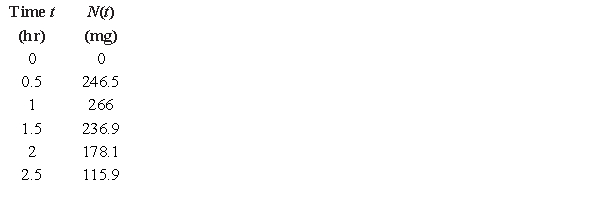 Use the trapezoidal rule to approximate the average number of milligrams in the bloodstream during the first
 hours and round your answer to two decimal places.
Use the trapezoidal rule to approximate the average number of milligrams in the bloodstream during the first hours and round your answer to two decimal places. (Multiple Choice)
4.9/5 (63)
(63) 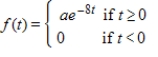 a probability density function?
Use integration by parts to evaluate  . Note that evaluation may require integration by parts more than once.
(Multiple Choice)
4.7/5 (76)
(76) Determine the most appropriate method or integral formula for evaluating the given integral. Next, evaluate the integral.
I. Integration by parts
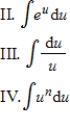

(Multiple Choice)
4.8/5 (85)
(85) If the supply function for a commodity is  where p is in millions of dollars and x is the number of thousands of units. What is the producer's surplus when 8 thousand units are sold? Round your answer to the nearest million dollars.
 (Multiple Choice)
4.8/5 (84)
(84) 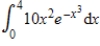 .
Use the function  from
 to
 and n equal subintervals with the function evaluated at the right-hand endpoints of each subinterval. Find a formula for the sum of the areas of the n rectangles (call this S).
from to and n equal subintervals with the function evaluated at the right-hand endpoints of each subinterval. Find a formula for the sum of the areas of the n rectangles (call this S). (Multiple Choice)
4.8/5 (68)
(68) The probability density function for the life span of an electronics part is 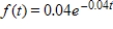 where t is the number of months in service. Find the probability that any given part of this type lasts longer than 18 months. Round your answer to three decimal places.
 (Multiple Choice)
4.8/5 (96)
(96) With the data for selected years from 1920 to 2007, the life span of individuals in a country can be modeled by  where x = 0 represents 1900. Find the predicted average life span from 2040 to 2055. Round your answer to the nearest year.
 (Multiple Choice)
4.9/5 (73)
(73) Suppose that the rate at which a nuclear power plant produces radioactive waste is proportional to the number of years it has been operating, according to  in pounds per year. Suppose also that the waste decays exponentially at a rate of 9% per year. Then the amount of radioactive waste that will accumulate in b years is given by
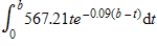 . Evaluate this integral.
in pounds per year. Suppose also that the waste decays exponentially at a rate of 9% per year. Then the amount of radioactive waste that will accumulate in b years is given by . Evaluate this integral. (Multiple Choice)
4.9/5 (76)
(76) Evaluate the integral  by integration. Round your answer to two decimal places.
 (Multiple Choice)
4.8/5 (71)
(71) The demand function for a product is  and the supply function is
 , where p is the number of dollars and x is the number of units. Find the consumer's surplus there. Round to the nearest cent.
and the supply function is , where p is the number of dollars and x is the number of units. Find the consumer's surplus there. Round to the nearest cent. (Multiple Choice)
4.8/5 (89)
(89) A drug manufacturer has developed a time-release capsule with the number of milligrams of the drug in the bloodstream given by 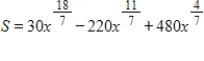 where x is in hours and
 . Find the average number of milligrams of the drug in the bloodstream for the first 3 hours after a capsule is taken. Round your answer to the nearest milligram.
where x is in hours and . Find the average number of milligrams of the drug in the bloodstream for the first 3 hours after a capsule is taken. Round your answer to the nearest milligram. (Multiple Choice)
4.9/5 (95)
(95) 
Filters
- Essay(0)
- Multiple Choice(0)
- Short Answer(0)
- True False(0)
- Matching(0)