



 Chat with AI
Exam 7: Mathematics of Finance

Exam 1: Algebraic Concepts308 Questions
Exam 2: Linear Equations and Functions243 Questions
Exam 3: Quadratic and Other Special Functions113 Questions
Exam 4: Matrices227 Questions
Exam 5: Inequalities and Linear Programming120 Questions
Exam 6: Exponential and Logarithmic Functions108 Questions
Exam 7: Mathematics of Finance131 Questions
Exam 8: Introduction to Probability178 Questions
Exam 9: Further Topics in Probability; Data Description114 Questions
Exam 10: Derivatives248 Questions
Exam 11: Applications of Derivatives172 Questions
Exam 12: Derivatives Continued139 Questions
Exam 13: Indefinite Integrals120 Questions
Exam 14: Definite Integrals: Techniques of Integration185 Questions
Exam 15: Functions of Two or More Variables119 Questions
Select questions type


Decide whether the problem relates to an ordinary annuity or an annuity due. A retiree inherits $100,000 and invests it at an annual rate of 7.7%, compounded monthly, in an annuity that provides an amount at the end of each month for the next 11 years. Find the monthly amount.
(Multiple Choice)
4.9/5  (67)
(67) Suppose Emily Yu deposited $1,400 in an account that earned simple interest at an annual rate of 10% and left it there for 3 years. At the end of the 3 years, Emily deposited the entire amount from that account into a new account that earned 10% compounded quarterly. She left the money in this account for 8 years. How much did she have after the 11 years? Round your answer to the nearest cent.
(Multiple Choice)
4.8/5 (68)
(68) Suppose a new business makes a $1,000 profit in its first month and has its profit increase by 13% each month for the next 2 years. How much profit will the business earn in its 15th month? Round your answer to the nearest cent.
(Multiple Choice)
4.7/5 (79)
(79) What does $159,900 represent in the following equation? 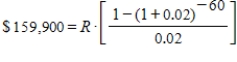
(Multiple Choice)
4.9/5 (72)
(72) What does the number $25,000 represent in the given equation: 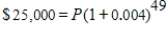 ?
? (Multiple Choice)
4.9/5 (60)
(60) Gail Kelley deposits $300 in an account at the beginning of each 3-month period for 12 years. If the account pays interest at the annual rate of 8%, compounded quarterly, how much will she have in her account after 12 years? Round your answer to the nearest cent.
(Multiple Choice)
4.9/5 (76)
(76) Suppose that in order to buy a Treasury bill (T-bill) that matures to $10,000 in 10 months, you must pay $9,750. What rate does this earn? Round your answer to one decimal place.
(Multiple Choice)
4.8/5 (85)
(85) Leah Hagel bought a $3,000, 9-month certificate of deposit (CD) that would earn 9% annual simple interest. Three months before the CD was due to mature, Leah needed her CD money, so a friend agreed to lend her money and receive the value of the CD when it matured. If their agreement allowed the friend to earn a 7% annual simple interest return on her loan to Leah, how much did Leah receive from her friend? Round your answer to the nearest cent.
(Multiple Choice)
4.9/5 (92)
(92) Find the interest that will result if $12,000 is invested at an annual rate of 7%, compounded continuously, for 8 years. Round your answer to the nearest cent.
(Multiple Choice)
4.9/5 (89)
(89) If $67,000 is invested in an annuity that earns an annual rate of 8.0%, compounded quarterly, what payments will it provide at the end of each quarter for the next 6.5 years? Round your answer to the nearest cent.
(Multiple Choice)
4.9/5 (89)
(89) Suppose a young couple deposits $1,100 at the end of each quarter in an account that earns an annual rate of 8.8%, compounded quarterly, for a period of 6 years. After the 6 years, they start a family and find they can contribute only $300 per quarter. If they leave the money from the first 6 years in the account and continue to contribute $300 at the end of each quarter for the next  years, how much will they have in the account (to help with their child's college expenses)? Round your answer to the nearest cent.
 (Multiple Choice)
4.9/5 (77)
(77) 
Filters
- Essay(0)
- Multiple Choice(0)
- Short Answer(0)
- True False(0)
- Matching(0)