



 Chat with AI
Exam 1: Algebraic Concepts

Exam 1: Algebraic Concepts308 Questions
Exam 2: Linear Equations and Functions243 Questions
Exam 3: Quadratic and Other Special Functions113 Questions
Exam 4: Matrices227 Questions
Exam 5: Inequalities and Linear Programming120 Questions
Exam 6: Exponential and Logarithmic Functions108 Questions
Exam 7: Mathematics of Finance131 Questions
Exam 8: Introduction to Probability178 Questions
Exam 9: Further Topics in Probability; Data Description114 Questions
Exam 10: Derivatives248 Questions
Exam 11: Applications of Derivatives172 Questions
Exam 12: Derivatives Continued139 Questions
Exam 13: Indefinite Integrals120 Questions
Exam 14: Definite Integrals: Techniques of Integration185 Questions
Exam 15: Functions of Two or More Variables119 Questions
Select questions type


Use the following factorization formulas involving cubes to factor the polynomial below. 
 Perfect cube
 Difference of two cubes
 Sum of two cubes

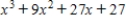
Perfect cube Difference of two cubes Sum of two cubes (Multiple Choice)
4.8/5  (81)
(81) 
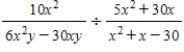
Assume that  ,
 ,
 and that U is the universal set of natural numbers less than 11. Find
 .
, , and that U is the universal set of natural numbers less than 11. Find . (Multiple Choice)
4.7/5 (92)
(92) Write the expression in radical form. Do not simplify. 
(Multiple Choice)
4.8/5 (61)
(61) Choose the correct interval notation for this subset of the real numbers.  and

and (Multiple Choice)
4.8/5 (83)
(83) Choose the correct interval notation for this subset of the real numbers. 
(Multiple Choice)
4.9/5 (103)
(103) Use the properties of exponents to simplify the expression so that only positive exponents remain. 
(Multiple Choice)
4.7/5 (73)
(73) 
Evaluate the following expression if it represents a real number. 
(Multiple Choice)
4.8/5 (90)
(90) 
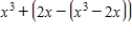
Name the type of interval expressed in the inequality. 
(Multiple Choice)
4.8/5 (80)
(80) The Richter scale reading for an earthquake measures its intensity (as a multiple of some minimum intensity used for comparison). The intensity I corresponding to a Richter scale reading R is given by  . A quake measuring 8.5 on the Richter scale would be severe. Express the intensity of such a quake in exponential and radical form.
 (Multiple Choice)
4.8/5 (74)
(74) 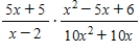
If the sets A and B are nonempty and disjoint, what does  equal?
 (Multiple Choice)
4.9/5 (61)
(61) Indicate whether the given expression is one or more of the following types of numbers: rational, irrational, integer, natural. 
(Multiple Choice)
4.8/5 (91)
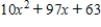
(91) 
Assume that  ,
 and that U is the universal set of natural numbers less than 11. Find
 .
, and that U is the universal set of natural numbers less than 11. Find . (Multiple Choice)
4.8/5 (86)
(86)  .

Filters
- Essay(0)
- Multiple Choice(0)
- Short Answer(0)
- True False(0)
- Matching(0)