



 Chat with AI
Exam 18: Inventory and Overhead

Exam 1: Whole Numbers: How to Dissect and Solve Word Problems55 Questions
Exam 2: Fractions62 Questions
Exam 3: Decimals62 Questions
Exam 4: Banking59 Questions
Exam 5: Solving for the Unknown: a How-To Approach for Solving Equations79 Questions
Exam 6: Percents and Their Applications86 Questions
Exam 7: Discounts: Trade and Cash87 Questions
Exam 8: Markups and Markdowns: Perishables and Breakeven Analysis74 Questions
Exam 9: Payroll62 Questions
Exam 10: Simple Interest61 Questions
Exam 11: Promissory Notes, Simple Discount Notes, and the Discount Process75 Questions
Exam 12: Compound Interest and Present Value66 Questions
Exam 13: Annuities and Sinking Funds68 Questions
Exam 14: Installment Buying47 Questions
Exam 15: The Cost of Home Ownership59 Questions
Exam 16: How to Read, Analyze, and Interpret Financial Reports68 Questions
Exam 17: Depreciation58 Questions
Exam 18: Inventory and Overhead67 Questions
Exam 19: Sales, Excise, and Property Taxes66 Questions
Select questions type


Moore Co. has a beginning inventory at a cost of $50,000 and an ending inventory at a cost of $90,000. Sales were $150,000. Assume Moore's markup rate is 40%. Based on the selling price, what is the inventory turnover at cost? (Round to the nearest hundredth.)
1.29
(Essay)
4.9/5  (71)
(71) The specific identification method might be used by companies with high-cost items.
(True/False)
4.9/5 (88)
(88) Finney's MMA Gym had a total of $1,300 worth of boxing gloves on June 1. The ending inventory for the month was $524. What was the cost of goods sold for June?
(Multiple Choice)
4.7/5 (75)
(75) In FIFO, the most recent cost is assigned to the inventory sold.
(True/False)
5.0/5 (87)
(87) The following information was provided to Mel Blank, owner of Morse Market. Can you help Mel calculate the cost of ending inventory under LIFO, FIFO, and weighted average? During the year, a total of 1,200 were sold.
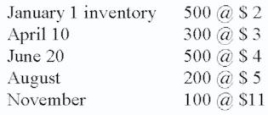
(Essay)
4.7/5 (79)
(79) The cost ratio times ending inventory at cost equals ending inventory at retail.
(True/False)
4.9/5 (81)
(81) During inflation, the best method to use in inventory valuation that produces the smallest amount of profit is:
(Multiple Choice)
4.8/5 (71)
(71) In the specific identification method, the total cost of ending inventory is equal to the number of units not sold times the actual cost per unit.
(True/False)
4.8/5 (79)
(79) Cost of goods sold equals cost of goods available for sale plus cost of ending inventory.
(True/False)
4.9/5 (76)
(76) A company can change from LIFO to FIFO without notifying the Internal Revenue Service.
(True/False)
4.8/5 (83)
(83) Under certain circumstances, ending inventory could be valued at less than cost.
(True/False)
4.7/5 (84)
(84) Companies with homogeneous products might use the weighted-average method.
(True/False)
4.8/5 (81)
(81) In the specific identification method, the flow of goods and the flow of costs are not the same.
(True/False)
4.7/5 (74)
(74)  1.92
In the retail method the ending inventory at cost is calculated by multiplying the cost ratio times:
(Multiple Choice)
5.0/5 (83)
(83) LIFO doesn't always match the physical flow of goods but still can be used to calculate the flow of costs.
(True/False)
4.8/5 (84)
(84) A cost ratio of $.68 means that for each $1 of retail inventory it costs the store $.68.
(True/False)
4.8/5 (88)
(88) 
Filters
- Essay(0)
- Multiple Choice(0)
- Short Answer(0)
- True False(0)
- Matching(0)