



 Chat with AI
Exam 18: Inventory and Overhead

Exam 1: Whole Numbers: How to Dissect and Solve Word Problems55 Questions
Exam 2: Fractions62 Questions
Exam 3: Decimals62 Questions
Exam 4: Banking59 Questions
Exam 5: Solving for the Unknown: a How-To Approach for Solving Equations79 Questions
Exam 6: Percents and Their Applications86 Questions
Exam 7: Discounts: Trade and Cash87 Questions
Exam 8: Markups and Markdowns: Perishables and Breakeven Analysis74 Questions
Exam 9: Payroll62 Questions
Exam 10: Simple Interest61 Questions
Exam 11: Promissory Notes, Simple Discount Notes, and the Discount Process75 Questions
Exam 12: Compound Interest and Present Value66 Questions
Exam 13: Annuities and Sinking Funds68 Questions
Exam 14: Installment Buying47 Questions
Exam 15: The Cost of Home Ownership59 Questions
Exam 16: How to Read, Analyze, and Interpret Financial Reports68 Questions
Exam 17: Depreciation58 Questions
Exam 18: Inventory and Overhead67 Questions
Exam 19: Sales, Excise, and Property Taxes66 Questions
Select questions type


Cost of goods sold is equal to cost of goods available for sale:
(Multiple Choice)
4.9/5  (69)
(69) Inventory turnover at cost is net sales divided by average inventory at retail.
(True/False)
4.9/5 (98)
(98) Given the following: LIFO method 250 units left in inventory
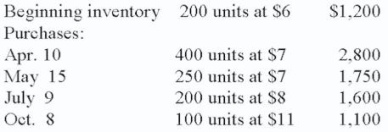 The cost of ending inventory is:
Totals for each date should include dollars signs in the third column.
The cost of ending inventory is:
Totals for each date should include dollars signs in the third column. (Multiple Choice)
4.8/5 (67)
(67) The specific identification method is able to identify in the ending inventory the actual invoice cost associated with it.
(True/False)
4.9/5 (78)
(78) During inflation, LIFO produces the highest possible income for a company.
(True/False)
4.9/5 (86)
(86) Weighted-average unit cost is total cost of goods available for sale divided by beginning number of units available for sale.
(True/False)
4.9/5 (74)
(74) The cost ratio in the retail method is found by the cost of goods available for sale at cost divided by:
(Multiple Choice)
4.8/5 (87)
(87) Complete (assume $100,000 of overhead to be distributed):
 A. .25
B. $25,000
C. .75
D. $75,000
A. .25
B. $25,000
C. .75
D. $75,000 (Essay)
4.9/5 (76)
(76) Allison Co. has a beginning inventory costing $90,000 and an ending inventory costing $120,000. Sales were $380,000. Assume Allison's markup rate is 40%. Based on the selling price, the inventory turnover at cost (to the nearest hundredth) is:
(Multiple Choice)
4.8/5 (80)
(80) Mac's Hardware's gross profit on sales is 40%. At the beginning of January, cost of inventory was $18,000. During one month, Mac had net purchases of $42,000. Net sales at retail for the month were $49,000. The estimated cost of ending inventory using the gross profit method is:
(Multiple Choice)
4.9/5 (79)
(79) Compared with cost due to theft, spoilage, etc., inventory turnover at retail is usually:
(Multiple Choice)
4.9/5 (79)
(79) To use the retail method of estimating ending inventory, the figure for net sales at retail must be known.
(True/False)
4.7/5 (64)
(64) Molls Co. allocates overhead expenses to all departments on the basis of the floor space (sq. ft.) occupied by each department. The total overhead expenses for a recent year amounted to $80,000. Department A occupied 4,000 square feet, Department B 7,000 square feet, and Department C 9,000 square feet. What is the amount of the overhead allocated to Department C?
(Essay)
4.8/5 (100)
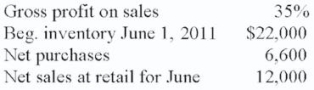
(100) Calculate estimated cost of ending inventory using the gross profit method:
(Essay)
4.9/5 (83)
(83) Given the following: FIFO method: 16 units left in inventory
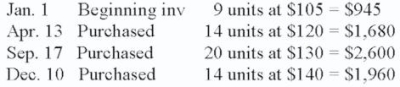 The cost of goods sold is:
 (Multiple Choice)
4.9/5 (76)
(76) With beginning inventory at cost of $9,000, ending inventory at cost of $7,000, net sales of $51,000, and cost of goods sold of $46,000, the inventory turnover at cost to the nearest hundredth is:
(Multiple Choice)
4.9/5 (84)
(84) All but which one of the following is information needed to calculate inventory valuation by the retail method?
(Multiple Choice)
4.8/5 (85)
(85) 
Filters
- Essay(0)
- Multiple Choice(0)
- Short Answer(0)
- True False(0)
- Matching(0)