



 Chat with AI
Exam 4: Classical Macroeconomics II: Money,prices,and Interest

Exam 1: Introduction7 Questions
Exam 2: Measurement of Macroeconomic Variables57 Questions
Exam 3: Classical Macroeconomics I: Output and Employment57 Questions
Exam 4: Classical Macroeconomics II: Money,prices,and Interest60 Questions
Exam 5: Keynesian System I: the Role of Aggregate Demand60 Questions
Exam 6: Keynesian System II: Money,interest,and Income63 Questions
Exam 7: Keynesian System III: Policy Effects in the Is-Lm Model53 Questions
Exam 8: Keynesian System Iv: Aggregate Supply and Demand57 Questions
Exam 9: The Monetarist Counterrevolution54 Questions
Exam 10: Output,inflation,and Unemployment: Alternative Views55 Questions
Exam 11: New Classical Economics51 Questions
Exam 12: Real Business Cycles and New Keynesian Economics58 Questions
Exam 13: Macroeconomic Models:a Summary47 Questions
Exam 14: Exchange Rates and the International Monetary System57 Questions
Exam 15: Monetary and Fiscal Policy in the Open Economy45 Questions
Exam 16: Money,the Banking System,and Interest Rates63 Questions
Exam 17: Optimal Monetary Policy56 Questions
Exam 18: Fiscal Policy44 Questions
Exam 19: Policies for Intermediate-Run Growth54 Questions
Exam 20: Long-Run Economic Growth: Origins of the Wealth of Nations51 Questions
Select questions type


Explain the intuition behind why the aggregate demand curve is downward sloping.Why does an increase in the money supply shift the aggregate demand curve to the right?
(Essay)
4.9/5  (70)
(70) Figure 4.1
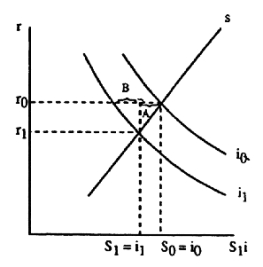 -According to the classical model shown in Figure 4.1,an autonomous decline in investment shifts the investment schedule to the left.Furthermore,the equilibrium interest rate declines.Distance B describes an interest rate induced
 (Multiple Choice)
4.8/5 (73)
(73) Let M = 36,k = 3,Ls = W/P,MPN = L-1/2 and Y = 2L1/2.Calculate the labor demand curve,the aggregate demand curve,and the equilibrium values of the real wage,labor,output,and the price level.
(Essay)
4.9/5 (88)
(88) If the money supply increases 10-percent,velocity decreases 5-percent,and the price level increases 6-percent,then the change in real GDP is
(Multiple Choice)
4.8/5 (64)
(64) Which of the following is (are)correct? In the classical system,the suppliers of bonds were the
(Multiple Choice)
4.9/5 (64)
(64) If the propensity to hold money is 6 and the money supply is 12,then the classical aggregate demand curve is
(Multiple Choice)
4.9/5 (71)
(71) Discuss the meaning of the phrase of supply-side economics,discussing how it is similar and different from the traditional classical model.Make sure to discuss the role of the Laffer curve in supply-side theory.
(Essay)
4.9/5 (92)
(92) According to the quantity theory of money,the quantity of money determines the
(Multiple Choice)
4.9/5 (76)
(76) In the classical system,output and employment are primarily dependent on
(Multiple Choice)
4.7/5 (85)
(85) What does the Classical model predict about the relationship between a country's budget balance (total revenue minus total spending)and a country's level of real interest rates and investment in a closed economy? Use a graph of the capital market to illustrate.
(Essay)
4.8/5 (74)
(74) The quantity theory of money implies that if the money stock were to double,the price level would
(Multiple Choice)
4.8/5 (82)
(82) According to the quantity theory of money,a 10-percent increase in the money stock would lead to a 10-percent rise in the
(Multiple Choice)
4.9/5 (84)
(84) Contrast the Cambridge and Fisher versions of the quantity theory.Explain why the Cambridge version of the quantity theory represents a more modern monetary theory when compared to Fisher's version.
(Essay)
4.8/5 (70)
(70) In the classical model,an increase in saving is assumed to increase
(Multiple Choice)
4.9/5 (80)
(80) 
Filters
- Essay(0)
- Multiple Choice(0)
- Short Answer(0)
- True False(0)
- Matching(0)