



 Chat with AI
Exam 14: Analysis of Variance

Exam 1: What Is Statistics43 Questions
Exam 2: Graphical Descriptive Techniques I93 Questions
Exam 3: Graphical Descriptive Techniques II183 Questions
Exam 4: Numerical Descriptive Techniques274 Questions
Exam 5: Data Collection and Sampling82 Questions
Exam 6: Probability234 Questions
Exam 7: Random Variables and Discrete Probability Distributions274 Questions
Exam 8: Continuous Probability Distributions215 Questions
Exam 9: Sampling Distributions153 Questions
Exam 10: Introduction to Estimation152 Questions
Exam 11: Introduction to Hypothesis Testing182 Questions
Exam 12: Inference About a Population147 Questions
Exam 13: Inference About Comparing Two Populations170 Questions
Exam 14: Analysis of Variance153 Questions
Exam 15: Chi-Squared Tests175 Questions
Exam 16: Simple Linear Regression and Correlation298 Questions
Exam 17: Multiple Regression157 Questions
Select questions type


Migraine Treatments
The following data were generated from a 2 x2 factorial experiment with 3 replicates, where factor A levels represent two different injection procedures of an anesthetic to the occipital nerve (located in the back of the neck), and factor B levels represent two different drugs, which physicians recommend to increase the effectiveness of the injections.Three migraine patients were randomly selected for each combination of injection and drug.
 -{Migraine Treatments Narrative} Test at the 5% significance level to determine if differences exist among the levels of factor B.
 (Essay)
4.9/5  (86)
(86) In a one-way ANOVA, error variability is computed as the sum of the squared errors, SSE, for all values of the response variable.This variability is the:
(Multiple Choice)
4.7/5 (91)
(91) The sum of squares for treatments, SST, achieves its smallest value (zero) when all the sample means are equal.
(True/False)
4.9/5 (92)
(92) When we perform a blocked experiment by using the same subject for each treatment, this is called a(n) ____________________ design.
(Short Answer)
4.9/5 (80)
(80) In a two-factor ANOVA, there are 4 levels for factor A and 5 levels for factor B, and two observations within each cell.The number of treatments in this experiment is 40.
(True/False)
4.9/5 (85)
(85) We use the analysis of variance (ANOVA) technique to compare two or more population means.
(True/False)
4.8/5 (88)
(88) In which case can an F-test be used to compare two population means?
(Multiple Choice)
4.8/5 (86)
(86) In one-way ANOVA, the total variation SS(Total) is partitioned into two sources of variation: the sum of squares for treatments (SST) and the sum of squares for error (SSE).
(True/False)
4.8/5 (88)
(88) The analysis of variance (ANOVA) technique analyzes the variance of the data to determine whether differences exist between the population means.
(True/False)
4.9/5 (92)
(92) The sum of squares for treatments (SST) is the variation attributed to the differences between the treatment means, while the sum of squares for error (SSE) measures the within-treatment variation.
(True/False)
4.8/5 (73)
(73) In a two-factor ANOVA, there are 4 levels for factor A, 5 levels for factor B, and 3 observations for each combination of factor A and factor B levels.The total number of observations in this experiment equals:
(Multiple Choice)
4.9/5 (81)
(81) The F-test in ANOVA is an expansion of the t-test for two independent population means.
(True/False)
4.9/5 (74)
(74) In the two-factor ANOVA where a is the number of factor A levels, b is the number of factor B levels, and r is the number of replicates, the number of degrees of freedom for interaction is:
(Multiple Choice)
4.8/5 (80)
(80) Multiple comparison methods are used to determine whether or not any differences occur amongst a group of population means.
(True/False)
4.8/5 (86)
(86) Food Irradiation
In recent years the irradiation of food to reduce bacteria and preserve the food longer has become more common.A company that performs this service has developed four different methods of irradiating food.To determine which is best, it conducts an experiment where different foods are irradiated and the bacteria count is measured.As part of the experiment the following foods are irradiated: meat, poultry, veal, tuna, and yogurt.The results are shown below.
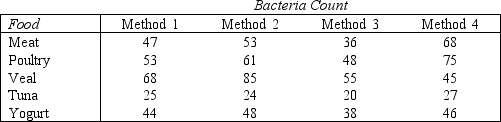 -{Food Irradiation Narrative} Can the company infer at the 1% significance level that differences in the bacteria count exist among the four irradiation methods?
 (Essay)
4.7/5 (88)
(88) The average cost of remodeling one room in a house was compared for four different remodeling companies.A random sample of 10 rooms remodeled by each company were selected all with the same square footage, and cost of remodeling each room was recorded.(Rooms were randomly chosen from different houses.) The data are shown below.An F-test using ANOVA concluded that average costs differ for at least two of the remodeling companies.
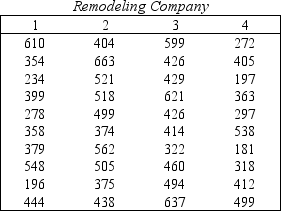 Use Tukey's and LSD multiple comparison methods to determine which remodeling companies differ in their average cost.Compare the results and discuss.(Keep the experimentwise Type I error at or close to 5%.)
 (Essay)
4.8/5 (82)
(82) The value of the test statistic in a completely randomized design for ANOVA is F = 6.29.The degrees of freedom for the numerator and denominator are 5 and 10, respectively.Using an F table, the most accurate statements to be made about the p-value is that it is:
(Multiple Choice)
4.8/5 (80)
(80) Acid Reflux
A partial ANOVA table in a randomized block design is shown below, where the treatments refer to different acid reflux medicines, and the blocks refer to groups of men with similar levels of stomach acid.
 -{Acid Reflux Narrative} Fill in the missing values (identified by asterisks) in the above ANOVA Table.
 (Essay)
5.0/5 (92)
(92) Tukey's multiple comparison method is more powerful than Fisher's LSD Method at finding differences in pairwise population means.
(True/False)
4.8/5 (78)
(78) 
Filters
- Essay(0)
- Multiple Choice(0)
- Short Answer(0)
- True False(0)
- Matching(0)