



 Chat with AI
Exam 14: Tax Consequences of Home Ownership

Exam 1: An Introduction to Tax113 Questions
Exam 2: Tax Compliance,the Irs,and Tax Authorities112 Questions
Exam 3: Tax Planning Strategies and Related Limitations115 Questions
Exam 4: Individual Income Tax Overview,dependents,and Filing Status125 Questions
Exam 5: Gross Income and Exclusions130 Questions
Exam 6: Individual Deductions98 Questions
Exam 7: Investments74 Questions
Exam 8: Individual Income Tax Computation and Tax Credits154 Questions
Exam 9: Business Income,deductions,and Accounting Methods99 Questions
Exam 10: Property Acquisition and Cost Recovery103 Questions
Exam 11: Property Dispositions110 Questions
Exam 12: Compensation99 Questions
Exam 13: Retirement Savings and Deferred Compensation111 Questions
Exam 14: Tax Consequences of Home Ownership108 Questions
Exam 15: Entities Overview80 Questions
Exam 16: Corporate Operations106 Questions
Exam 17: Accounting for Income Taxes100 Questions
Exam 18: Corporate Taxation: Nonliquidating Distributions100 Questions
Exam 19: Corporate Formation,reorganization,and Liquidation100 Questions
Exam 20: Forming and Operating Partnerships106 Questions
Exam 21: Dispositions of Partnership Interests and Partnership Distributions100 Questions
Exam 22: S Corporations134 Questions
Exam 23: State and Local Taxes117 Questions
Exam 24: The Ustaxation of Multinational Transactions89 Questions
Exam 25: Transfer Taxes and Wealth Planning123 Questions
Select questions type


Katy owns a second home.During the year,she used the home for 20 personal-use days and 50 rental days.Katy allocates expenses associated with the home between rental use and personal use.Katy did not incur any expenses to obtain tenants.Which of the following statements is correct regarding the tax treatment of Katy's income and expenses from the home?
(Multiple Choice)
4.7/5  (77)
(77) In certain circumstances,a taxpayer who does not meet the ownership and use tests may still be allowed to exclude the entire realized gain on the sale of a principal residence.
(True/False)
5.0/5 (87)
(87) What is the maximum amount of gain on the sale of principal residence a married couple may exclude from gross income?
(Multiple Choice)
4.8/5 (68)
(68) Alison Jacobs (single)purchased a home in Las Vegas,Nevada,for $400,000.She moved into the home on September 1,year 0.She lived in the home as her primary residence until July 1 of year 4,when she sold the home for $675,000.If Alison's tax rate on long-term capital gains is 15 percent,what amount of tax will Alison pay on the $275,000 gain?
(Essay)
4.8/5 (82)
(82) Which of the following best describes a qualified residence for the purposes of determining a taxpayer's deductible home mortgage interest expense?
(Multiple Choice)
4.9/5 (76)
(76) Which of the following statements regarding the home office expense deduction is correct?
(Multiple Choice)
4.8/5 (84)
(84) Patricia purchased a home on January 1,2017,for $1,200,000 by making a down payment of $100,000 and financing the remaining $1,100,000 with a loan,secured by the residence,at 6 percent.From 2017 through 2019,Patricia made interest-only payments on the loan each year in the amount of $66,000.What amount of the $66,000 interest expense that Patricia paid during 2019 may she deduct as an itemized deduction? (Assume not married filing separately.)
(Multiple Choice)
4.8/5 (82)
(82) Which of the following statements regarding limitations on the deductibility of home office expenses of employees is correct?
(Multiple Choice)
4.9/5 (94)
(94) Tyson owns a condominium near Laguna Beach,California.This year,he incurs the following expenses in connection with his condo:
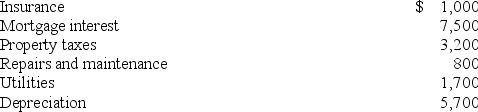 During the year,Tyson rented the condo for 100 days,receiving $25,000 of gross income.He personally used the condo for 60 days.Assume Tyson uses the Tax Court method of allocating expenses to rental use of the property.What is Tyson's net rental income for the year (assume this is not a leap year)?
 (Essay)
4.9/5 (83)
(83) Lebron Taylor purchased a home on July 1,2018,for $500,000.Lebron paid for the entire purchase price with cash.On January 1,2019,Lebron needed additional cash for purposes unrelated to his home,so he took out a loan secured by the residence for $150,000.During 2019,he made interest-only payments of $4,500 on the loan.What amount of the $4,500 interest expense can Lebron deduct in 2019?
(Essay)
4.8/5 (82)
(82) A taxpayer who otherwise meets the ownership and use tests may not be allowed to exclude all of her realized gain if the taxpayer has nonqualified use of the home before selling.
(True/False)
4.9/5 (85)
(85) Nelson Whiting (single)purchased a home in Denver,Colorado,for $300,000.He moved into the home on July 1 of year 1.He lived in the home as his primary residence until December 1,year 2,when he sold the home for $450,000.Nelson sold the home because he needed to move to change jobs and his new job was located several hundred miles away.What amount of gain must Nelson recognize on the home sale in year 2?
(Essay)
4.9/5 (84)
(84) On November 1,year 1,Jamie (who is single)purchased and moved into her principal residence.In the early part of year 2,Jamie was laid off from her job.On February 1,year 2,Jamie sold the home at a $35,000 gain.She sold the home because she found a new job in a different state.How much of the gain,if any,may Jamie exclude from her gross income in year 2?
(Multiple Choice)
4.8/5 (71)
(71) A taxpayer who purchases real property during the year is allowed to deduct the property taxes on that property for the entire year in which the property was purchased.
(True/False)
4.8/5 (83)
(83) Amanda purchased a home for $1,000,000 in 2016.She paid $200,000 cash and borrowed the remaining $800,000.This is Amanda's only residence.Assume that in year 2022,when the home had appreciated to $1,500,000 and the remaining mortgage was $600,000,interest rates declined and Amanda refinanced her home.She borrowed $1,000,000 at the time of the refinancing,paid off the first mortgage,and used the remainder for purposes unrelated to the home.What is her total amount of acquisition indebtedness for the purposes of determining the deduction for home mortgage interest? (Assume not married filing separately.)
(Multiple Choice)
4.9/5 (86)
(86) When allocating expenses of a vacation home between personal use and rental use,the amount of depreciation expense allocated to rental use is based on the number of rental days over rental days plus personal-use days.
(True/False)
4.9/5 (78)
(78) In certain circumstances,a taxpayer could rent her personal residence at a profit and not pay any tax on the income.
(True/False)
5.0/5 (85)
(85) Jamison is self-employed and he works out of an office in his home.After allocating the home-related expenses between the business office and the rest of the home,which of the following statements regarding the sequence of deductibility of the expenses allocated to the home office business use is correct? (Jamison does not use the simplified method for determining the home office expense deduction.)
(Multiple Choice)
4.9/5 (81)
(81) For determining whether a taxpayer qualifies to exclude gain on the sale of a principal residence,the periods of ownership and use need not be continuous nor do they need to cover the same two-year period.
(True/False)
4.8/5 (75)
(75) When determining the number of days a taxpayer has rented out a home during the year,any day when the home is available for rent but not actually rented out counts as a day of personal use.
(True/False)
4.9/5 (70)
(70) 
Filters
- Essay(0)
- Multiple Choice(0)
- Short Answer(0)
- True False(0)
- Matching(0)