



 Chat with AI
Exam 19: Corporate Formation,reorganization,and Liquidation

Exam 1: An Introduction to Tax113 Questions
Exam 2: Tax Compliance,the Irs,and Tax Authorities112 Questions
Exam 3: Tax Planning Strategies and Related Limitations115 Questions
Exam 4: Individual Income Tax Overview,dependents,and Filing Status125 Questions
Exam 5: Gross Income and Exclusions130 Questions
Exam 6: Individual Deductions98 Questions
Exam 7: Investments74 Questions
Exam 8: Individual Income Tax Computation and Tax Credits154 Questions
Exam 9: Business Income,deductions,and Accounting Methods99 Questions
Exam 10: Property Acquisition and Cost Recovery103 Questions
Exam 11: Property Dispositions110 Questions
Exam 12: Compensation99 Questions
Exam 13: Retirement Savings and Deferred Compensation111 Questions
Exam 14: Tax Consequences of Home Ownership108 Questions
Exam 15: Entities Overview80 Questions
Exam 16: Corporate Operations106 Questions
Exam 17: Accounting for Income Taxes100 Questions
Exam 18: Corporate Taxation: Nonliquidating Distributions100 Questions
Exam 19: Corporate Formation,reorganization,and Liquidation100 Questions
Exam 20: Forming and Operating Partnerships106 Questions
Exam 21: Dispositions of Partnership Interests and Partnership Distributions100 Questions
Exam 22: S Corporations134 Questions
Exam 23: State and Local Taxes117 Questions
Exam 24: The Ustaxation of Multinational Transactions89 Questions
Exam 25: Transfer Taxes and Wealth Planning123 Questions
Select questions type


Camille transfers property with a tax basis of $800 and a fair market value of $1,200 to a corporation in exchange for stock with a fair market value of $850 and $350 in cash in a transaction that qualifies for deferral under section 351.Camille also incurred selling expenses of $100.What is the amount realized by Camille in the exchange?

Free
(Multiple Choice)
4.7/5  (91)
(91) Correct Answer: Verified
B
Which of the following statements best describes the tax law approach to recognizing gain or loss realized in an exchange?
Free
(Multiple Choice)
4.9/5 (69)
(69) Correct Answer:Verified
VerifiedB
Maria defers $100 of gain realized in a §351 transaction.The stock she receives in the exchange has a fair market value of $500.Maria's tax basis in the stock will be $400.
Free
(True/False)
4.8/5 (82)
(82) Correct Answer:Verified
VerifiedTrue
Francine incorporated her sole proprietorship by transferring inventory,a building,and land to the corporation in return for 100 percent of the corporation's stock.The property transferred to the corporation had the following fair market values and tax-adjusted bases.
 The corporation also assumed a mortgage of $60,000 attached to the building and land.The fair market value of the corporation's stock received in the exchange was $150,000.
a.What amount of gain or loss does Francine realize on the transfer of the property to her corporation?
b.What amount of gain or loss does Francine recognize on the transfer of the property to her corporation?
c.What is Francine's basis in the stock she receives in her corporation?
The corporation also assumed a mortgage of $60,000 attached to the building and land.The fair market value of the corporation's stock received in the exchange was $150,000.
a.What amount of gain or loss does Francine realize on the transfer of the property to her corporation?
b.What amount of gain or loss does Francine recognize on the transfer of the property to her corporation?
c.What is Francine's basis in the stock she receives in her corporation? (Essay)
4.8/5 (88)
(88) Mandel transferred property to his new corporation in a §351 transaction.Among the several properties transferred by Mandel was land with a fair market value of $200,000 and a tax basis of $250,000.In all cases,the corporation will always take a tax basis in the land of $200,000 to prevent the "built-in loss" from being transferred from Mandel to the corporation.
(True/False)
4.8/5 (79)
(79) The requirements for tax deferral in a forward triangular merger and a reverse triangular merger are the same.
(True/False)
4.8/5 (90)
(90) Katarina transferred her 10 percent interest to Spartan Company as part of a complete liquidation of the company.In the exchange,she received land with a fair market value of $200,000.Katarina's basis in the Spartan stock was $100,000.The land had a basis to Spartan Company of $50,000.What amount of gain does Spartan recognize in the exchange and what is Katarina's basis in the land she receives?
(Multiple Choice)
4.7/5 (86)
(86) Ken and Jim agree to go into business together selling old comic books and records.According to the agreement,Ken will contribute inventory valued at $200,000 in return for 80 percent of the stock in the corporation.Ken's tax basis in the inventory is $100,000.Jim will receive 20 percent of the stock in return for providing accounting services to the corporation (these qualify as organizational expenditures).The accounting services are valued at $50,000.
Please answer the following questions about the tax consequences of the transaction to Ken.
a.What amount of gain or loss does Ken realize on the formation of the corporation?
b.What amount of gain or loss,if any,does he recognize?
c.What is Ken's tax basis in the stock he receives in return for his contribution of property to the corporation?
(Essay)
4.9/5 (87)
(87) Gary and Laura decided to liquidate their jointly owned corporation,Amelia,Inc.After liquidating its remaining inventory and paying off its remaining liabilities,Amelia had the following tax accounting balance sheet.
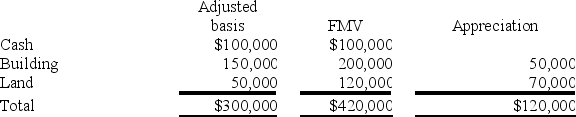 Under the terms of the agreement,Gary will receive the $100,000 cash in exchange for his interest in Amelia.Gary's tax basis in his Amelia stock is $30,000.Laura will receive the building and land in exchange for her interest in Amelia.Laura's tax basis in her Amelia stock is $60,000.
What amount of gain or loss does Gary recognize in the complete liquidation?
Under the terms of the agreement,Gary will receive the $100,000 cash in exchange for his interest in Amelia.Gary's tax basis in his Amelia stock is $30,000.Laura will receive the building and land in exchange for her interest in Amelia.Laura's tax basis in her Amelia stock is $60,000.
What amount of gain or loss does Gary recognize in the complete liquidation? (Essay)
4.8/5 (71)
(71) Celeste transferred 100 percent of her stock in Supply Chain Company to Marketing Corporation in a Type A merger.In exchange,she received stock in Marketing with a fair market value of $500,000 plus $500,000 in cash.Celeste's tax basis in the Supply Chain stock was $1,200,000.What amount of loss does Celeste recognize in the exchange and what is her basis in the Marketing stock she receives?
(Multiple Choice)
5.0/5 (86)
(86) Which of the following statements does not describe a motivation by the buyer or seller in the acquisition or sale of a company?
(Multiple Choice)
4.9/5 (73)
(73) Jasmine transferred 100 percent of her stock in Emerald Company to Jade Corporation in a Type A merger.In exchange she received stock in Jade with a fair market value of $800,000 plus $1,200,000 in cash.Jasmine's tax basis in the Emerald stock was $900,000.What amount of gain does Jasmine recognize in the exchange and what is her basis in the Jade stock she receives?
(Essay)
4.8/5 (83)
(83) To meet the control test under §351,taxpayers transferring property to a corporation must in aggregate own 80 percent or more of the corporation's voting stock and 80 percent of each class of nonvoting stock after the transfer.
(True/False)
4.8/5 (87)
(87) Casey transfers property with a tax basis of $2,000 and a fair market value of $5,000 to a corporation in exchange for stock with a fair market value of $4,000 and $400 in cash in a transaction that qualifies for deferral under section 351.The corporation assumed a liability of $600 on the property transferred.Casey also incurred selling expenses of $300.What is the amount realized by Casey in the exchange?
(Multiple Choice)
4.8/5 (70)
(70) Which of the following amounts is not included in the computation of a property's adjusted basis in an exchange?
(Multiple Choice)
4.8/5 (73)
(73) Which of the following statements does not describe a requirement that must be met in a tax-deferred reverse triangular merger?
(Multiple Choice)
5.0/5 (90)
(90) Rich and Rita propose to have their corporation,Big Blue,acquire another corporation,Green Company,in a stock-for-stock Type B acquisition.The sole shareholder of Green,Mark Dee,will receive $500,000 of Big Blue voting stock in the transaction.Mark's tax basis in his Green stock is $100,000.What is Mark's tax basis in the Big Blue stock he receives in the exchange and what is Big Blue's basis in the Green stock it receives in return?
(Essay)
4.9/5 (77)
(77) Juan transferred 100 percent of his stock in Rosa Company to Azul Corporation in a Type B stock-for-stock exchange.In exchange,he received stock in Azul with a fair market value of $1,000,000.Juan's tax basis in the Rosa stock was $400,000.What amount of gain does Juan recognize in the exchange and what is his basis in the Azul stock he receives?
(Multiple Choice)
4.8/5 (89)
(89) Which of the following statements best describes the continuity of interest principle as it applies to a tax-deferred acquisition?
(Multiple Choice)
4.8/5 (75)
(75) Tristan transfers property with a tax basis of $900 and a fair market value of $1,200 to a corporation in exchange for stock with a fair market value of $900 and $200 in cash in a transaction that qualifies for deferral under section 351.The corporation assumed a liability of $100 on the property transferred.What is the corporation's tax basis in the property received in the exchange?
(Multiple Choice)
4.8/5 (75)
(75) 
Filters
- Essay(0)
- Multiple Choice(0)
- Short Answer(0)
- True False(0)
- Matching(0)