



 Chat with AI
Exam 11: S Corporations

Exam 1: Business Income, Deductions, and Accounting Methods99 Questions
Exam 2: Property Acquisition and Cost Recovery107 Questions
Exam 3: Property Dispositions110 Questions
Exam 4: Entities Overview80 Questions
Exam 5: Corporate Operations106 Questions
Exam 6: Accounting for Income Taxes100 Questions
Exam 7: Corporate Taxation: Nonliquidating Distributions100 Questions
Exam 8: Corporate Formation, Reorganization, and Liquidation100 Questions
Exam 9: Forming and Operating Partnerships106 Questions
Exam 10: Dispositions of Partnership Interests and Partnership Distributions100 Questions
Exam 11: S Corporations134 Questions
Exam 12: State and Local Taxes117 Questions
Exam 13: The Us Taxation of Multinational Transactions89 Questions
Exam 14: Transfer Taxes and Wealth Planning123 Questions
Select questions type


Which of the following income items from an S corporation is not considered investment income for purposes of the net investment income tax?

Free
(Multiple Choice)
4.8/5  (78)
(78) Correct Answer: Verified
E
The same exact requirements for forming and contributing property govern S corporations and partnerships.
Free
(True/False)
4.8/5 (81)
(81) Correct Answer:Verified
VerifiedFalse
Which of the following statements is correct regarding S corporation estimated taxes?
Free
(Multiple Choice)
4.8/5 (87)
(87) Correct Answer:Verified
VerifiedB
Corporations taxed as S corporations offer the same legal protection to owners as corporations taxed as C corporations.
(True/False)
5.0/5 (90)
(90) Which of the following is not an adjustment to an S corporation shareholder's stock basis?
(Multiple Choice)
4.7/5 (76)
(76) At the beginning of the year, Harold, Missy, and Ranae formed HMR Corporation as an S corporation. For one-third of the HMR stock, Harold contributed $50,000 cash and land with a fair market value of $75,000 and adjusted tax basis of $60,000. The land was subject to a $45,000 mortgage, which was assumed by HMR on the formation. Missy and Ranae each contributed $80,000 cash to HMR for one-third of the HMR stock. What is Harold's basis in the HMR stock after the formation? What is Missy's basis in her HMR stock after the formation?
(Essay)
4.8/5 (72)
(72) Assume that at the end of 2019, Clampett, Inc. (an S corporation) distributes property (fair market value of $40,000, basis of $5,000) to each of its four equal shareholders (aggregate distribution of $160,000). At the time of the distribution, Clampett, Inc., has no corporate earnings and profits and J.D. has a basis of $50,000 in his Clampett, Inc., stock. What is J.D.'s stock basis after the distribution?
(Multiple Choice)
4.9/5 (90)
(90) SEC Corporation has been operating as a C corporation since 2016. It elected to become an S corporation, effective January 1, 2019. On December 31, 2018, SEC reported a net unrealized built-in gain of $60,000. In addition to other transactions in 2019, SEC sold inventory it owned at the beginning of 2019 (it did not sell any other assets it owned at the beginning of 2019). At the beginning of the year, the inventory it sold had a fair market value of $30,000 and a FIFO tax basis of $10,000. SEC sold the inventory for $35,000. If SEC had been a C corporation in 2019, its taxable income would have been $100,000. How much built-in gains tax must SEC pay in 2019?
(Essay)
4.8/5 (74)
(74) Clampett, Inc., converted to an S corporation on January 1, 2019. At that time, Clampett, Inc., had cash ($40,000), inventory (FMV $60,000, basis $30,000), accounts receivable (FMV $40,000, basis $40,000), and equipment (FMV $60,000, basis $80,000). In 2020, Clampett, Inc., sells its entire inventory for $60,000 (basis $30,000). Assume the corporate tax rate is 21 percent. Clampett, Inc.'s taxable income in 2020 would have been $1,000,000 if it had been a C corporation. How much built-in gains tax does Clampett, Inc., pay in 2020?
(Multiple Choice)
4.7/5 (77)
(77) MWC is a C corporation that uses the accrual method of accounting. MWC made an S election, effective January 1 of 2019. The following assets were owned by MWC on December 31, 2018.
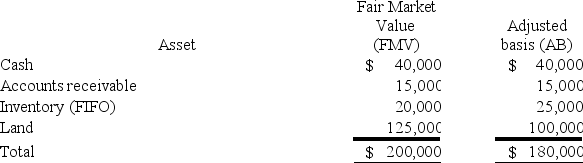 What is MWC's net unrealized built-in gain when it converts to an S corporation on January 1, 2019?
 (Essay)
4.8/5 (98)
(98) Vanessa contributed $20,000 of cash and land with a fair market value of $100,000 and an adjusted basis of $40,000 to Cook, Inc. (an S corporation) when it was formed. The land was encumbered by a $30,000 mortgage executed two years before. What is Vanessa's tax basis in her Cook, Inc., stock after formation?
(Multiple Choice)
4.8/5 (77)
(77) Clampett, Inc., has been an S corporation since its inception. On July 15, 2020, Clampett, Inc., distributed $50,000 to J.D. His basis in his Clampett, Inc., stock on January 1, 2020, was $45,000. For 2020, J.D. was allocated $10,000 of ordinary income from Clampett, Inc., and no separately stated items. What is the amount of income J.D. recognizes related to Clampett, Inc., in 2020?
(Multiple Choice)
4.9/5 (75)
(75) Differences in voting powers are permissible across shares of S corporation stock as long as the shares have identical distribution and liquidation rights.
(True/False)
4.8/5 (90)
(90) Clampett, Inc., has been an S corporation since its inception. On July 15, 2020, Clampett, Inc., distributed $50,000 to J.D. His basis in his Clampett, Inc., stock on January 1, 2020, was $30,000. For 2020, J.D. was allocated $10,000 of ordinary income from Clampett, Inc., and no separately stated items. What is the amount of income J.D. recognizes related to Clampett, Inc., in 2020?
(Multiple Choice)
4.9/5 (87)
(87) Which of the following is a requirement to be an S corporation?
(Multiple Choice)
4.9/5 (97)
(97) S corporation distributions of cash are not taxable to the shareholder to the extent of the combined stock and debt basis of the shareholder.
(True/False)
4.9/5 (92)
(92) Which of the following would not result in an S election termination?
(Multiple Choice)
4.9/5 (78)
(78) When an S corporation distributes appreciated property to all of its shareholders pro rata, the shareholders who receive the distributed property recognize income on their distributive share of the deemed gain.
(True/False)
4.9/5 (87)
(87) At the beginning of the year, Clampett, Inc., had $100,000 in its AAA and $60,000 of earnings and profits from prior C corporation years. During the year, Clampett, Inc., earned $50,000 of ordinary income and paid $200,000 in distributions to its shareholders. Assume that J.D. owns 25 percent of Clampett, Inc., his basis in Clampett, Inc., at the beginning of the year is $10,000, and his share of the distribution was $50,000. How much income does J.D. recognize this year from these transactions?
(Multiple Choice)
4.8/5 (82)
(82) 
Filters
- Essay(0)
- Multiple Choice(0)
- Short Answer(0)
- True False(0)
- Matching(0)