



 Chat with AI
Exam 15: Transfer Pricing

Exam 1: Cost Accounting: Information for Decision Making145 Questions
Exam 2: Cost Concepts and Behavior153 Questions
Exam 3: Fundamentals of Cost-Volume-Profit Analysis161 Questions
Exam 4: Fundamentals of Cost Analysis for Decision Making150 Questions
Exam 5: Cost Estimation131 Questions
Exam 6: Fundamentals of Product and Service Costing150 Questions
Exam 7: Job Costing159 Questions
Exam 8: Process Costing153 Questions
Exam 9: Activity-Based Costing153 Questions
Exam 10: Fundamentals of Cost Management144 Questions
Exam 11: Service Department and Joint Cost Allocation152 Questions
Exam 12: Fundamentals of Management Control Systems160 Questions
Exam 13: Planning and Budgeting157 Questions
Exam 14: Business Unit Performance Measurement147 Questions
Exam 15: Transfer Pricing147 Questions
Exam 16: Fundamentals of Variance Analysis156 Questions
Exam 17: Additional Topics in Variance Analysis138 Questions
Exam 18: Performance Measurement to Support Business Strategy148 Questions
Select questions type


In general, negotiated transfer prices fall in a range between the selling division's differential costs and the buying division's market price.
(True/False)
4.9/5  (82)
(82) Ms. Clarke, one of the marketing managers, has come to the meeting with a number of reports about one of her products. The Vice President of Marketing sees her agitation and asks her what the problem is. "Well, the product made by the East Coast Division is losing sales even after the price had been lowered drastically. The manager of the division is threatening to close because of the reduced demand."
The Vice President of Marketing asks why the lowered prices are a problem and Ms. Clarke says that, according to the manager, the price used to transfer the goods to the Southern Division are based on market price and, with the lowered market price, the unit-level costs are no longer being covered and he is losing money on every transfer as well as every third-party sale.
Required:
Explain further to the Vice President of Marketing the issues involved in transfer pricing when there are distressed market prices.
(Essay)
4.9/5 (93)
(93) A selling division at capacity is indifferent between selling to outsiders and transferring inside at the market price.
(True/False)
5.0/5 (92)
(92) A division can sell externally for $60 per unit. Its variable manufacturing costs are $35 per unit, and its variable marketing costs are $12 per unit. What is the opportunity cost of transferring internally, assuming the division is operating at capacity?
(Multiple Choice)
4.8/5 (67)
(67) If the selling division has excess capacity, the transfer price should be set at its:
(Multiple Choice)
4.9/5 (88)
(88) Division A of Chappelle Company has the capacity for making 3,000 motors per month and regularly sells 1,950 motors each month to outside customers at a contribution margin of $62 per motor. The variable cost per motor is $35.70. Division B of Chappelle Company would like to obtain 1,400 motors each month from Division A. What should be the lowest acceptable transfer price from the perspective of Division A?
(Multiple Choice)
4.9/5 (70)
(70) If an intermediate market exists but divisions are prohibited from buying or selling from the outside, the intermediate market can be ignored in determining the optimal transfer price.
(True/False)
4.9/5 (82)
(82) The Eastern Division sells goods internally to the Western Division at Tennessee Company. The quoted external price in industry publications from a supplier near Eastern is $200 per ton plus transportation. It costs $20 per ton to transport the goods to Western. Eastern's actual market cost per ton to buy the direct materials to make the transferred product is $100 and actual per-ton direct labor is $50. Other actual costs of storage and handling are $40. Tennessee Company's president selects a $220 transfer price. This is an example of: (CIA adapted)
(Multiple Choice)
4.9/5 (78)
(78) Division A of Spangler Company expects the following results:
To Division B To Outsiders Sales (5,000\times\ 60) \3 00,000 (\ 25,000\times\ 72) \ 1,500,000 Variable costs at \ 36 Contribution margin \ 120,000 \ 900,000 Fixed costs, all common, allocated on the basis of relative units profit \6 0,000 \ 600,000
Division B has the opportunity to buy the 5,000 units it needs from an outside supplier at $45 each. Assume that Division A cannot increase sales to outsiders.
Required:
(a) What would be the optimal transfer price?
(b) Assume that Spangler allows the divisional managers to negotiate transfer prices. What would the maximum transfer price be?
(c) Assume that Spangler allows the divisional managers to negotiate transfer prices. What would the minimum transfer price be?
(Essay)
4.8/5 (69)
(69) Tax avoidance is unethical when inflated transfer prices are used in international transactions to shift profits from a division in one country to a division in another country.
(True/False)
4.7/5 (80)
(80) Randolph Company has two divisions organized as profit centers: Redmon and Tomlin. Randolph expects the following results in the coming period:
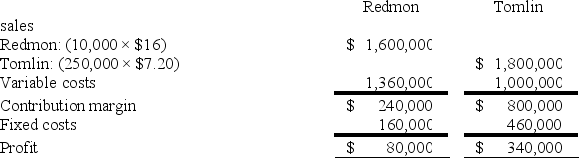 Included in Redmon's costs are 100,000 units of a subcomponent purchased from an outside supplier for $4.50. The managers have recently initiated negotiations for Tomlin to supply the components to Redmon. Tomlin has a total capacity of 400,000 units.
Required:
a. Prepare a new segment reporting statement for Randolph, assuming an internal transfer at the maximum transfer price.
b. Prepare a new segment reporting statement for Randolph, assuming an internal transfer at the minimum transfer price.
Included in Redmon's costs are 100,000 units of a subcomponent purchased from an outside supplier for $4.50. The managers have recently initiated negotiations for Tomlin to supply the components to Redmon. Tomlin has a total capacity of 400,000 units.
Required:
a. Prepare a new segment reporting statement for Randolph, assuming an internal transfer at the maximum transfer price.
b. Prepare a new segment reporting statement for Randolph, assuming an internal transfer at the minimum transfer price. (Essay)
4.7/5 (74)
(74) Altoona Corporation has two divisions, Hinges and Doors, which are both organized as profit centers. The Hinge Division produces and sells hinges to the Door Division and to outside customers. The Hinge Division has total costs of $35, $20 of which are variable. The Hinge Division is operating significantly below capacity and sells the hinges for $50.
The Door Division has received an offer from an outsider vendor to supply all the hinges it needs (20,000 hinges) at a cost of $45. The manager of the Door Division is considering the offer but wants to approach the Hinge Division first.
-
What is the maximum transfer price that the Door Division would accept from the Hinge Division?
(Multiple Choice)
4.9/5 (80)
(80) The Counter Division can sell externally for $60 per unit. Its variable manufacturing costs are $35 per unit, and its fixed costs are $12 per unit.
Required:
(a) What is the optimal transfer price for transferring internally, assuming the division is operating at capacity?
(b) What is the optimal transfer price for transferring internally, assuming the division is operating at well below capacity?
(Essay)
4.9/5 (78)
(78) Frocks and Gowns, Incorporated, has two divisions, Day Wear and Night Wear. The Day Wear Division has an investment base of $750,000 and produces and sells 100,000 units of Collars at a market price of $10.00 per unit. Variable costs for the Collars total $3.50 per unit and fixed charges are $4.00 per unit (based on a capacity of 120,000 units). The Night Wear Division wants to purchase 25,000 units of Collars from the Day Wear Division. However, the Night Wear Division is only willing to pay $6.75 per unit.
-
What is the minimum transfer price that the Day Wear Division would accept for the 25,000 unit order from the Night Wear Division if it wishes to maintain its pre-order contribution margin?
(Multiple Choice)
4.7/5 (87)
(87) A transfer price is the value assigned to the transfer of goods or services between divisions within the same organization.
(True/False)
4.9/5 (81)
(81) The use of an optimal transfer price eliminates potential conflicts between an organization's interests and the divisional manager's interest.
(True/False)
4.9/5 (74)
(74) A company has two divisions, Softwoods and Hardwoods, each operating as a profit center. The Softwood Division charges the Hardwood Division $35 per unit for each unit transferred to the Hardwood Division. Other data for the Softwood Division are as follows:
Variable Cost per unit \ 30 Fixed Costs \ 10,000 Annual Sales to the Hardwood Division 5,000 units Annual Sales to Outsiders 50,000 units
The Softwood Division is planning to raise its transfer price to $50 per unit. The Hardwood Division can purchase units at $40 per unit from outsiders but doing so would idle the Softwood Division's facilities (now committed to producing units for the Hardwood Division). The Softwood Division cannot increase its sales to outsiders. From the perspective of the company as a whole, from who should the Hardwood Division acquire the units, assuming the Hardwood Division's market is unaffected?
(Multiple Choice)
4.8/5 (69)
(69) Division A has variable manufacturing costs of $50 per unit and fixed costs of $10 per unit. Assuming that Division A is operating significantly below capacity, what is the optimal transfer price of an internal transfer when the market price is $75?
(Multiple Choice)
4.9/5 (88)
(88) The following information is available for the two divisions of MAC Company:
Division A: Selling price to outside market \5 5 Standard unit\_level costs 35 Division B: Selling price of finished product \9 5 Standard unit\_level costs 25
Division A has no excess production capacity.
Required:
a) In order to ensure the best use of the productive capacity of Division A, what transfer price should be set by Division A and what effect does this transfer price have on the overall margin for the company? Is the answer goal congruent under the general rule?
b) Should Division B accept a special order for its product if the selling price is reduced to $70. Use your answer from (a) and explain.
c) Would your answer to (b) change if Division A had excess capacity? Explain.
(Essay)
4.8/5 (95)
(95) In the United States, more companies use cost-based transfer prices than market-based transfer prices.
(True/False)
4.8/5 (87)
(87) 
Filters
- Essay(0)
- Multiple Choice(0)
- Short Answer(0)
- True False(0)
- Matching(0)