



 Chat with AI
Exam 15: Transfer Pricing

Exam 1: Cost Accounting: Information for Decision Making145 Questions
Exam 2: Cost Concepts and Behavior153 Questions
Exam 3: Fundamentals of Cost-Volume-Profit Analysis161 Questions
Exam 4: Fundamentals of Cost Analysis for Decision Making150 Questions
Exam 5: Cost Estimation131 Questions
Exam 6: Fundamentals of Product and Service Costing150 Questions
Exam 7: Job Costing159 Questions
Exam 8: Process Costing153 Questions
Exam 9: Activity-Based Costing153 Questions
Exam 10: Fundamentals of Cost Management144 Questions
Exam 11: Service Department and Joint Cost Allocation152 Questions
Exam 12: Fundamentals of Management Control Systems160 Questions
Exam 13: Planning and Budgeting157 Questions
Exam 14: Business Unit Performance Measurement147 Questions
Exam 15: Transfer Pricing147 Questions
Exam 16: Fundamentals of Variance Analysis156 Questions
Exam 17: Additional Topics in Variance Analysis138 Questions
Exam 18: Performance Measurement to Support Business Strategy148 Questions
Select questions type


Given the following data for Keyboard Division:
Selling price to outside customers \ 25 Variable cost per unit \ 12 Total fixed cost \ 50,000 Capacity (in units) 125,000
The Computer Division would like to purchase 15,000 units each period from the Keyboard Division. The Keyboard Division has ample excess capacity to handle all of the Computer Division's needs. The Computer Division now purchases from an outside supplier at a price of $20. If the Keyboard Division refuses to accept an $18 price internally, the company, as a whole, will be worse off by:
(Multiple Choice)
4.8/5  (75)
(75) Dockside Enterprises Incorporated operates two divisions: (1) a management division that owns and manages bulk carriers on the Great Lakes and (2) a repair division that operates a dry dock in Tampa, Florida. The repair division works on company ships and outside large-hull ships. The repair division has an estimated variable cost of $37 per labor-hour, has a backlog of work for outside ships, and charges $70.00 per hour for labor, which is standard for this type of work. The management division complained that it could hire its own repair workers for $45.00 per hour, including leasing an adequate work area.
-
What is the maximum transfer price per hour that the management division should pay?
(Multiple Choice)
4.7/5 (83)
(83) Thai Company has two divisions organized as profit centers: Redmon and Tomlin. Thai expects the following results in the coming period:
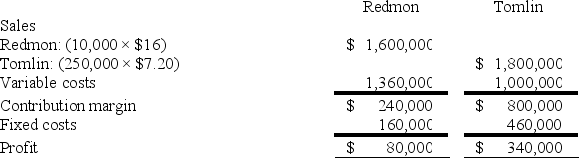 Included in Redmon's costs are 100,000 units of a subcomponent purchased from an outside supplier for $4.50 per unit. The managers have recently initiated negotiations for Tomlin to supply the components to Redmon. Tomlin has a total capacity of 400,000 units.
Required:
(a) Would Thai Company prefer the subcomponent used by Redmon to be purchased internally from Tomlin or from the outside vendor? What would be the profit impact of this decision?
(b) What would be the maximum and minimum transfer prices?
Included in Redmon's costs are 100,000 units of a subcomponent purchased from an outside supplier for $4.50 per unit. The managers have recently initiated negotiations for Tomlin to supply the components to Redmon. Tomlin has a total capacity of 400,000 units.
Required:
(a) Would Thai Company prefer the subcomponent used by Redmon to be purchased internally from Tomlin or from the outside vendor? What would be the profit impact of this decision?
(b) What would be the maximum and minimum transfer prices? (Essay)
4.9/5 (73)
(73) A limitation of transfer prices based on actual cost is that they: (CIA adapted)
(Multiple Choice)
4.9/5 (82)
(82) Division N has asked Division M of the same company to supply it with 10,000 units of part P782 this year to use in one of its products. Division N has received a bid from an outside supplier for the parts at a price of $25.00 per unit. Division M has the capacity to produce 50,000 units of part P782 per year. Division M expects to sell 46,000 units of part P782 to outside customers this year at a price of $26.00 per unit. To fill the order from Division N, Division M would have to cut back its sales to outside customers. Division M produces part P782 at a variable cost of $17.00 per unit. The cost of packing and shipping the parts for outside customers is $1.00 per unit. These packing and shipping costs would not have to be incurred on sales of the parts to Division N.
Required:
(a) What is the range of transfer prices within which both divisions' profits would increase as a result of agreeing to the transfer of 10,000 parts this year from Division M to Division N?
(b) Is it in the best interest of the overall company for this transfer to take place? Explain.
(Essay)
4.9/5 (92)
(92) Altoona Corporation has two divisions, Hinges and Doors, which are both organized as profit centers. The Hinge Division produces and sells hinges to the Door Division and to outside customers. The Hinge Division has total costs per unit of $35, $20 of which are variable. The Hinge Division is operating significantly below capacity and sells the hinges for $50.
The Door Division has received an offer from an outsider vendor to supply all the hinges it needs (20,000 hinges) at a cost of $45. The manager of the Door Division is considering the offer but wants to approach the Hinge Division first.
What would be the profit impact to Altoona Corporation as a whole if the Door Division purchased the 20,000 hinges it needs from the outside vendor for $45?
(Multiple Choice)
4.8/5 (72)
(72) Dockside Enterprises Incorporated operates two divisions: (1) a management division that owns and manages bulk carriers on the Great Lakes and (2) a repair division that operates a dry dock in Tampa, Florida. The repair division works on company ships and outside large-hull ships. The repair division has an estimated variable cost of $37 per labor-hour, has a backlog of work for outside ships, and charges $70.00 per hour for labor, which is standard for this type of work. The management division complained that it could hire its own repair workers for $45.00 per hour, including leasing an adequate work area.
-
If the repair division had idle capacity, what is the minimum transfer price that the repair division should obtain?
(Multiple Choice)
4.9/5 (81)
(81) Division X makes a part that it sells to customers outside of the company. Data concerning this part appear below:
Selling price to outside customers \ 50 Variable cost per unit \3 0 Total fixed costs \ 400,000 Capacity in units 25,000
Division Y of the same company would like to use the part manufactured by Division X in one of its products. Division Y currently purchases a similar part made by an outside company for $49 per unit and would substitute the part made by Division X. Division Y requires 5,000 units of the part each period. Division X can sell all of the units it makes to outside customers. What is the lowest acceptable transfer price from the standpoint of the selling division?
(Multiple Choice)
4.8/5 (88)
(88) Given the following data for Electrical Cord Division:
Selling price to outside customers \4 0 Variable cost per unit 30 Total fixed cost 10,000 Capacity (in units) 2,000
Assume that the Electrical Cord Division is selling all it can produce to outside customers. If it sells to the Appliance Division, $1 can be avoided in variable cost per unit. The Appliance Division is presently purchasing from an outside supplier at $38 per unit. From the point of view of the company as a whole, any sales to the Appliance Division should be priced at:
(Multiple Choice)
4.8/5 (82)
(82) A perfect intermediate market exists if buyers can buy and sellers can sell outside of the organization.
(True/False)
4.9/5 (95)
(95) The following segment reporting statement includes Salamander Company's expected results for the coming period:
Salamander Company Segment Reporting Statement Division A Division B Sales A: (10,000\times\ 160) \1 ,600000 B:(25,000\times\ 72) \ 1,800,00 Variable costs Contribution margin \2 40,000 \9 00,000 Fixed costs Profit
Included in Division A's costs are 10,000 units of a subcomponent purchased from an outside supplier for $45. The managers have recently initiated negotiations for Division B to supply the components to Division A. Division B has a total capacity of 40,000 units.
Required:
(a) Prepare a new segment reporting statement for the Salamander Company, assuming an internal transfer at the maximum transfer price.
(b) Prepare a new segment reporting statement for the Salamander Company, assuming an internal transfer at the minimum transfer price.
(Essay)
4.8/5 (89)
(89) Martin Company currently manufactures all component parts used in the manufacturing of various hand tools. The Extruding Division produces a steel handle used in three different tools. The budget for these handles is 120,000 units with the following unit cost:
Direct material \ 0.60 Direct labor 0.40 Variable overhead 0.10 Fixed overhead 0.20 Total unit cost \ 1.30
The Polishing Division purchases 20,000 handles from the Extruding Division and completes the hand tools. An outside supplier, Venture Steel, has offered to supply 20,000 units of the handle to the Polishing Division for $1.25 per unit. The Extruding Division currently has idle capacity that cannot be used.
If Martin Company would like to develop a range of transfer prices, what would be the maximum transfer price that the Polishing Division would be willing to pay the Extruding Division?
(Multiple Choice)
4.9/5 (81)
(81) A transfer made at cost does not motivate the selling division to transfer its goods or services internally.
(True/False)
4.9/5 (82)
(82) The Wheel Division of Frankov Corporation has the capacity for making 75,000 wheel sets per year and regularly sells 60,000 each year on the outside market. The regular sales price is $100 per wheel set, and the variable production cost per unit is $65. The Retail Division of Frankov Corporation currently buys 30,000 wheel sets (of the kind made by the Wheel Division) yearly from an outside supplier at a price of $90 per wheel set. If the Retail Division were to buy the 30,000 wheel sets it needs annually from the Wheel Division at a transfer price of $87 per wheel set, the change in annual net operating income for the company as a whole would be:
(Multiple Choice)
4.7/5 (85)
(85) Some managers prefer to use cost rather than market price in controlling transfers between divisions. If cost is to be used, then it should be:
(Multiple Choice)
4.7/5 (78)
(78) Pomme Corporation has a Motor Division that does work for other divisions in the company as well as for outside customers. The company's Equipment Division has asked the Motor Division to provide it with 2,000 special motors each year. The special motors would require $17.00 per unit in variable production costs. The Equipment Division has a bid from an outside supplier for the special motors at $28.00 per unit. In order to have time and space to produce the special motor, the Motor Division would have to cut back production of another motor - the J789 that it is currently producing. The J789 sells for $34.00 per unit and requires $22.00 per unit in variable production costs. Packaging and shipping costs of the J789 are $4.00 per unit. Packaging and shipping costs for the new special motor would be only $0.50 per unit. The Motor Division is currently producing and selling 10,000 units of the J789 each year. Production and sales of the J789 would drop by 10% if the new special motor is produced for the Equipment Division.
Required:
a. What is the range of transfer prices within which both the divisions' profits would increase as a result of agreeing to the transfer of 2,000 special motors per year from the Motor Division to the Equipment Division?
b. Is it in the best interest of Pomme Corporation for this transfer to take place? Explain.
(Essay)
4.8/5 (71)
(71) Briefly discuss transfer prices in relation to external segment reporting under GAAP.
(Essay)
4.9/5 (59)
(59) The GrowPro Manufacturing Company has a division (Division P) that produces an essential ingredient used by the Lawn Division in making lawn fertilizer. Historically, 75% of Division P's output has been purchased by Division L and 25% has been sold to other fertilizer companies. The transfer price between Division P and Division L has been based on the outside sales price less selling and administrative expenses directly applicable to the outside sales. Last year, the transfer price was $35 per ton and Division P would like the same transfer price this year. However, the general manager of Division L has found an outside supplier who will sell the ingredient for $30 per ton. She would like to continue buying from Division P, but Division P's manager does not want to match the $30 price because he thinks that the margin is too small. Top management does not get involved in transfer pricing disputes, but rather, allows division managers to make their own decisions concerning internal or external purchases and sales.
The following information has been gathered regarding Division P's operations last year:
Sales to L External Sales \ 4,200,000 \ 2,000,000 Variable costs 3,000,000 1,000,000 Fixed costs 360,000 120,000
The information presented above is based on selling 120,000 tons internally and 40,000 tons externally.
Required:
(a) If Division L buys externally, Division P can increase its current external sales by only 20,000 tons. What arguments can the general manager of Division L make to help Division P to match the $30 price?
(b) Division L wants to use only one supplier, so Division P will either sell 120,000 tons to Division L or nothing. If Division L's capacity is 160,000 tons, how many units does Division P need to sell to outsiders at $50 per ton before it is better off selling to outsiders? Ignore any additional marketing costs which would be incurred to increase sales.
(Essay)
4.7/5 (80)
(80) If a transfer has no effect on divisional profit, risk-neutral managers will be indifferent between making the transfer or not.
(True/False)
4.7/5 (77)
(77) Which of the following is the most significant disadvantage of a cost-based transfer price? (CIA adapted)
(Multiple Choice)
4.8/5 (78)
(78) 
Filters
- Essay(0)
- Multiple Choice(0)
- Short Answer(0)
- True False(0)
- Matching(0)