



 Chat with AI
Exam 3: Demand, Supply, and the Market Process

Exam 1: The Economic Approach225 Questions
Exam 2: Some Tools of the Economist239 Questions
Exam 3: Demand, Supply, and the Market Process408 Questions
Exam 4: Supply and Demand: Applications and Extensions270 Questions
Exam 5: Difficult Cases for the Market, and the Role of Government184 Questions
Exam 6: The Economics of Political Action208 Questions
Exam 7: Consumer Choice and Elasticity229 Questions
Exam 8: Costs and the Supply of Goods222 Questions
Exam 9: Price Takers and the Competitive Process261 Questions
Exam 10: Price-Searcher Markets With Low Entry Barriers232 Questions
Exam 11: Price-Searcher Markets With High Entry Barriers260 Questions
Exam 12: The Supply of and Demand for Productive Resources154 Questions
Exam 13: Earnings, Productivity, and the Job Market91 Questions
Exam 14: Investment, the Capital Market, and the Wealth of Nations106 Questions
Exam 15: Income Inequality and Poverty105 Questions
Exam 16: Gaining From International Trade179 Questions
Select questions type


Other things being equal, the effect of an increase in the price of milk would be illustrated by
(Multiple Choice)
4.8/5  (71)
(71) Assume that corn and soybeans are alternatives that could be grown by most farmers. An increase in the price of corn will
(Multiple Choice)
4.9/5 (81)
(81) "He [the producer] intends only his gain, and he is in this, as in many other cases, led by an invisible hand to promote an end which was no part of his intention." What is the "invisible hand" referred to in this statement?
(Multiple Choice)
4.8/5 (89)
(89) 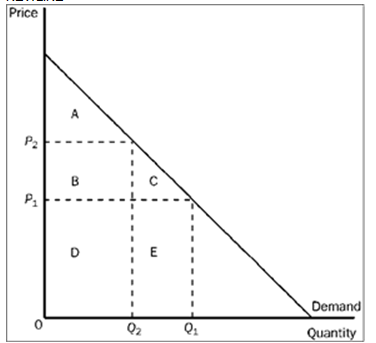 Figure 3-17.
-Refer to Figure 3-15. Which area represents the increase in producer surplus when the price rises from P1 to P2?
Figure 3-17.
-Refer to Figure 3-15. Which area represents the increase in producer surplus when the price rises from P1 to P2? (Multiple Choice)
4.7/5 (80)
(80) Figure 3-19  -Refer to Figure 3-19. Sellers whose costs are greater than price are represented by segment
 (Multiple Choice)
4.7/5 (68)
(68) Figure 3-22 


 -Refer to Figure 3-22. Graph C shows which of the following?
 (Multiple Choice)
4.8/5 (72)
(72) In which statement(s) are "demand" and "quantity demanded" used correctly? (I) "An increase in the price of tea will reduce the quantity demanded of tea."
(II) "An increase in the price of tea will reduce the demand for sugar used in tea."
(Multiple Choice)
5.0/5 (59)
(59) A decrease in the expected future price of a good will cause the current demand for the good to
(Multiple Choice)
4.8/5 (71)
(71) A hotel in New Hampshire charges $150 per room in the winter ski season and $90 during the summer months. The number of rooms and operating costs are constant year round. These prices indicate
(Multiple Choice)
4.8/5 (72)
(72) If the interest rate were 12.5 percent, how much would people be willing to pay for a stock that was certain to yield a $20 per share stream of net earnings continuously in the future?
(Multiple Choice)
4.9/5 (84)
(84)
Figure 3-17.
-Refer to Figure 3-16. When the price falls from P2 to P1, producer surplus
Figure 3-17.
-Refer to Figure 3-16. When the price falls from P2 to P1, producer surplus (Multiple Choice)
4.8/5 (79)
(79) Table 3-2
 -Refer to Table 3-2. If the price is $775, who would be willing to supply the product?
 (Multiple Choice)
4.8/5 (82)
(82) Around Easter time, the price of eggs rises. Some consumers complain about this and claim stores are 'price gouging.' Are there any positive functions played by the higher price of eggs around Easter? What would happen if the price of eggs were not permitted to rise by law?
(Essay)
4.8/5 (80)
(80) If consumer purchases of a good are not very sensitive to the price of the good, this is illustrated by a
(Multiple Choice)
4.9/5 (90)
(90) Assume that supply decreases slightly and demand decreases greatly. Which of the following will happen?
(Multiple Choice)
4.9/5 (90)
(90) Which of the following events would decrease producer surplus?
(Multiple Choice)
4.8/5 (85)
(85) 
Filters
- Essay(0)
- Multiple Choice(0)
- Short Answer(0)
- True False(0)
- Matching(0)