



 Chat with AI
Exam 7: Blood

Exam 1: Human Biology, Science, and Society85 Questions
Exam 2: The Chemistry of Living Things118 Questions
Exam 3: Structure and Function of Cells124 Questions
Exam 4: From Cells to Organ Systems107 Questions
Exam 5: The Skeletal System95 Questions
Exam 6: The Muscular System107 Questions
Exam 7: Blood114 Questions
Exam 8: Heart and Blood Vessels112 Questions
Exam 9: The Immune System and Mechanisms of Defense118 Questions
Exam 10: The Respiratory System: Exchange of Gases94 Questions
Exam 11: The Nervous System: Integration and Control111 Questions
Exam 12: Sensory Mechanisms107 Questions
Exam 13: The Endocrine System94 Questions
Exam 14: The Digestive System and Nutrition91 Questions
Exam 15: The Urinary System73 Questions
Exam 16: Reproductive Systems97 Questions
Exam 17: Cell Reproduction and Differentiation95 Questions
Exam 18: Cancer: Uncontrolled Cell Division and Differentiation89 Questions
Exam 19: Genetics and Inheritance81 Questions
Exam 20: DNA Technology and Genetic Engineering75 Questions
Exam 21: Development and Aging84 Questions
Exam 22: Evolution and the Origins of Life89 Questions
Exam 23: Ecosystems and Populations85 Questions
Exam 24: Human Impacts, Biodiversity, and Environmental Issues74 Questions
Select questions type


Fragments of cells that are important in blood clotting are called ________.
(Short Answer)
4.8/5  (90)
(90) Vascular spasm, formation of a platelet plug, and coagulation are the three stages of ________.
(Short Answer)
4.9/5 (74)
(74) Which one of the following is directly involved in the process of blood clotting?
(Multiple Choice)
4.9/5 (76)
(76) The practice by which athletes abuse commercial erythropoietin by injecting it to increase the oxygen-carrying capacity of the blood is known as ________.
(Short Answer)
4.9/5 (63)
(63) 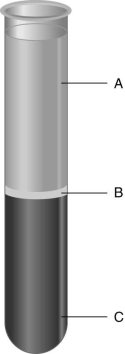 Using the figure above, answer the following question(s).
-The blood components in B include ________ and ________.
Using the figure above, answer the following question(s).
-The blood components in B include ________ and ________. (Short Answer)
4.8/5 (76)
(76) Match each of the following cells to its description(s). Answers may be used more than once.
-gives rise to plasma cells, which produce antibodies
(Multiple Choice)
4.7/5 (84)
(84) Match each of the following conditions with its description
-a blood cancer characterized by overproduction of abnormal or immature white blood cells
(Multiple Choice)
4.7/5 (80)
(80) Match each of the following cells to its description(s). Answers may be used more than once.
-the most abundant type of white blood cell
(Multiple Choice)
4.9/5 (85)
(85) Match each of the following cells to its description(s). Answers may be used more than once.
-filled with hemoglobin
(Multiple Choice)
4.7/5 (77)
(77) Hemoglobin binds oxygen most efficiently in areas of the body where the pH is low and the concentration of carbon dioxide is high.
(True/False)
4.8/5 (75)
(75) If an individual is O+, which of the following antigens are on the surface of his or her red blood cells?
(Multiple Choice)
4.7/5 (73)
(73) Hemoglobin is most likely to release oxygen to tissues when the pH of tissues is ________ and the temperature is ________.
(Short Answer)
4.9/5 (89)
(89) Match each of the following cells to its description(s). Answers may be used more than once.
-an agranulocyte that targets and then destroys cancer cells and viral-infected cells
(Multiple Choice)
4.8/5 (80)
(80) Results of an ABO blood typing indicate agglutination reactions when anti-A and anti-B are added to the blood sample. The blood type of the individual would therefore be
(Multiple Choice)
4.8/5 (73)
(73) The percentage of red blood cells compared to blood volume is known as the ________.
(Short Answer)
4.9/5 (78)
(78) The inflammatory response is initiated by the release of ________ from basophils.
(Multiple Choice)
4.8/5 (76)
(76) Blood poisoning (septicemia) is typically treated with transfusions.
(True/False)
4.8/5 (65)
(65) 
Filters
- Essay(0)
- Multiple Choice(0)
- Short Answer(0)
- True False(0)
- Matching(0)